


During this fascinating mountain journey, where you’ll feel like a true explorer and researcher, you’ll experience the creations of prehistoric people who lived in the mountains of Uzbekistan thousands of years ago.
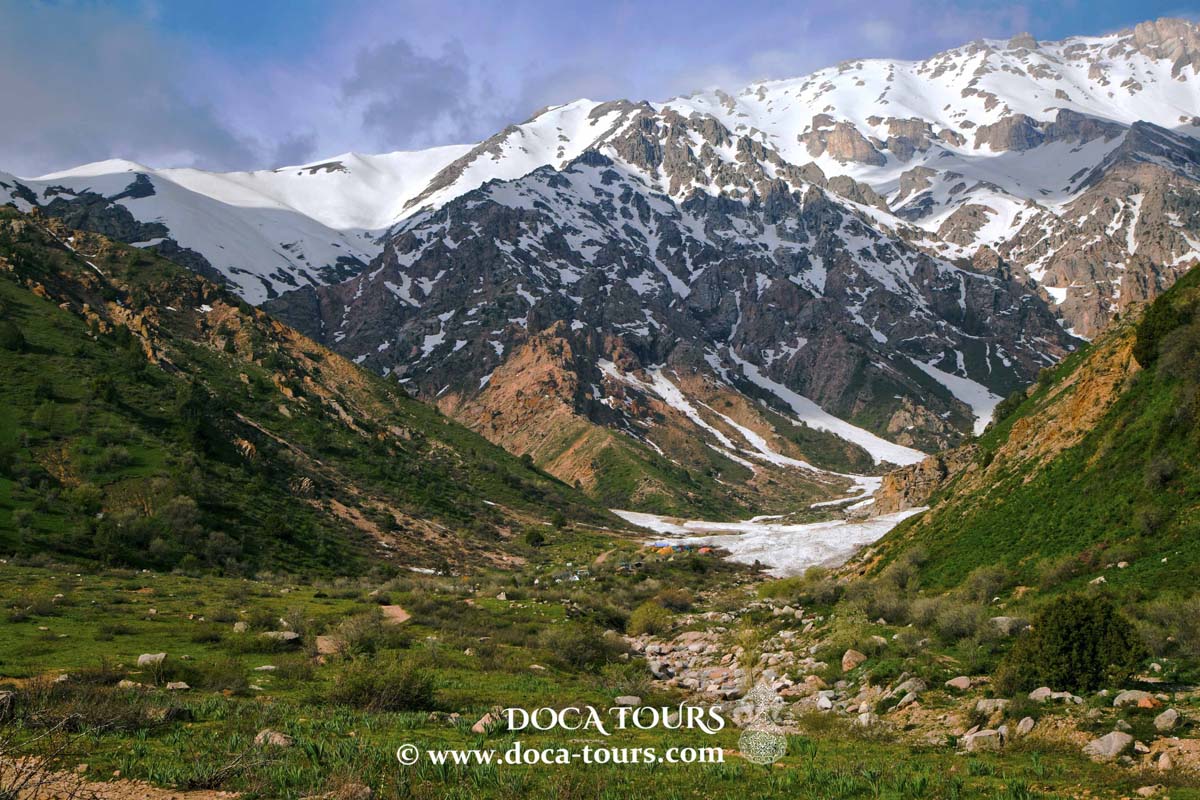
The impressive mountain landscape enhances the magic of these people, nestled against a backdrop of gorges and caves, vast plains dotted with fir trees, and wheat fields—perfect for hiking.
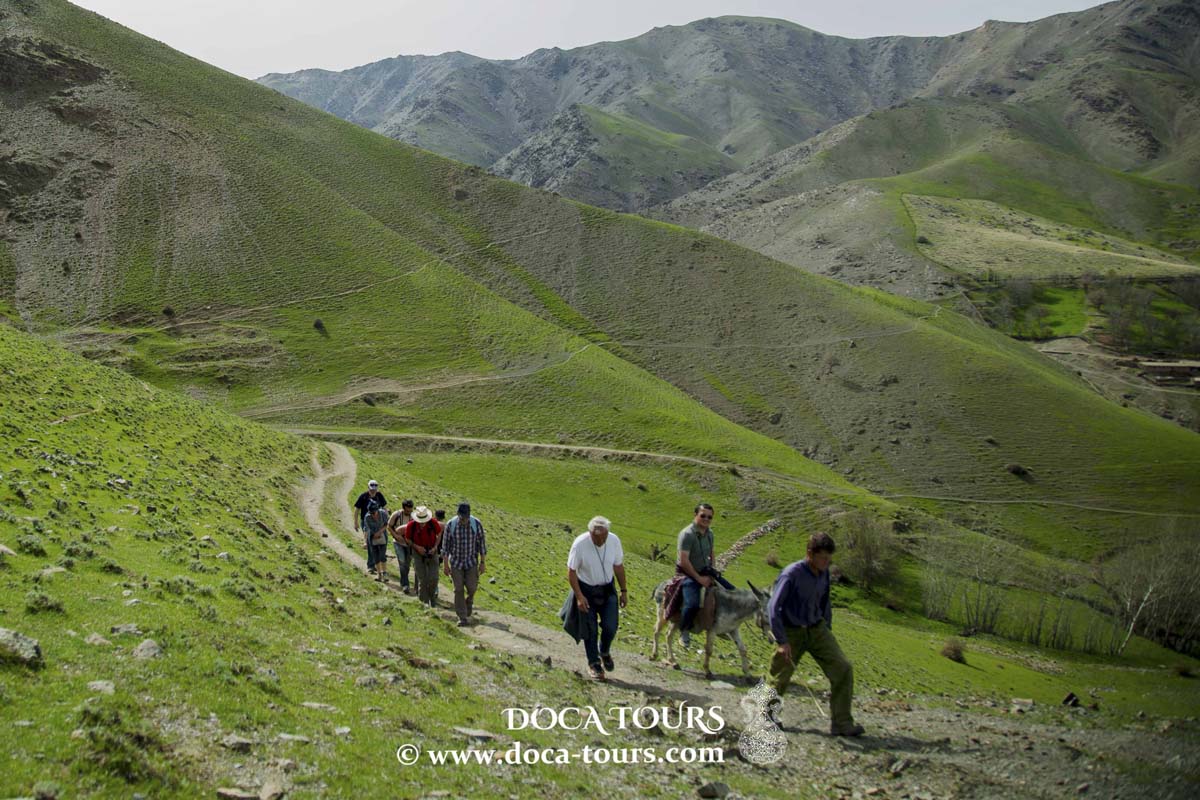
You’ll hike through green fields with grazing horses, over hills covered with bright yellow ferula bushes, past ancient juniper trees with tangled roots, through majestic mountain ranges, and, of course, to the petroglyphs from the Stone Age.
It’s not just the country’s rich culture that makes your trip to Uzbekistan an unforgettable experience, but also its scenic highlights and—last but not least—its hospitable people.
Detailed 15-day itinerary
Arrive in Tashkent with another airline at midnight or early morning.
Your guide will meet you and transfer you to your hotel for a rest.
After breakfast, the city tour of Uzbekistan's capital begins.
You will visit Khast Imam Square, home to the Barak Khan Madrasa and the Kaffal Shashi Mausoleum.
This historic complex is located in the Old Town and still consists primarily of old mud houses that survived the 1966 earthquake.
The complex was built around the tomb of one of Central Asia's first Quran preachers, who was also a renowned scholar.
The large square also houses a library with a collection of original manuscripts, including the world-famous 7th-century Ottoman Quran.
We then visit the Chorsu Bazaar, already known in the Middle Ages and located at the crossroads of caravanserais on the Silk Road.
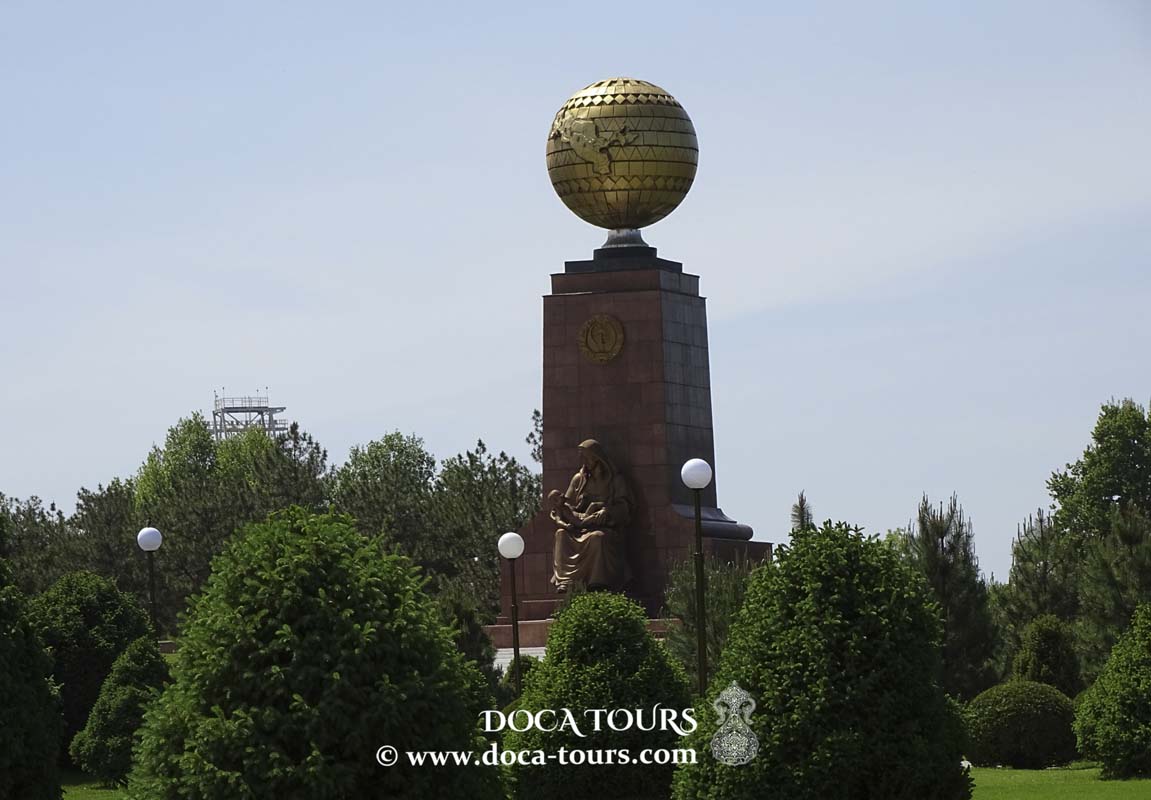
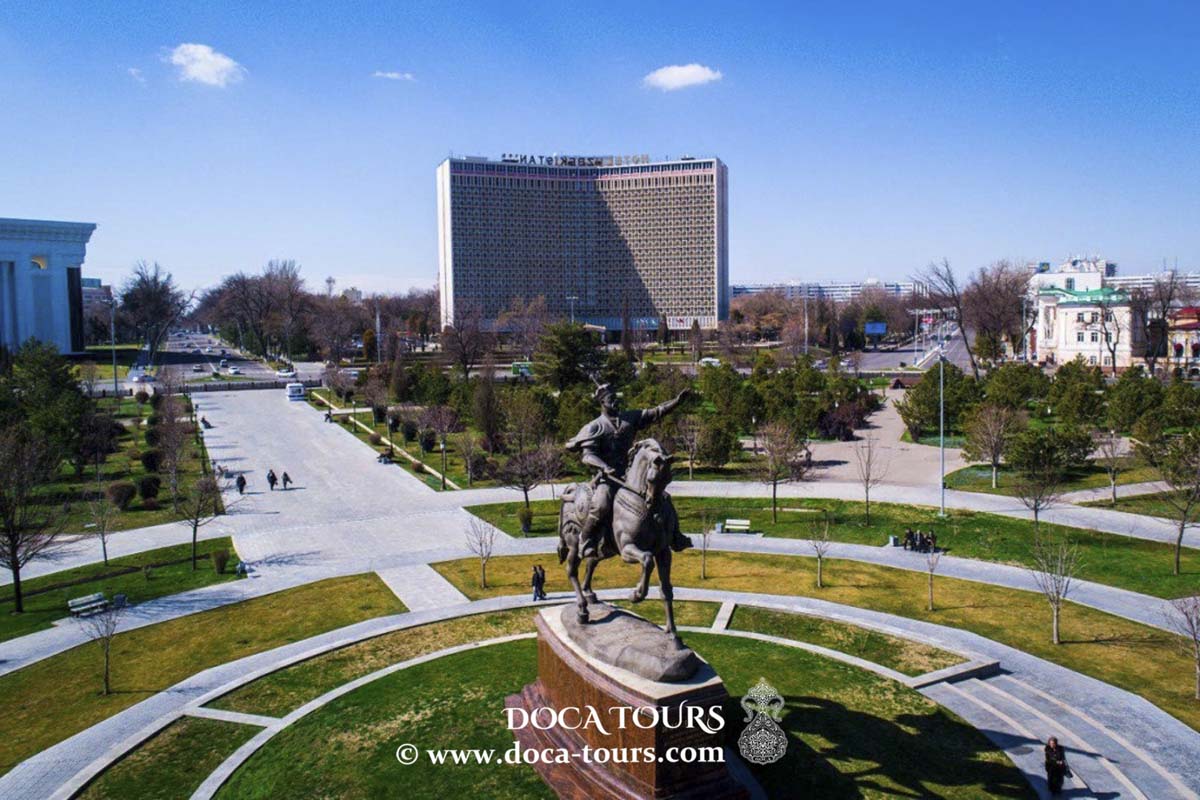
In the afternoon, we will visit modern Tashkent, stopping by Independence Square, the Monument to the Mourning Mother, the Alisher Navoi Opera House, and Amir Timur Park.
Dinner at a local restaurant.
In the morning, we drive through countless Uzbek villages, gardens, and rivers to the Chimgan Mountains (80 km, approximately 2 hours).
Arrival, check-in at the hotel, and lunch.
We then take the cable car to Kumbel (2,080 m above sea level), where Uzbekistan's longest ski slope begins.
From here, we hike for about 45 minutes to the summit (2,350 m above sea level).
Enjoy the wonderful view! On a clear day, we can see Tashkent in the distance.
On the way back, we hike along the ski slope back to the hotel (1,800 m above sea level).
Dinner.
After breakfast, we descend to the Mramornya River (1,500 m above sea level).
Then we hike along the river to a birch grove.
After a short break, we begin a 45-minute climb to the Urta-Kumbel Pass (1,820 m above sea level).
Once at the top, breathtaking views of the valley, including the Beldersay River and the Chet-Kumbel Pass, await us.
An easy, relatively flat descent takes us back to the Beldersay River, where a shady grove is perfect for a rest and a picnic.
After lunch, we ascend to the Chet-Kumbel Pass (1,850 m above sea level).
From here, we have magnificent views of the valley, the Nurekata River, and the peak of Great Chimgan (3,309 m above sea level). We then hike to the Beldersay cable car station (1,550 m above sea level), where our bus awaits us.
Return to Tashkent, check-in to the hotel.
Dinner at a local restaurant. Overnight in Tashkent.
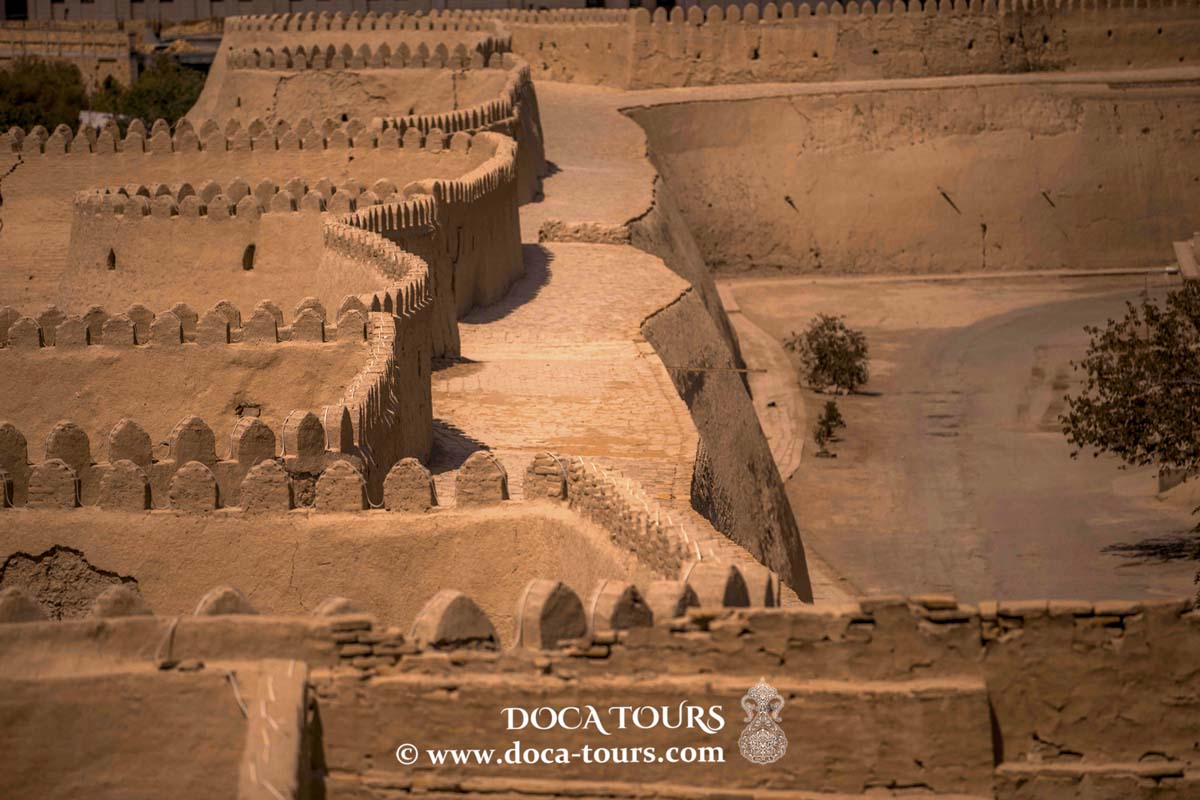
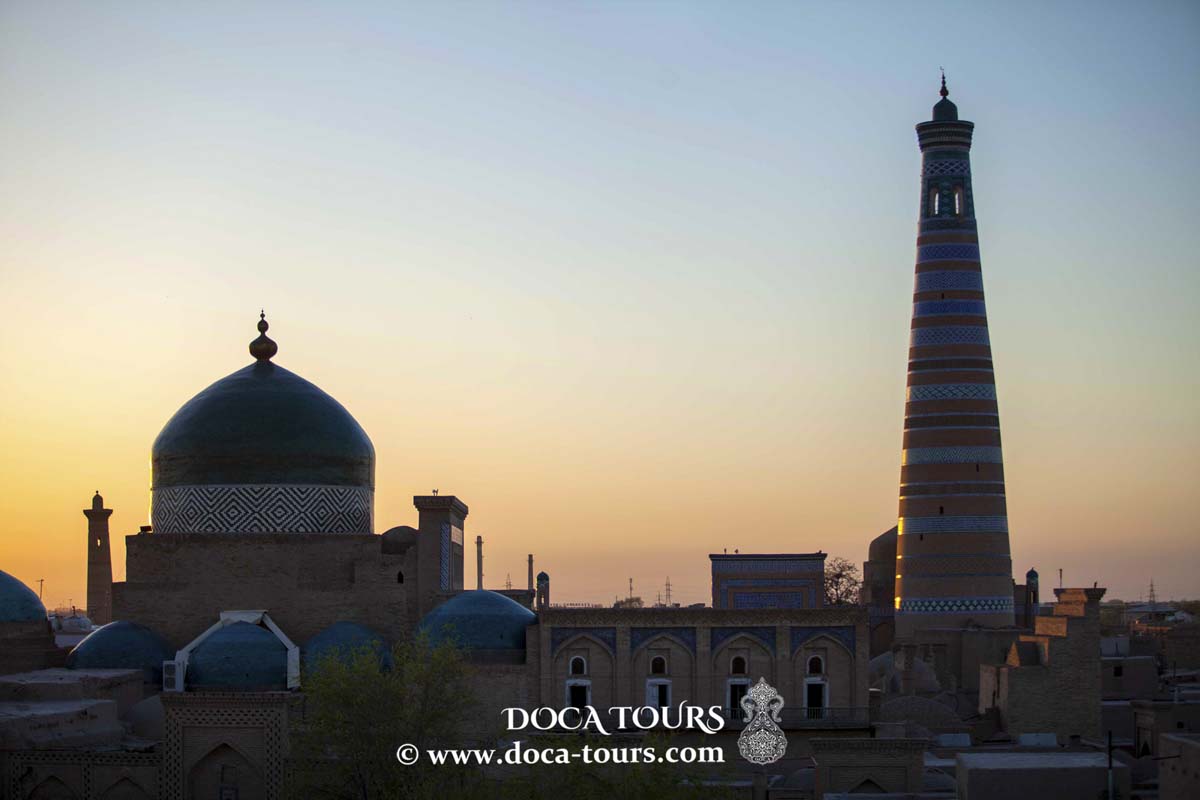
Early morning flight to Urgench, followed by a bus ride to the historic city of Khiva (40 km). Today we visit the Ichan-Kala in the old town, which has retained its oriental character to this day. The sight of the massive city walls with their four entrance gates will transport you to another world. Life pulsates around the Kalta-Minor (short minaret), which was once intended to be so tall that you could see distant Bukhara from its summit.
On our city tour, we admire numerous sights:
- Kunya Ark – the ancient residence of the Khans of Khiva
- Muhammad Rakhim Khan Madrasa
- Pakhlavon Makhmud Mausoleum
- Islam Khodja Madrasa and Minaret
- Tosh Hovli Palace
- Juma Mosque (Friday Mosque) – its wooden roof supported by 212 intricately carved wooden pillars. Dinner at a local restaurant.
Impressive drive through the vegetation-rich Kyzylkum Desert ("Red Sands") and the vast steppes to Bukhara (420 km).
En route, we'll stop for lunch at an Uzbek teahouse.
In the evening, we'll reach Bukhara, and you'll have time to explore the old town on your own.
Dinner at a local restaurant. Two nights in Bukhara.
Day 5: Khiva – Bukhara (approx. 420 km)
Impressive drive through the vegetation-rich Kyzylkum Desert ("Red Sands") and the vast steppes to Bukhara (420 km).
En route, we'll stop for lunch at an Uzbek teahouse.
In the evening, we'll reach Bukhara, and you'll have time to explore the old town on your own.
Dinner at a local restaurant. Two nights in Bukhara.
Day 6: Bukhara
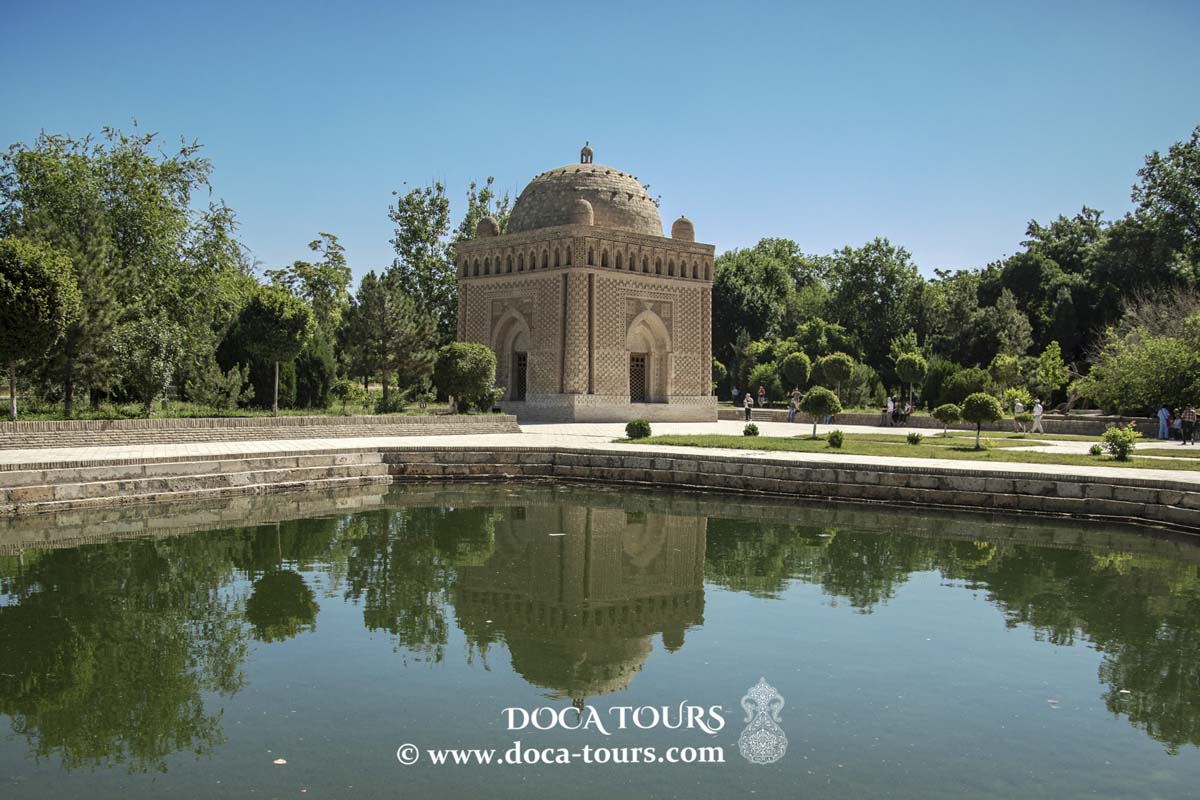
We begin our city tour with the Ismail Samani Mausoleum and Khashmai Ayub.
Afterwards, we'll take a walking tour of the city.
Bukhoroi Sharif ("Noble Bukhara") is a city with impressive domed bazaars, active mosques, and madrasas.
Bukhara has been declared a UNESCO World Heritage Site.
You'll feel like you've been transported to the world of "One Thousand and One Nights."
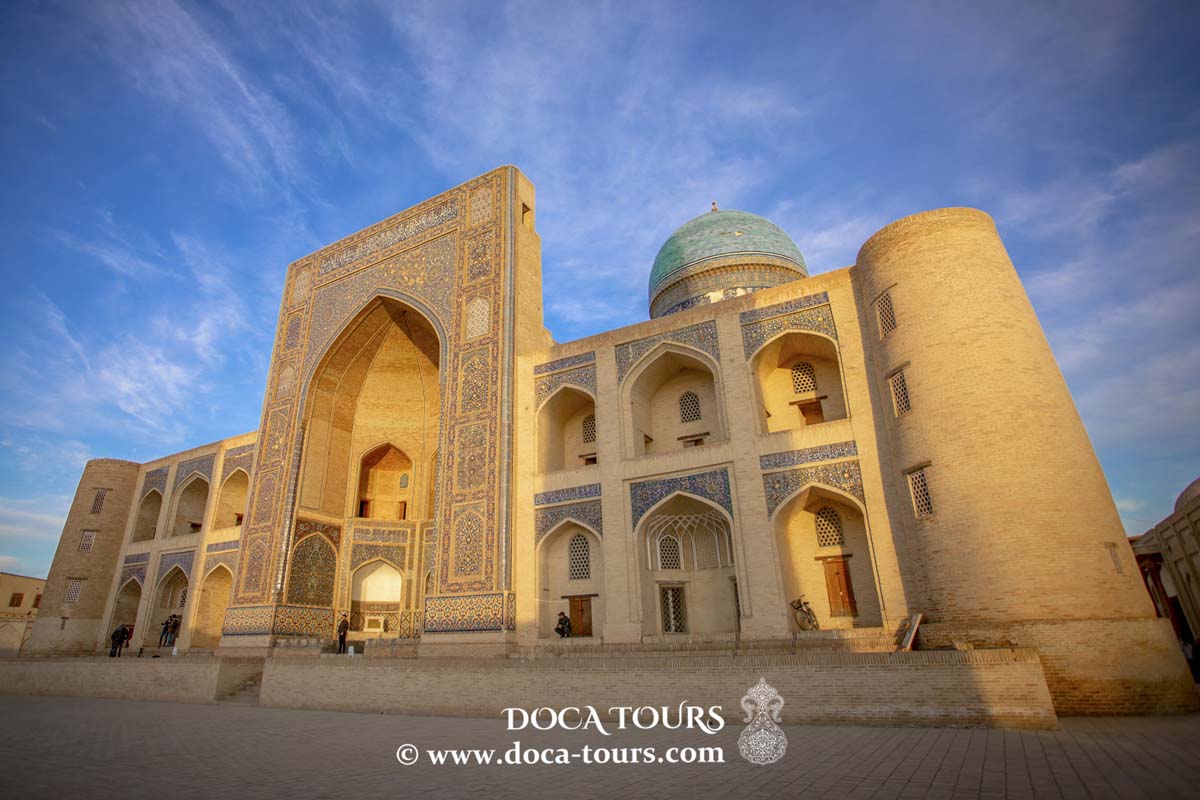
It's remarkable that even today, teaching and learning still take place in the mosques and madrasas, such as the Miri Arab Madrasa, the Kalyan Minaret, and the Kalyan Mosque.
You can admire the classical architectural ensemble of Lyabi Hauz with its domed bazaars, mosques, madrasas, and the Khanaka Dervish Monastery, and understand why Bukhara bears the honorary title of "the Noble."
Along the way, we'll also visit the covered bazaars of Toki Zargaron, Toki Telpakfurushon, and Toki Saraffon.
Dinner at a local restaurant.
Breakfast at the hotel. In the morning, you have time to explore Bukhara on your own.
We then drive to Nurata (approx. 3 hours drive) and visit the ruins of Alexander the Great's fortress and the sacred Chashma spring (spring water).
We then continue through the Kyzylkum Desert to Yangigazgan to our traditional yurt camp.
The Kyzylkum Desert ("red sand") owes its name to the reddish hue of the sand, which glows particularly intensely at sunset.
Due to the high groundwater table and the low rainfall in spring, only hardy plants such as saxaul, tamarisk, sand acacia, as well as grasses and herbs, can survive here.
These enable modest agriculture around the oases.
In the late afternoon, we take a test ride on our camels to familiarize ourselves with the animals and prepare for our caravan journey through the desert the next day.
Lunch with a local family in Nurata.
Dinner and overnight stay at the yurt camp.
After breakfast at the yurt camp, our camel trek begins.
There's one camel for every two people, so you can take turns riding and walking.
In the afternoon, we visit a small farm where livestock is kept despite the harsh desert conditions. Then we prepare our tents for the night (almost) under the stars.
Picnic lunch en route. Dinner around the campfire. One night in a tent in the desert.
Early in the morning, after breakfast at the yurt camp, we begin the final leg of our desert trek.
We bid farewell to our camels, and our luggage is taken to our next destination:
the Aydarkul Reservoir, which suddenly and surreally appears in the middle of the desert after about three hours.
Here we take a long swim break and a picnic on the beach.
On our way to the Nuratau Mountains, we notice how the desert slowly transforms into a steppe landscape.
We leave the plains and climb into the mountains – a region in the western foothills of the Tian Shan Mountains with peaks up to 2,000 m, before the mountains merge back into the flat Kyzylkum Desert.
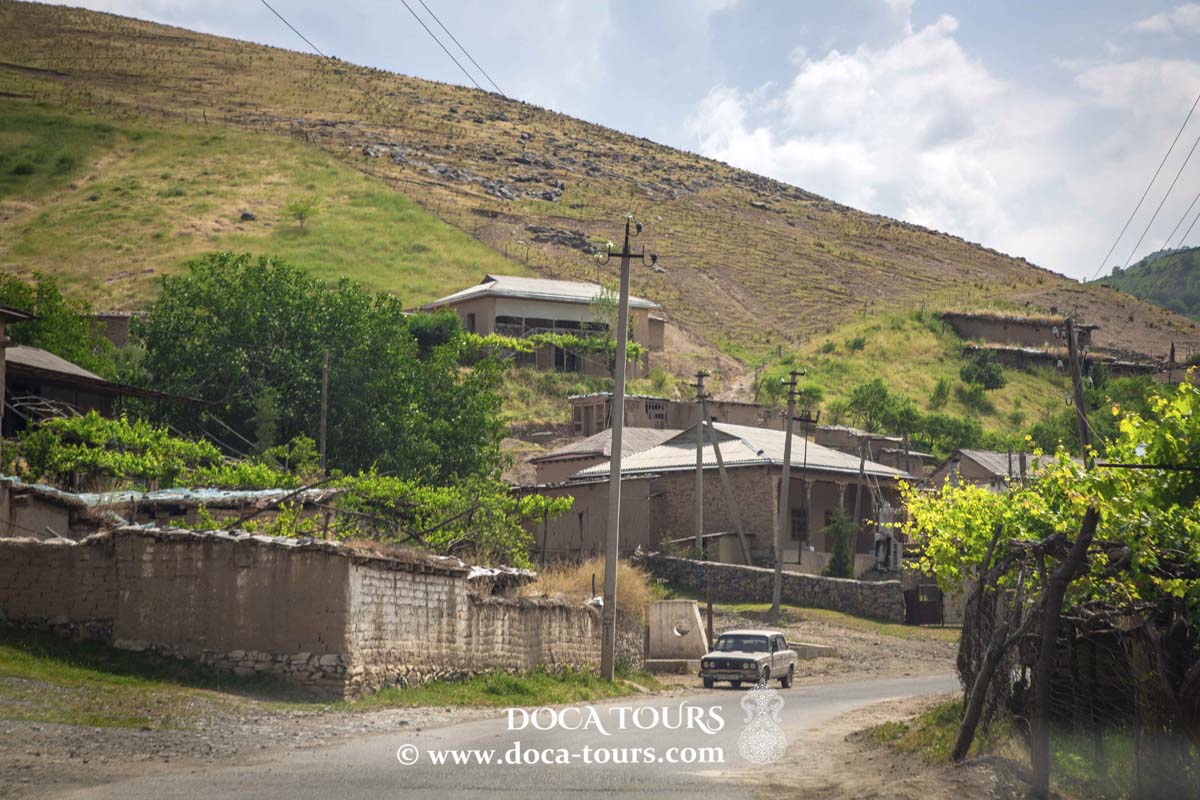
In the Tajik mountain village of Sentob, we spend the night in one or two guesthouses, depending on the group size.
In the afternoon, we have time to explore the village, climb to the ruins of an old fortress, or experience village life – for example, by visiting the irrigation systems and stone buildings, baking bread, or making butter. Dinner with the family at the guesthouse. Two nights in Sentob Village.
After breakfast at the guesthouse, we begin an easy hike of approximately 6 hours with breaks.
This hike takes us along an idyllic mountain river with many small natural pools where we can refresh ourselves.
Along the way, we pass an old watermill and Arabic inscriptions engraved in the rocks.
The route is also ideal for birdwatching as well as the local flora and fauna, which are very diverse here.
Depending on your desire and stamina, we can hike for hours through the valley or take a break at a particularly beautiful spot. We return to Sentob in the late afternoon.
Those who don't want to hike can alternatively continue the activities in the village.
After breakfast with the host family, we drive to the next mountain village, Hayat (approx. 45 minutes).
Here, we visit the sanctuary of the Severtsov Argali, a rare species of wild sheep with impressive horns that are larger than those of any other wild sheep.
90% of the world's population of this species lives in the Nuratau Mountains, but here we have the opportunity to see them in a protected enclosure.
After lunch at the guesthouse in Hayat, we embark on a 4- to 5-hour hike through the Nuratau Nature Reserve (entrance fee included).
In the evening, we can watch the preparation of the Uzbek national dish, plov, or help with it ourselves.
Dinner with the family at the guesthouse. One overnight stay in the village of Hayat.
Our luggage will be transported to the next village, so we hike with only a light backpack.
After breakfast with the family in Hayat, we hike for approximately 3 hours to Uhum.
We cross the Guzar and Sari-Bedak passes (1,035 m) and enjoy breathtaking views of the mountain panorama.
If time permits, we visit the ruins of a Sogdian fortress from the 4th-5th centuries and a traditional watermill.
Lunch is served with our host family in Uhum.
Afterwards, we continue to the village of Ashraf (approx. 3 hours).
Along the way, we experience a diverse landscape with interesting flora and fauna.
From several viewpoints, we have fantastic views of Lake Aydarkul and the Kyzylkum Desert. We pass the ruins of the ancient Mongolian fortress "Qorgoni Honkeldi."
In Ashraf, we have time to explore the village or relax in the traditional seating areas (tapchans and ayvans). Our host family has an idyllically situated house with a stream and a large orchard and vegetable garden. In the evening, a local musician comes to play for us (not a tourist show). Dinner with the family. One overnight stay in Ashraf.
After breakfast, we say goodbye to our host family in the village – the ancient city of Samarkand awaits us!
During Timur's reign, Samarkand was considered one of the most beautiful cities in the world.
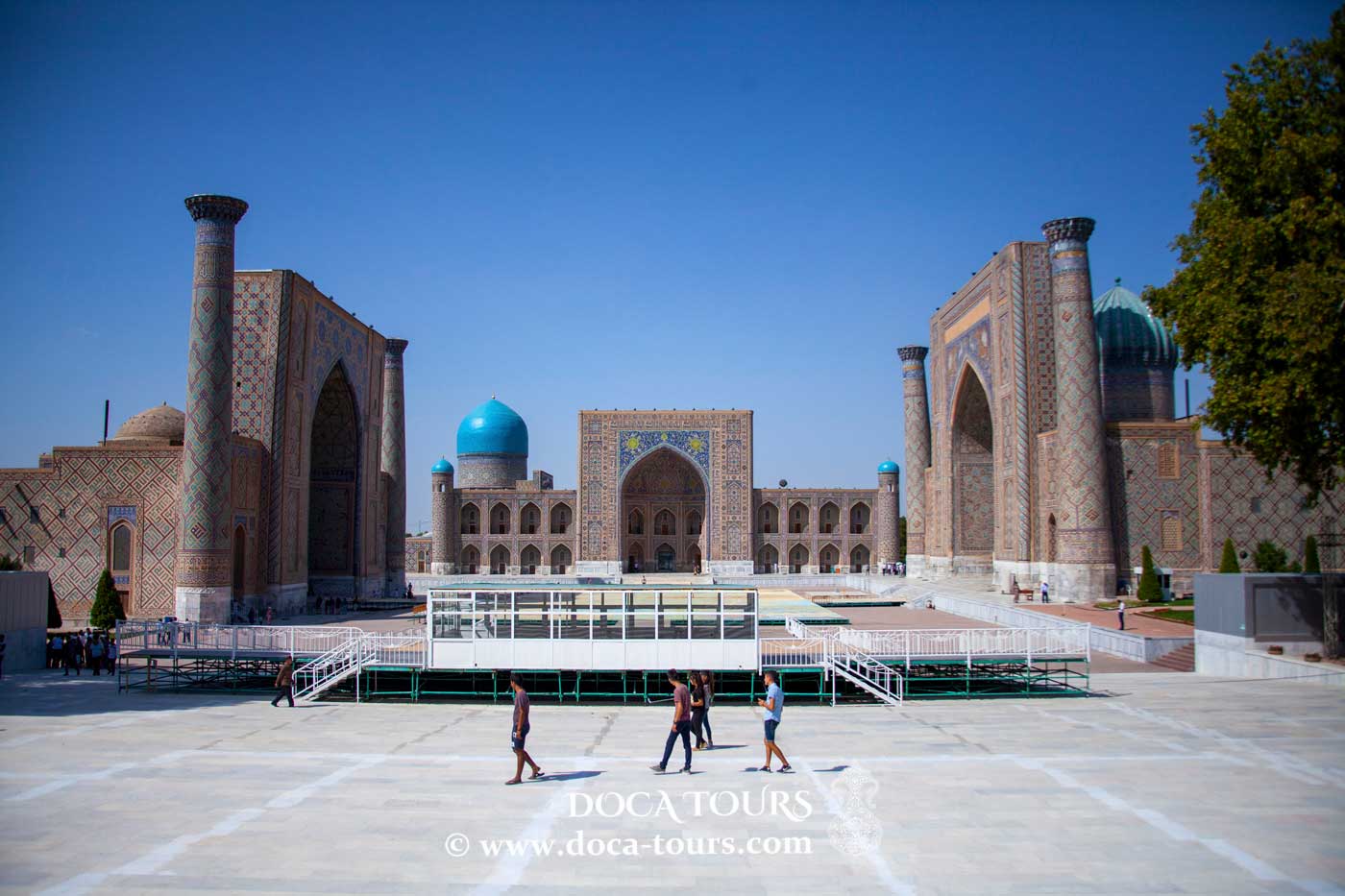
You will be impressed by the palatial mausoleum of the ruler Timur – the Gur-Emir Mausoleum. Today, the highlight of your trip awaits you: Registan Square with its three imposing, enormous, and richly decorated madrasas.
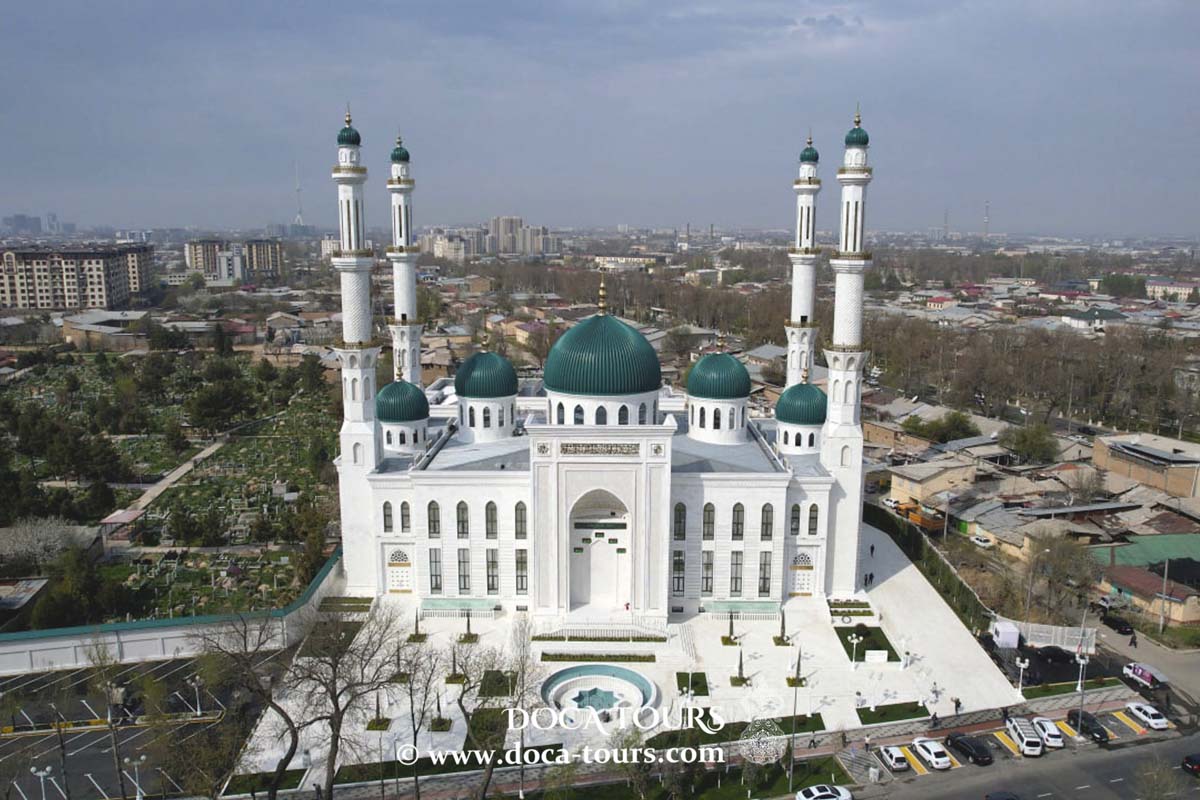
Afterwards, we will visit the largest mosque in Central Asia – the Bibi-Khanym Mosque.
With this building, Timur wanted to demonstrate his unlimited technical and financial capabilities and create the most beautiful mosque in the Eastern world.
During a stroll through the bazaar, we invite you to sample raisins, apricots, and nuts.
Samarkand is famous not only for its historical monuments but also for its wine.
Wine and cognac slide easily down your throat here!
After a visit to the Samarkand Wine Museum, you can sample 10 of the best Uzbek wines and cognacs.
Day 13: Rome of the Orient – Samarkand
After breakfast, we say goodbye to our host family in the village – the ancient city of Samarkand awaits us!
During Timur's reign, Samarkand was considered one of the most beautiful cities in the world.
You will be impressed by the palatial mausoleum of the ruler Timur – the Gur-Emir Mausoleum. Today, the highlight of your trip awaits you: Registan Square with its three imposing, enormous, and richly decorated madrasas.
Afterwards, we will visit the largest mosque in Central Asia – the Bibi-Khanym Mosque.
With this building, Timur wanted to demonstrate his unlimited technical and financial capabilities and create the most beautiful mosque in the Eastern world.
During a stroll through the bazaar, we invite you to sample raisins, apricots, and nuts.
Samarkand is famous not only for its historical monuments but also for its wine.
Wine and cognac slide easily down your throat here!
After a visit to the Samarkand Wine Museum, you can sample 10 of the best Uzbek wines and cognacs.
Day 14: Samarkand – Tashkent
Samarkand is one of the oldest cities in the world and was also an important center of the Silk Road.
At the Afrosiyob Museum, you'll gain insight into ancient Samarkand.
Then we'll visit one of the greatest pilgrimage sites in the Islamic world – the tomb of St. Daniel.
Afterwards, we'll continue to the Shahi Zinda complex, a beautiful ensemble of various mausoleums decorated with majolica and mosaic tiles in the Timur style.
After a short break, we'll visit a tissue paper factory founded by the Mukhtarov brothers. Thanks to their dedication, the ancient tradition of papermaking using Samarkand technology was revived. What's special is that the entire production process is done by hand, and guests can watch the papermaking process live.
Afterwards, we'll travel to the Ulugbek Observatory, once the largest research center in Central Asia. Ulugbek, the grandson of Amir Timur, was a world-famous astronomer.
You'll see his observatory's sextant, which was only excavated in 1908.
At 6:00 p.m., we'll take the "Afrosiyob" express train from Samarkand to Tashkent.
Arrival at 8:08 p.m., transfer to the hotel. Dinner at a local restaurant.
After an early breakfast, transfer to Tashkent Airport for your return flight home.
End of the "Natural Wonders of Uzbekistan" tour.
Book your 14-day Natural Wonders of Uzbekistan tour today!
Included in the standard price:
- Domestic flight Tashkent-Urgench
- Tour / excursions and transfers in air-conditioned vehicles, typical for the region
- Train journey Samarkand-Tashkent
- All accommodations as per itinerary (hotels, guesthouses, yurts, and tents during the camel trek)
- Treks as per itinerary with local guides, tent rental, kitchen equipment, luggage transport by camel or car
- Meals – breakfast, lunch, and dinner as per itinerary
- Sightseeing program including entrance fees as per itinerary
- Wine tasting in Samarkand
- English-speaking tour guide from DOCA TOURS from/to Tashkent Airport
Not included in the standard price:
- International flights
- Photo/video fees
- Gratuities for tour guides and drivers
- Visa fees
Thank you for your interest in our travel services – we greatly appreciate it!
With us, you will embark on some of the most unforgettable journeys of your life.
Simply send us your travel request, and we will create a customized itinerary according to your wishes.
We value flexible, personalized service to ensure your trip meets your exact needs.
Once we receive your inquiry, you will receive a response within 24 hours.
For a faster response, you can also contact us directly via WhatsApp: +99893 352 00 44.
We look forward to planning your dream trip!
Your DOCA TOURS Team
Book your 14-day Natural Wonders of Uzbekistan tour today!
Included in the standard price:
- Domestic flight Tashkent-Urgench
- Tour / excursions and transfers in air-conditioned vehicles, typical for the region
- Train journey Samarkand-Tashkent
- All accommodations as per itinerary (hotels, guesthouses, yurts, and tents during the camel trek)
- Treks as per itinerary with local guides, tent rental, kitchen equipment, luggage transport by camel or car
- Meals – breakfast, lunch, and dinner as per itinerary
- Sightseeing program including entrance fees as per itinerary
- Wine tasting in Samarkand
- English-speaking tour guide from DOCA TOURS from/to Tashkent Airport
Not included in the standard price:
- International flights
- Photo/video fees
- Gratuities for tour guides and drivers
- Visa fees
Thank you for your interest in our travel services – we greatly appreciate it!
With us, you will embark on some of the most unforgettable journeys of your life.
Simply send us your travel request, and we will create a customized itinerary according to your wishes.
We value flexible, personalized service to ensure your trip meets your exact needs.
Once we receive your inquiry, you will receive a response within 24 hours.
For a faster response, you can also contact us directly via WhatsApp: +99893 352 00 44.
We look forward to planning your dream trip!
Your DOCA TOURS Team
Arrive in Tashkent with another airline at midnight or early morning.
Your guide will meet you and transfer you to your hotel for a rest.
After breakfast, the city tour of Uzbekistan's capital begins.
You will visit Khast Imam Square, home to the Barak Khan Madrasa and the Kaffal Shashi Mausoleum.
This historic complex is located in the Old Town and still consists primarily of old mud houses that survived the 1966 earthquake.
The complex was built around the tomb of one of Central Asia's first Quran preachers, who was also a renowned scholar.
The large square also houses a library with a collection of original manuscripts, including the world-famous 7th-century Ottoman Quran.
We then visit the Chorsu Bazaar, already known in the Middle Ages and located at the crossroads of caravanserais on the Silk Road.
In the afternoon, we will visit modern Tashkent, stopping by Independence Square, the Monument to the Mourning Mother, the Alisher Navoi Opera House, and Amir Timur Park.
Dinner at a local restaurant.
In the morning, we drive through countless Uzbek villages, gardens, and rivers to the Chimgan Mountains (80 km, approximately 2 hours).
Arrival, check-in at the hotel, and lunch.
We then take the cable car to Kumbel (2,080 m above sea level), where Uzbekistan's longest ski slope begins.
From here, we hike for about 45 minutes to the summit (2,350 m above sea level).
Enjoy the wonderful view! On a clear day, we can see Tashkent in the distance.
On the way back, we hike along the ski slope back to the hotel (1,800 m above sea level).
Dinner.
After breakfast, we descend to the Mramornya River (1,500 m above sea level).
Then we hike along the river to a birch grove.
After a short break, we begin a 45-minute climb to the Urta-Kumbel Pass (1,820 m above sea level).
Once at the top, breathtaking views of the valley, including the Beldersay River and the Chet-Kumbel Pass, await us.
An easy, relatively flat descent takes us back to the Beldersay River, where a shady grove is perfect for a rest and a picnic.
After lunch, we ascend to the Chet-Kumbel Pass (1,850 m above sea level).
From here, we have magnificent views of the valley, the Nurekata River, and the peak of Great Chimgan (3,309 m above sea level). We then hike to the Beldersay cable car station (1,550 m above sea level), where our bus awaits us.
Return to Tashkent, check-in to the hotel.
Dinner at a local restaurant. Overnight in Tashkent.
Early morning flight to Urgench, followed by a bus ride to the historic city of Khiva (40 km). Today we visit the Ichan-Kala in the old town, which has retained its oriental character to this day. The sight of the massive city walls with their four entrance gates will transport you to another world. Life pulsates around the Kalta-Minor (short minaret), which was once intended to be so tall that you could see distant Bukhara from its summit.
On our city tour, we admire numerous sights:
- Kunya Ark – the ancient residence of the Khans of Khiva
- Muhammad Rakhim Khan Madrasa
- Pakhlavon Makhmud Mausoleum
- Islam Khodja Madrasa and Minaret
- Tosh Hovli Palace
- Juma Mosque (Friday Mosque) – its wooden roof supported by 212 intricately carved wooden pillars. Dinner at a local restaurant.
Impressive drive through the vegetation-rich Kyzylkum Desert ("Red Sands") and the vast steppes to Bukhara (420 km).
En route, we'll stop for lunch at an Uzbek teahouse.
In the evening, we'll reach Bukhara, and you'll have time to explore the old town on your own.
Dinner at a local restaurant. Two nights in Bukhara.
Day 5: Khiva – Bukhara (approx. 420 km)
Impressive drive through the vegetation-rich Kyzylkum Desert ("Red Sands") and the vast steppes to Bukhara (420 km).
En route, we'll stop for lunch at an Uzbek teahouse.
In the evening, we'll reach Bukhara, and you'll have time to explore the old town on your own.
Dinner at a local restaurant. Two nights in Bukhara.
Day 6: Bukhara
We begin our city tour with the Ismail Samani Mausoleum and Khashmai Ayub.
Afterwards, we'll take a walking tour of the city.
Bukhoroi Sharif ("Noble Bukhara") is a city with impressive domed bazaars, active mosques, and madrasas.
Bukhara has been declared a UNESCO World Heritage Site.
You'll feel like you've been transported to the world of "One Thousand and One Nights."
It's remarkable that even today, teaching and learning still take place in the mosques and madrasas, such as the Miri Arab Madrasa, the Kalyan Minaret, and the Kalyan Mosque.
You can admire the classical architectural ensemble of Lyabi Hauz with its domed bazaars, mosques, madrasas, and the Khanaka Dervish Monastery, and understand why Bukhara bears the honorary title of "the Noble."
Along the way, we'll also visit the covered bazaars of Toki Zargaron, Toki Telpakfurushon, and Toki Saraffon.
Dinner at a local restaurant.
Breakfast at the hotel. In the morning, you have time to explore Bukhara on your own.
We then drive to Nurata (approx. 3 hours drive) and visit the ruins of Alexander the Great's fortress and the sacred Chashma spring (spring water).
We then continue through the Kyzylkum Desert to Yangigazgan to our traditional yurt camp.
The Kyzylkum Desert ("red sand") owes its name to the reddish hue of the sand, which glows particularly intensely at sunset.
Due to the high groundwater table and the low rainfall in spring, only hardy plants such as saxaul, tamarisk, sand acacia, as well as grasses and herbs, can survive here.
These enable modest agriculture around the oases.
In the late afternoon, we take a test ride on our camels to familiarize ourselves with the animals and prepare for our caravan journey through the desert the next day.
Lunch with a local family in Nurata.
Dinner and overnight stay at the yurt camp.
After breakfast at the yurt camp, our camel trek begins.
There's one camel for every two people, so you can take turns riding and walking.
In the afternoon, we visit a small farm where livestock is kept despite the harsh desert conditions. Then we prepare our tents for the night (almost) under the stars.
Picnic lunch en route. Dinner around the campfire. One night in a tent in the desert.
Early in the morning, after breakfast at the yurt camp, we begin the final leg of our desert trek.
We bid farewell to our camels, and our luggage is taken to our next destination:
the Aydarkul Reservoir, which suddenly and surreally appears in the middle of the desert after about three hours.
Here we take a long swim break and a picnic on the beach.
On our way to the Nuratau Mountains, we notice how the desert slowly transforms into a steppe landscape.
We leave the plains and climb into the mountains – a region in the western foothills of the Tian Shan Mountains with peaks up to 2,000 m, before the mountains merge back into the flat Kyzylkum Desert.
In the Tajik mountain village of Sentob, we spend the night in one or two guesthouses, depending on the group size.
In the afternoon, we have time to explore the village, climb to the ruins of an old fortress, or experience village life – for example, by visiting the irrigation systems and stone buildings, baking bread, or making butter. Dinner with the family at the guesthouse. Two nights in Sentob Village.
After breakfast at the guesthouse, we begin an easy hike of approximately 6 hours with breaks.
This hike takes us along an idyllic mountain river with many small natural pools where we can refresh ourselves.
Along the way, we pass an old watermill and Arabic inscriptions engraved in the rocks.
The route is also ideal for birdwatching as well as the local flora and fauna, which are very diverse here.
Depending on your desire and stamina, we can hike for hours through the valley or take a break at a particularly beautiful spot. We return to Sentob in the late afternoon.
Those who don't want to hike can alternatively continue the activities in the village.
After breakfast with the host family, we drive to the next mountain village, Hayat (approx. 45 minutes).
Here, we visit the sanctuary of the Severtsov Argali, a rare species of wild sheep with impressive horns that are larger than those of any other wild sheep.
90% of the world's population of this species lives in the Nuratau Mountains, but here we have the opportunity to see them in a protected enclosure.
After lunch at the guesthouse in Hayat, we embark on a 4- to 5-hour hike through the Nuratau Nature Reserve (entrance fee included).
In the evening, we can watch the preparation of the Uzbek national dish, plov, or help with it ourselves.
Dinner with the family at the guesthouse. One overnight stay in the village of Hayat.
Our luggage will be transported to the next village, so we hike with only a light backpack.
After breakfast with the family in Hayat, we hike for approximately 3 hours to Uhum.
We cross the Guzar and Sari-Bedak passes (1,035 m) and enjoy breathtaking views of the mountain panorama.
If time permits, we visit the ruins of a Sogdian fortress from the 4th-5th centuries and a traditional watermill.
Lunch is served with our host family in Uhum.
Afterwards, we continue to the village of Ashraf (approx. 3 hours).
Along the way, we experience a diverse landscape with interesting flora and fauna.
From several viewpoints, we have fantastic views of Lake Aydarkul and the Kyzylkum Desert. We pass the ruins of the ancient Mongolian fortress "Qorgoni Honkeldi."
In Ashraf, we have time to explore the village or relax in the traditional seating areas (tapchans and ayvans). Our host family has an idyllically situated house with a stream and a large orchard and vegetable garden. In the evening, a local musician comes to play for us (not a tourist show). Dinner with the family. One overnight stay in Ashraf.
After breakfast, we say goodbye to our host family in the village – the ancient city of Samarkand awaits us!
During Timur's reign, Samarkand was considered one of the most beautiful cities in the world.
You will be impressed by the palatial mausoleum of the ruler Timur – the Gur-Emir Mausoleum. Today, the highlight of your trip awaits you: Registan Square with its three imposing, enormous, and richly decorated madrasas.
Afterwards, we will visit the largest mosque in Central Asia – the Bibi-Khanym Mosque.
With this building, Timur wanted to demonstrate his unlimited technical and financial capabilities and create the most beautiful mosque in the Eastern world.
During a stroll through the bazaar, we invite you to sample raisins, apricots, and nuts.
Samarkand is famous not only for its historical monuments but also for its wine.
Wine and cognac slide easily down your throat here!
After a visit to the Samarkand Wine Museum, you can sample 10 of the best Uzbek wines and cognacs.
Day 13: Rome of the Orient – Samarkand
After breakfast, we say goodbye to our host family in the village – the ancient city of Samarkand awaits us!
During Timur's reign, Samarkand was considered one of the most beautiful cities in the world.
You will be impressed by the palatial mausoleum of the ruler Timur – the Gur-Emir Mausoleum. Today, the highlight of your trip awaits you: Registan Square with its three imposing, enormous, and richly decorated madrasas.
Afterwards, we will visit the largest mosque in Central Asia – the Bibi-Khanym Mosque.
With this building, Timur wanted to demonstrate his unlimited technical and financial capabilities and create the most beautiful mosque in the Eastern world.
During a stroll through the bazaar, we invite you to sample raisins, apricots, and nuts.
Samarkand is famous not only for its historical monuments but also for its wine.
Wine and cognac slide easily down your throat here!
After a visit to the Samarkand Wine Museum, you can sample 10 of the best Uzbek wines and cognacs.
Day 14: Samarkand – Tashkent
Samarkand is one of the oldest cities in the world and was also an important center of the Silk Road.
At the Afrosiyob Museum, you'll gain insight into ancient Samarkand.
Then we'll visit one of the greatest pilgrimage sites in the Islamic world – the tomb of St. Daniel.
Afterwards, we'll continue to the Shahi Zinda complex, a beautiful ensemble of various mausoleums decorated with majolica and mosaic tiles in the Timur style.
After a short break, we'll visit a tissue paper factory founded by the Mukhtarov brothers. Thanks to their dedication, the ancient tradition of papermaking using Samarkand technology was revived. What's special is that the entire production process is done by hand, and guests can watch the papermaking process live.
Afterwards, we'll travel to the Ulugbek Observatory, once the largest research center in Central Asia. Ulugbek, the grandson of Amir Timur, was a world-famous astronomer.
You'll see his observatory's sextant, which was only excavated in 1908.
At 6:00 p.m., we'll take the "Afrosiyob" express train from Samarkand to Tashkent.
Arrival at 8:08 p.m., transfer to the hotel. Dinner at a local restaurant.
After an early breakfast, transfer to Tashkent Airport for your return flight home.
End of the "Natural Wonders of Uzbekistan" tour.