























Key takeaways
- The Silk Road was formally opened in 130 BCE under the Han dynasty and stayed active until 1453 CE, when the Ottoman Empire closed the western routes.
- The German geographer Ferdinand von Richthofen coined the term Silk Road in 1877; it was never one road but a shifting web of caravan trails.
- Samarkand, Bukhara and Merv were the great Central Asian hubs where trade, scholarship and religion met and spread.
- More than silk moved along the route: paper, spices, glass, and faiths such as Buddhism and Islam traveled with the caravans.
- You can still retrace the Silk Road today, with Uzbekistan's restored cities offering the most accessible and well-preserved stretch.
The Silk Road was a network of trade routes that linked China to Europe across Central Asia for more than 1,500 years. Rather than a single road, it was a shifting web of caravan trails that carried goods, ideas and faiths between civilizations. This guide covers silk road history from its origins to its great Central Asian cities, and shows how you can still walk its path today.
Understanding the route matters if you plan to travel it. The ruins and restored monuments across Uzbekistan, Kazakhstan and Turkmenistan make far more sense once you know who built them and why.
Where does silk road history begin?
The Silk Road was formally opened in 130 BCE during the Han dynasty of China and stayed active until 1453 CE, when the Ottoman Empire closed trade with the west (World History Encyclopedia). That span of roughly 1,500 years makes it one of the longest-running trade systems in human history.
The first push west came earlier. In 138 BCE, Emperor Wu sent his emissary Zhang Qian toward Central Asia to seek allies against nomadic raiders. Zhang Qian returned with reports of distant kingdoms, horses and markets. Those reports opened Chinese eyes to the lands beyond the deserts, and regular trade followed within a decade.
What drove the whole system was demand. Chinese silk was light, valuable and almost impossible to make elsewhere, so it fetched enormous prices in Rome and Persia. In return, the east wanted horses, gold, glass and wool. Because no single trader covered the full distance, the route survived on a chain of middlemen. That structure made it resilient: when one section closed through war or weather, goods simply found another path.
The name itself is much younger than the route. The German geographer Ferdinand von Richthofen coined the term in 1877, long after the caravans stopped running. He described a web of roads, not one highway, and that distinction still matters. Traders rarely traveled the whole length. Instead, goods passed hand to hand across dozens of relay points, gaining value with every exchange.
Which Central Asian cities powered the trade?
Three cities dominated the Central Asian stretch: Samarkand, Bukhara and Merv. Each sat at a junction where routes met, so each grew rich on tolls, trade and the scholars who followed the money. They became destinations in their own right, not merely stops along the way.
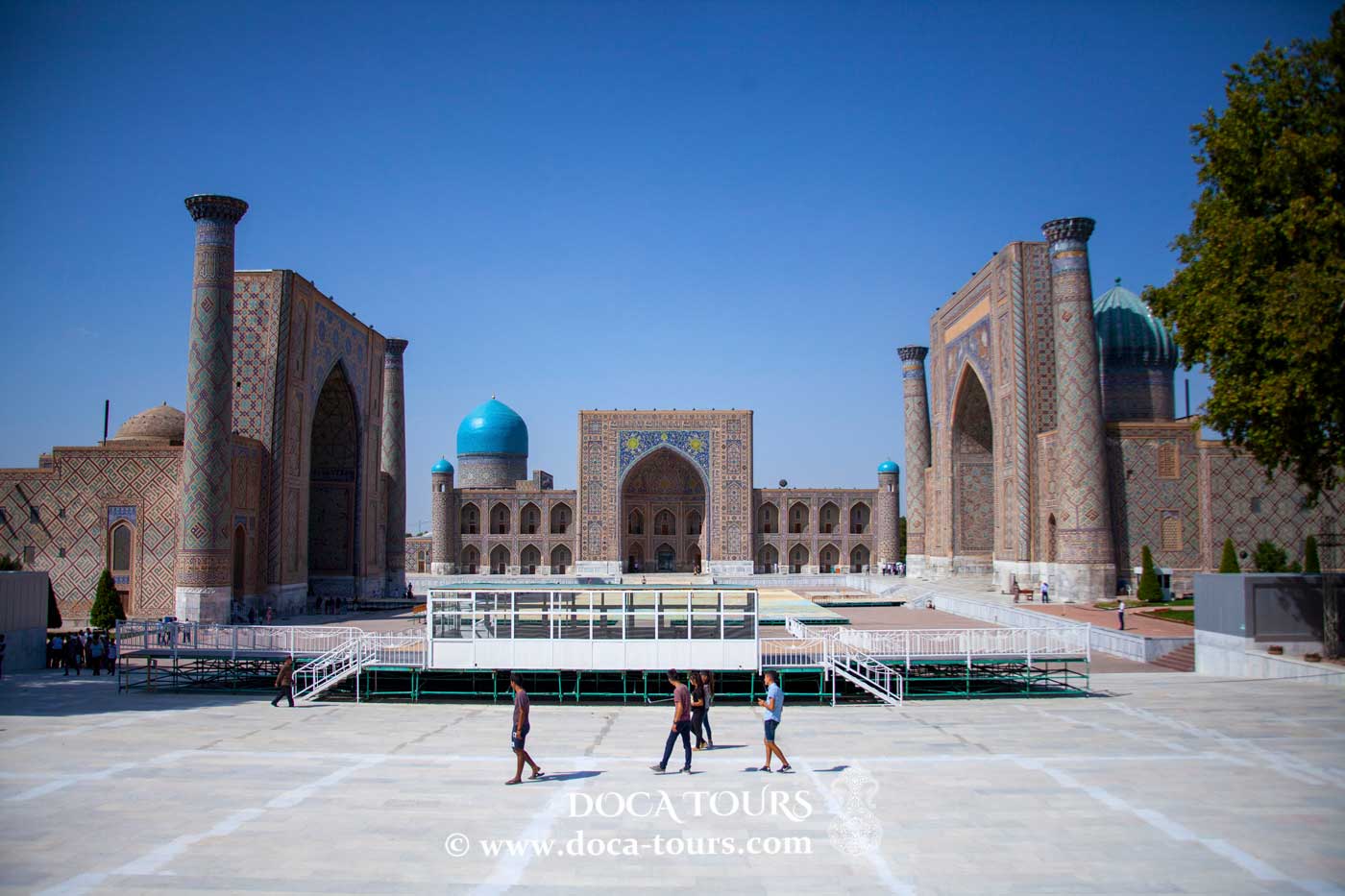
Samarkand became the jewel of the route. Under the conqueror Timur in the 14th century, it filled with turquoise domes and towering madrasas. Its central square still draws travelers from around the world today.
Bukhara played a quieter role as a city of learning and faith. Its old town packs mosques, trading domes and a surviving ark fortress into a compact maze that has changed little in centuries. For centuries it was a center of Islamic scholarship, home to libraries and theologians whose work traveled far beyond the city walls.
Merv, in modern Turkmenistan, was once among the largest cities on earth before the Mongols destroyed it in 1221. Today it survives as vast, haunting ruins on the edge of the Karakum Desert. Where Samarkand and Bukhara were restored and repopulated, Merv was left to the sand, which makes it the clearest reminder of how fragile these great hubs really were.
For a closer look at the most famous of these monuments, see our guide to the history of Registan Square, Samarkand's jewel.
What actually traveled along the route?
Silk gave the route its name, but the caravans carried far more. Paper, spices, glass, gunpowder, tea and precious stones all moved between east and west. The trade was two-way, and a single caravan might swap cargo many times before reaching its market.
Ideas traveled as freely as goods. Papermaking spread west from China and transformed how knowledge was recorded. Mathematics, astronomy and medicine crossed the same routes, carried in the heads of merchants and scholars rather than in saddlebags.
Religion followed the trade lines too. Buddhism spread from India into China along these roads. Later, Islam moved east through Central Asia, reshaping the culture of cities like Bukhara and Samarkand. Nestorian Christianity, Zoroastrianism and Manichaeism all left traces along the way. The route worked as a conveyor belt for belief, and the layered architecture of Central Asia still records it.
How did caravans actually cross the deserts?
Caravans survived the deserts thanks to two things: the Bactrian camel and the caravanserai. The two-humped Bactrian camel could carry heavy loads, go days without water and endure brutal temperature swings. Without it, the long desert crossings would have been impossible.
The caravanserai was the roadside inn of the ancient route. Spaced roughly a day's march apart, these fortified courtyards gave traders a safe place to rest, water their animals and store goods behind thick walls. Many were grand stone complexes with stables, wells and rooms arranged around a central yard.
These inns did more than shelter travelers. They became markets in their own right, where merchants from different regions met, traded and shared news. A caravanserai was a place of exchange for languages, prices and gossip, not only goods. You can still see restored examples across Uzbekistan and Iran, their courtyards quiet now but their scale still impressive.
How can you retrace the Silk Road today?
You can retrace the heart of the Silk Road most easily through Uzbekistan, where the great cities sit close together and are linked by a modern high-speed train. Samarkand, Bukhara and Khiva form a natural route, with restored monuments, working bazaars and comfortable hotels along the way.
A typical journey starts in Tashkent, then runs by rail to Samarkand and Bukhara before reaching the walled city of Khiva. Add Turkmenistan for the ruins of Merv, or Kazakhstan and Kyrgyzstan for the mountain and steppe sections of the route. Each country opens a different chapter of the same story.
Timing shapes the experience as much as the route. Spring and autumn bring mild days and clear light across the Uzbek cities, while summer in the desert can be punishing. In the Kyrgyz and Kazakh highlands the warm months open up the passes and the nomad camps, so a well-planned trip often balances the lowland cities against the mountain stretches. A good itinerary accounts for both climate and the rhythm of travel between sites.
Guided travel removes much of the friction. Visas, transport and local context are easier to arrange with an operator who knows the region. At Doca Tours we run guided Silk Road packages across all five Central Asian countries, built so the history makes sense on the ground rather than passing by in a blur.
If you want to shape the trip before booking, our guide to building a two-week Central Asia Silk Road itinerary lays out a route that connects the key cities without rushing.
To stand in Registan Square and picture the caravans that once filled it, start by choosing which stretch of the route fits your time and pace, then build your itinerary around those cities rather than trying to see everything at once.
Sources
- World History Encyclopedia, Silk Road, retrieved 2026-10-19, https://www.worldhistory.org/Silk_Road/
Frequently asked questions
What exactly was the Silk Road?
It was a network of overland and sea trade routes connecting China with Central Asia, Persia, the Middle East and Europe. The name describes many linked caravan trails rather than a single paved road.
When did the Silk Road begin and end?
Trade was formally opened in 130 BCE during China's Han dynasty. The overland routes declined after 1453 CE, when the Ottoman Empire closed trade with the west and sea routes took over.
Why is it called the Silk Road?
The German geographer Ferdinand von Richthofen coined the term in 1877. Silk was the most famous Chinese export carried west, though the caravans traded far more than fabric.
Which Silk Road cities can I still visit?
Samarkand, Bukhara and Khiva in Uzbekistan are the best preserved, with restored madrasas and bazaars. Merv in Turkmenistan survives mainly as atmospheric ruins.
What is the best country to experience the Silk Road today?
Uzbekistan is the most popular starting point. Its three UNESCO-listed cities sit close together and are easy to travel between by high-speed train.