
























Key takeaways
- A Song-Kol yurt stay puts you in a felt tent on a high summer pasture beside Kyrgyzstan's second-largest lake, at 3,016 metres.
- The jailoo season runs roughly June to September; the lake freezes and herders leave once the cold arrives.
- Son-Kol is a Ramsar Wetland of International Importance and remains a working pasture, so you stay as a guest of real herding families.
- Expect simple food, horse riding across open grassland, and some of the clearest night skies in Central Asia.
- A yurt night slots naturally into a wider Kyrgyzstan loop; pair it with Bishkek, Naryn, or a Silk Road route through Uzbekistan.
A song kol yurt stay is a night, or several, spent in a round felt tent on a high mountain pasture beside Song-Kol Lake in central Kyrgyzstan. You eat with a herding family, sleep under heavy quilts, and wake to horses grazing outside the door. It is one of the most direct ways to experience nomadic life still practised in Central Asia today.
This guide covers what the stay is really like, how to reach the lake, when to go, the food and daily rhythm, and how to fit a yurt night into a larger Kyrgyzstan trip.
What a Song-Kol yurt stay is really like
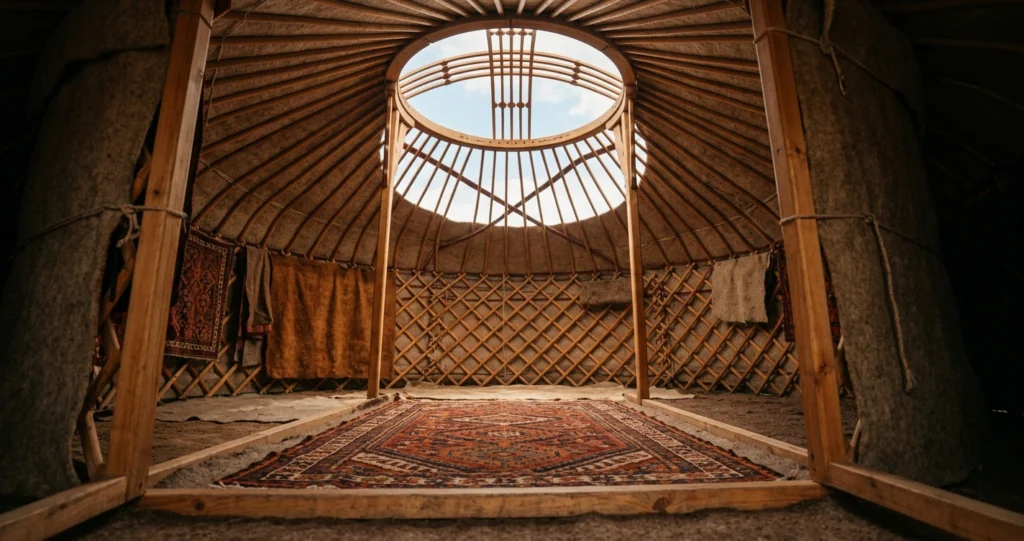
A yurt is a portable round home built from a wooden lattice frame wrapped in thick felt, and at Song-Kol you sleep inside one on padded mattresses laid directly on the floor. There is no bed frame, no grid electricity, and no plumbing. A central skylight, the tunduk, lets in morning light and marks the symbol you will recognise from the Kyrgyz flag.
Inside, the walls are often lined with bright felt carpets called shyrdaks. Families sleep, eat, and store belongings in the same space, and guests are given a corner of their own. Nights at this altitude are cold even in midsummer, so a wood or dung stove is lit in the evening and the family piles on quilts.
The experience is honest rather than staged. These are working camps, not hotels dressed up to look rustic. Son-Kol is recognised as a Ramsar Wetland of International Importance, designated in January 2011 and covering 36,869 hectares, and the official listing notes that the site remains important for the livelihood of pastoralists (Ramsar Convention, 2011). The families hosting you are there to graze animals first and welcome travellers second.
Getting to Song-Kol and the best season to visit
Song-Kol sits at 3,016 metres in the Tian Shan, making it the second-largest lake in Kyrgyzstan after Issyk-Kul, with a surface area of about 270 square kilometres. Reaching it means a long drive and a rough final climb, so most people treat the journey as part of the adventure rather than a quick detour.
The usual approach is from Bishkek or the town of Naryn. From Bishkek the drive takes most of a day, and the last stretch leaves paved roads behind for an unsealed mountain pass that needs a 4×4 in all but the driest weather. Some travellers ride in on horseback or trek over the passes with a pack animal carrying gear.
Timing matters more here than at almost any other site in the country. Herders bring their animals, and their yurts, up to the jailoo only in the warm months, roughly mid-June to early September. Outside that window the pasture empties, the camps close, and the lake itself freezes solid through the long winter. Arrive in July or August and you find dozens of family camps; arrive in May and you may find nothing but grass.
If you are building a broader regional route, check entry rules early, since several Central Asian countries changed their policies recently. Our Central Asia visa guide breaks this down country by country.
Daily life with herder families and local food
Daily life on the jailoo follows the animals, not the clock. The word jailoo means summer pasture in Kyrgyz, and families move up each year to graze sheep, horses, and yaks on the high grassland before returning to lower villages for winter. As a guest you fall into their rhythm: early starts, long open afternoons, and meals shared around a low table.
Food is simple, filling, and tied to the herd. Expect fresh bread, homemade jam, and dairy in many forms, including the fermented mare's milk known as kumis that hosts often offer with pride. Meat dishes appear at dinner, frequently mutton with noodles or rice. Vegetables are scarce at this altitude, so travellers with strict diets should plan ahead.
Hospitality is a genuine cultural value rather than a performance for tourists. You may be invited to help milk mares, round up animals on horseback, or simply sit with tea while the day passes. Bread, dairy, and shared tea sit at the centre of Central Asian hospitality, and you will meet these same staples across the wider region.
Communication runs on Kyrgyz and Russian, so a few words of either go a long way, and a guide or host who translates makes the evenings far richer.
Horse riding and stargazing on the jailoo
Horses are the heart of life at Song-Kol, and a short ride across the pasture is the classic way to spend a morning. The Kyrgyz have ridden these highlands for centuries, and the open, treeless terrain around the lake is forgiving for beginners while still rewarding for confident riders. Half-day rides to viewpoints and multi-day treks between camps are both common.
Beyond riding, the days are quiet by design. You can walk the shoreline, watch migratory birds, or help with camp chores. Because the lake lies far from any town, light pollution is almost nonexistent.
After dark the reward is the sky. On a clear, moonless night the Milky Way arches overhead with a clarity most visitors rarely see at home, and the cold, dry mountain air keeps the stars sharp. Bring warm layers, step away from the stove smoke, and let your eyes adjust for a few minutes.
How to include a yurt night in your Kyrgyzstan trip
A yurt night works best as the centrepiece of a longer Kyrgyzstan loop rather than a standalone errand. Tourism here is growing quickly: Kyrgyzstan welcomed over 3.7 million visitors in 2024, with travel and tourism contributing around 3.8 percent of national GDP (U.S. International Trade Administration, 2024). That growth means more organised yurt camps, but the best ones still fill up in peak summer.
A common structure is two or three nights built around Song-Kol. You might start in Bishkek, drive south with a stop near Naryn, spend one or two nights at the lake, then continue to Issyk-Kul or back toward the capital. One night gives you the core experience; a second lets the pace of the place settle in.
Because the route is remote and the camps are informal, many travellers join a guided itinerary. At Doca Tours we handle the 4×4 transfer over the pass, match you with a reliable herder family, and bridge the language gap, so you can focus on the experience rather than the logistics. Our Kyrgyzstan adventure tour weaves a Song-Kol yurt night into a wider mountains-and-lakes route.
To make the most of a yurt stay, pack for cold nights whatever the forecast, carry some cash for the family hosting you, and go with modest expectations about comfort. Book your summer dates well ahead, decide whether you want one night or two, and treat the long drive in as the opening chapter of the trip rather than an obstacle to the view.
Frequently asked questions
What is a Song-Kol yurt stay actually like?
You sleep on felt mattresses inside a decorated felt tent on an open pasture, share home-cooked meals with a herder family, and spend days riding horses or walking by the lake. There is no electricity grid and no running water.
What is the best time for a Song-Kol yurt stay?
Roughly mid-June to early September. Herders move their animals and yurts to the jailoo only in the warm months, and the lake freezes in winter, so camps are not open outside the summer window.
How do you get to Song-Kol Lake?
Most travellers drive from Bishkek or Naryn, then climb a rough mountain pass by 4×4 for the final stretch. The drive from Bishkek takes most of a day, and the last section is unpaved.
Is a Song-Kol yurt stay comfortable?
It is simple rather than luxurious. Nights are cold even in July, toilets are usually outdoor pit latrines, and washing is basic. The reward is the setting, the hospitality, and the quiet.
Do I need a guide or tour to visit Song-Kol?
You can arrange it independently, but the route is remote and the camps are informal. A guided trip handles the 4×4 transfer, matches you with a reliable family, and smooths the language gap with Kyrgyz and Russian-speaking hosts.