























Dear friends! As you may have already guessed, in this episode, we’ll showcase and tell you about the “Rome of the East,” the “Noble Face of the Earth”—the city of Samarkand. We are beginning a series of episodes about our hometown. Stay with us—it’s going to be very interesting and educational. Don’t miss any of our fascinating videos—subscribe to our channel.
So, Samarkand. What comes to your mind when you hear this name? That’s right! The Great Silk Road, the tales of One Thousand and One Nights, and the timeless riches of the East.
Samarkand is one of the oldest cities in the world, truly a peer of Rome. According to the latest data, its age is approximately 2,800 years. This means that as early as the 8th century BCE, Samarkand emerged in the Zarafshan River valley, exhibiting three key features of urban culture:
Monumental architecture: The city was surrounded by fortress walls and a moat, had city gates, a ruler’s citadel, residential quarters, roads, a temple, and even rudimentary sewer and water systems.
Population structure: At that time, the city-state of Samarkand was home to at least 5,000 people living under laws and hierarchy. Society consisted of the ruling elite, priests, craftsmen, merchants, warriors, and others.
Writing system: Writing, a crucial element of urban culture, already existed in Samarkand. The inhabitants spoke Sogdian—a dialect of the Indo-European language family—and wrote in Aramaic script. This suggests that as soon as people learned to write, protocols and bureaucracy emerged as well.
Regarding the city’s age, it’s worth noting that during the Soviet era, Samarkand was considered the second-oldest city in the USSR after Yerevan. In recent decades, however, archaeological findings have aged Samarkand by nearly 300 years, bringing it closer to Yerevan. But don’t think this is a ploy by Samarkand residents to grow older with each passing year. The age of the city is based on artifacts studied and analyzed not only by Uzbek but also by foreign scientists. We’ll let you in on a little secret: we aim to catch up to and surpass Yerevan in age—and we only need about 50 more years to do so!
The history of Samarkand is rich with wars, invasions, golden ages, and declines. Over its nearly 2,800-year history, the city has seen it all.
Samarkand has been conquered by Persian King Cyrus the Great, Alexander the Great, the Kushans, the Huns, the Chinese, the Arabs, the Samanids, the Karakhanids, Genghis Khan, Russian imperial troops, and the Bolsheviks.
Famous visitors to Samarkand include the Chinese diplomat Zhang Qian, Marco Polo, the Arab traveler Ibn Battuta, the Spanish ambassador Ruy González de Clavijo, and Hungarian scholar Arminius Vambéry. In modern times, the city has hosted Vladimir Putin, Recep Tayyip Erdoğan, Joschka Fischer, Frank-Walter Steinmeier, Ulla Schmidt (former German Minister of Health), Gérard Depardieu, and others.
At various points in history, Samarkand served as the capital of vast Eastern empires. For instance, during the reign of Amir Timur—known in Europe as Tamerlane—Samarkand was the capital of an empire stretching from Delhi to Damascus and from Kashgar to Izmir. According to legend, Timur ordered Samarkand to be marked with a golden dot on all world maps. At that time, Samarkand was one of the wealthiest cities in the world, a crossroads of the Great Silk Road where one could find nearly anything in its bustling bazaars and encounter merchants from all over the globe.
Samarkand: A City of Science and Trade
Samarkand was not only a city of merchants and caravans but also a center of science. The famous observatory of Timur’s grandson, Ulugh Beg, was one of a kind in the 15th century. It housed a sextant with a 40-meter radius, enabling incredibly precise astronomical observations. For example, Ulugh Beg calculated the length of the year in his observatory: 365 days, 10 minutes, and 8 seconds. Today’s figure for the length of the year is 365 days, 9 hours, and 6 seconds. However, we shouldn’t rush to conclude that Ulugh Beg was mistaken. Perhaps, in the 15th century, the year was indeed an hour longer than it is now!
Incidentally, Ulugh Beg’s observatory served as a prototype for the astronomical school of the Mughal Empire in India. After all, their great ancestor was Timur (Tamerlane), and the founder of the Mughal dynasty, Zahir-ud-din Muhammad Babur, was Timur’s great-great-grandson. Babur’s great-grandson, Shah Jahan, famously built the Taj Mahal as a mausoleum for his wife.
Every city along the Great Silk Road had its own unique goods. Samarkand was known for several special products, but perhaps its most exclusive was the famous “Samarkand silk paper.” Let’s clarify right away: Samarkand’s “silk paper” contained neither silk nor conventional paper—just as German Leberwurst contains neither liver nor sausage, despite its name translating to “liver sausage.” The paper was called “silk” because it was made from mulberry tree fiber (silkworm tree). This fiber, a thin yellow strip found between the bark and the wood, is an incredibly dense material. It allowed for the production of exceptionally high-quality paper with a lifespan of up to 2,000 years. In one of our future episodes, we’ll delve into the history of Samarkand paper and its production technology, so stay tuned!
We keep repeating the name “Samarkand”—it sounds magical. You’re probably curious about its etymology. There are many theories about the meaning of this name, tied to legends and the names of mythical rulers. However, we’d like to share two scientifically grounded versions of its origin:
“Maracanda” or “Smara-Kansa” – This is how the Greeks referred to Samarkand, meaning “city of merchants.” Evidently, even in the time of Alexander the Great, it was a wealthy trading hub.
“Semizkent” – According to medieval linguist Mahmud al-Kashgari, this was another name for Samarkand. Translated literally, it means “fat city,” referring to its wealth and abundance.
As you can see, the name “Samarkand” speaks for itself. Locals jokingly refer to a big belly as “years of accumulated authority.”
Samarkand is so iconic that streets named after it can be found in almost every city in Uzbekistan. There are Samarkand streets in Tajikistan (Dushanbe, Khujand), Kazakhstan (Almaty, Karaganda, Taraz, Temirtau), and in many other countries of the former Soviet Union, including Russia (Volgograd, Yekaterinburg, Kaliningrad, Nizhny Novgorod, and more). Moscow even has Samarkand Boulevard.
Beyond the post-Soviet space, Samarkand streets can be found in Jordan, the Saudi capital Riyadh, and Dubai. A residential district in the Turkish city of Bolu is also named after Samarkand. Turkey even has a popular educational TV channel called Semerkand TV. The name Samarkand has also been given to various objects, including a Russian Imperial wheel-steamer, the “Samarkand” electronic warfare system, and more.
Samarkand: Global Influence, Population, and Local Life
Samarkand’s name graces various plant and flower species, numerous restaurants and cafes worldwide, and several companies in different countries. There are also several books that feature the enchanting word “Samarkand” in their titles.
Population
As of early 2020, Samarkand’s population was around 600,000 residents. The Samarkand region is the most densely populated in Uzbekistan, with approximately 4 million people.
The city’s ethnic composition is highly diverse, with representatives of over 80 ethnic groups. The majority of the population consists of Uzbeks and Tajiks. Among the national minorities, Russians and Central Asian Iranians (Persians) are predominant. The city is also home to Armenian, Tatar, Korean, Turkmen, Azerbaijani, Ukrainian, Jewish, Polish, German, Central Asian Arab, Roma (Gypsy), and other communities.
Religious Composition
The dominant religion is Sunni Islam of the Hanafi school, practiced by Uzbeks and Tajiks. The Shi’a branch of Islam is primarily followed by Central Asian Iranians and Azerbaijanis.
Among Christians, Orthodox Christianity has the largest following, primarily among Russians, Ukrainians, and Belarusians. Samarkand has:
1 Orthodox Cathedral: St. Alexius of Moscow
2 Orthodox Churches: Church of the Intercession of the Holy Virgin and Church of St. George the Victorious
The Armenian Apostolic Church is the second-largest Christian denomination, represented by Surb Astvatsatsin Church. Catholicism, practiced mainly by Poles and Germans, ranks third, with the Church of St. John the Baptist serving the local Catholic community.
The city also has two synagogues, attended primarily by Bukharan Jews.
Climate
Samarkand has a sharply continental climate, characterized by very hot, dry summers and relatively cold winters. While winter temperatures rarely fall below 0°C, occasional frosts can occur. Winter lasts from mid-November to mid-March and is typically dry, with minimal precipitation.
Summer, lasting 5–6 months from May to October, sees daytime temperatures regularly exceed +35–40°C in June and July. Despite the high heat, the dry air makes the temperatures more bearable, thanks to Uzbekistan’s landlocked location.
Spring and autumn are short but beautiful. The best times to visit Samarkand are May and September, considered the “velvet season” for travel. For a quieter experience with fewer tourist crowds, consider visiting in August or October.
Sports
Football is one of the most popular sports in Samarkand, though locals humorously admit their skills might not match their enthusiasm. The city’s most well-known football club, “Dynamo,” was founded in 1960 and played in the Soviet Union’s Second League. In a lighthearted twist, Dynamo set a record last year by not scoring a single goal throughout the entire season.
Dynamo’s most notable achievements include:
Reaching the final of the Uzbekistan Cup in 1999/2000
Securing 4th place in the 2000 Uzbekistan Higher League
Competing in the Asian Cup Winners’ Cup in 2001
The city has two large stadiums:
“Dynamo” Stadium (13,800 seats)
“Olympia” Stadium (12,500 seats)
Samarkand also boasts numerous martial arts clubs offering training in kurash, karate, judo, Muay Thai, and more.
The city also features numerous other sports facilities:
Sartepa Sports Complex
Sports Complex of the Samarkand Olympic Reserve College
Dolphin Aquatic Center
Boxing Palace
A large tennis court surrounded by smaller ones
A complex for water sports
Since the mid-1990s, Samarkand has hosted an annual tennis tournament as part of the ATP Challenger Tour. Additionally, the city organizes various tournaments and championships in Uzbekistan across different sports disciplines.
Scientific Institutions
During the Soviet era, Samarkand was home to the Research Institute of Karakul Sheep Breeding, which worked to improve the Karakul sheep breed.
On the initiative of academicians Ya. Gulyamov and I. M. Muminov, in celebration of Samarkand’s 2,500th anniversary and by a resolution of the Council of Ministers of the Uzbek SSR in 1970, the Institute of Archaeology was established under a decree by the Presidium of the Academy of Sciences of the Uzbek SSR. In 1998, the institute was named after archaeologist, historian, and academician Ya. G. Gulyamov.
Theaters
Samarkand is home to several theaters. In the city center stands one of Uzbekistan’s largest and oldest theaters, the Samarkand Regional Theater of Music and Drama, named after Hamid Alimdjan. In the newer part of the city, there is the Samarkand State Russian Drama Theater, named after A. P. Chekhov, one of the largest Russian theaters in Uzbekistan. Other venues include the Samarkand Regional Puppet Theater and the Historical Costume Theater “El Merosi”.
Media
Television programs, newspapers, and magazines in Samarkand are broadcast and published not only in Uzbek but also in Russian and Tajik. Russian-language publications include the newspaper Samarkand Vestnik, while the Tajik-language newspaper Ovazi Samarkand is also popular. Local media outlets such as the private city TV channel STV and the regional state TV channel MTRK Samarqand broadcast partially in Tajik as well.
Education
Schools and Colleges:
As of 2019, Samarkand had over 60 general secondary schools and more than 20 colleges and lyceums.
Higher Education:
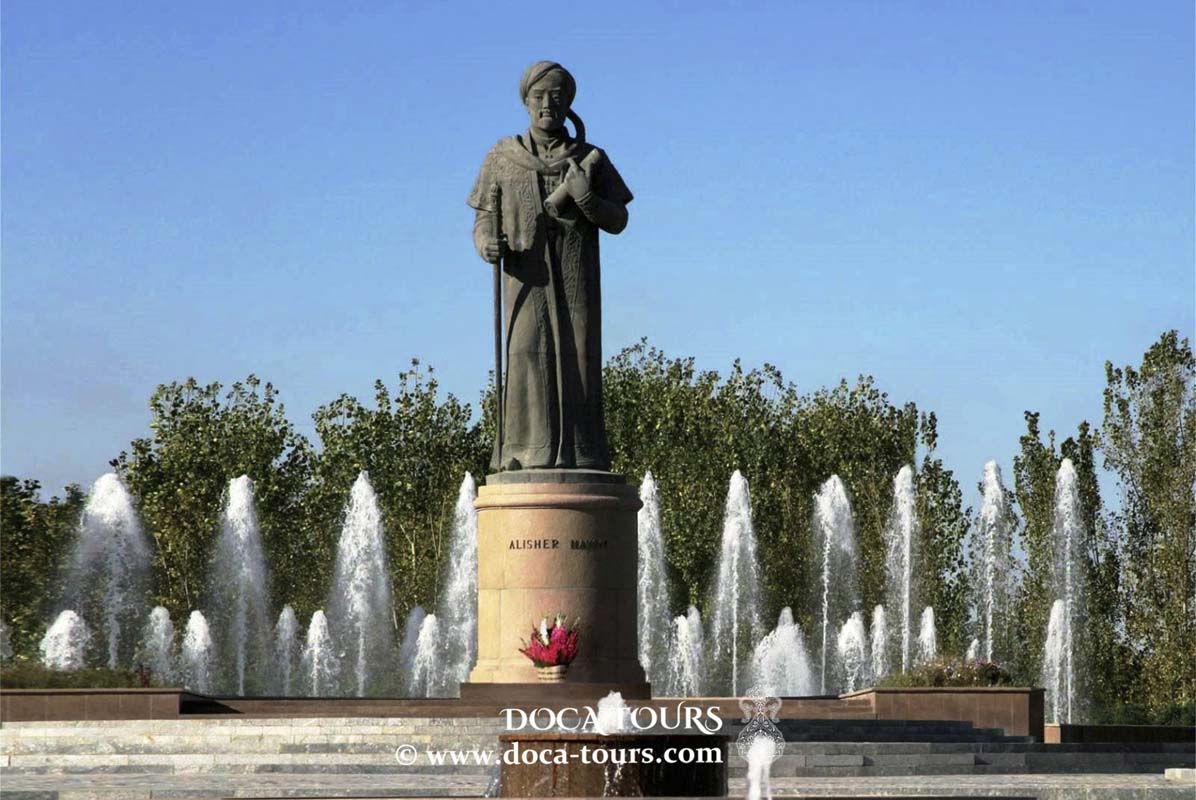
Samarkand is home to the largest university in the Samarkand region and the second largest in Uzbekistan, after the National University of Uzbekistan in Tashkent. The first higher education institution in Samarkand was established in 1927 as the Uzbek Pedagogical Institute. In 1930, it was renamed the Uzbek State Pedagogical Academy, in 1933 the Uzbek State University, and since 1961 it has been known as Samarkand State University, named after the great medieval poet, philosopher, and statesman Alisher Navoi.
The university includes 10 faculties:
Natural Sciences (departments of biology, chemistry, and geography)
History
Mechanics and Mathematics
Pedagogy
Professional Education
Social-Economics
Physics
Physical Education
Uzbek Philology
Philology (departments of Tajik and Russian philology)
During the Soviet era, other major higher education institutions were also established in Samarkand, including:
Samarkand State Medical Institute — one of the largest medical universities in Uzbekistan
Samarkand Institute of Economics and Service
Samarkand Branch of the Tashkent University of Information Technologies
Samarkand State Institute of Foreign Languages
Samarkand State Pedagogical Institute, named after Sadriddin Ayni
Samarkand State Institute of Architecture and Construction
Samarkand Agricultural Institute
Samarkand Higher Military Automobile Command-Engineering School
And others
In 1994, the Samarkand State Institute of Foreign Languages, one of Uzbekistan’s largest institutions for foreign language studies, was established.
All these institutions are still operational today. In terms of student population, Samarkand ranks second in Uzbekistan, following Tashkent.
Economy
Samarkand is a major industrial and economic hub in Uzbekistan, with its leading industry being mechanical engineering.
The Samarkand Automobile Plant (SamAuto) produces buses, trucks, and pickups under the Isuzu brand.
The MAN Auto-Uzbekistan plant manufactures MAN trucks, trailers, and special equipment. Plans are underway to produce VW cars and minibuses at this facility.
Other well-developed industries include light industry, construction, chemical and petrochemical production, pharmaceuticals, and food processing.
The city is also home to electronics factories that produce resistors, integrated circuits, and household electronic devices.
Key enterprises include:
An elevator manufacturing plant.
The UzBat factory for cigarette production and tobacco processing.
The Samarkand Tea Packaging Factory.
The Samarkand Wine Plant, one of the oldest and largest wineries in Central Asia.
Major dairy producers Pure Milky and AgroBravo.
The SAG Carpet Factory.
The Samarkand Textile Factory, among others.
Samarkand also has a thriving sector of private small businesses.
Tourism is a vital part of Samarkand’s economy. As one of Uzbekistan’s most visited tourist destinations, revenues from tourism play a key role in the city’s economic landscape.
Visitors to Samarkand primarily include tourists from Germany, France, Spain, Italy, and other EU countries, Russia and CIS nations, as well as Japan, South Korea, China, and Turkey.
Touring Samarkand: Highlights and Practical Advice
Let’s return to Samarkand’s tourism potential. Many travelers dream of visiting this city, and as with any destination, it has its unique aspects. Here are some key details to keep in mind:
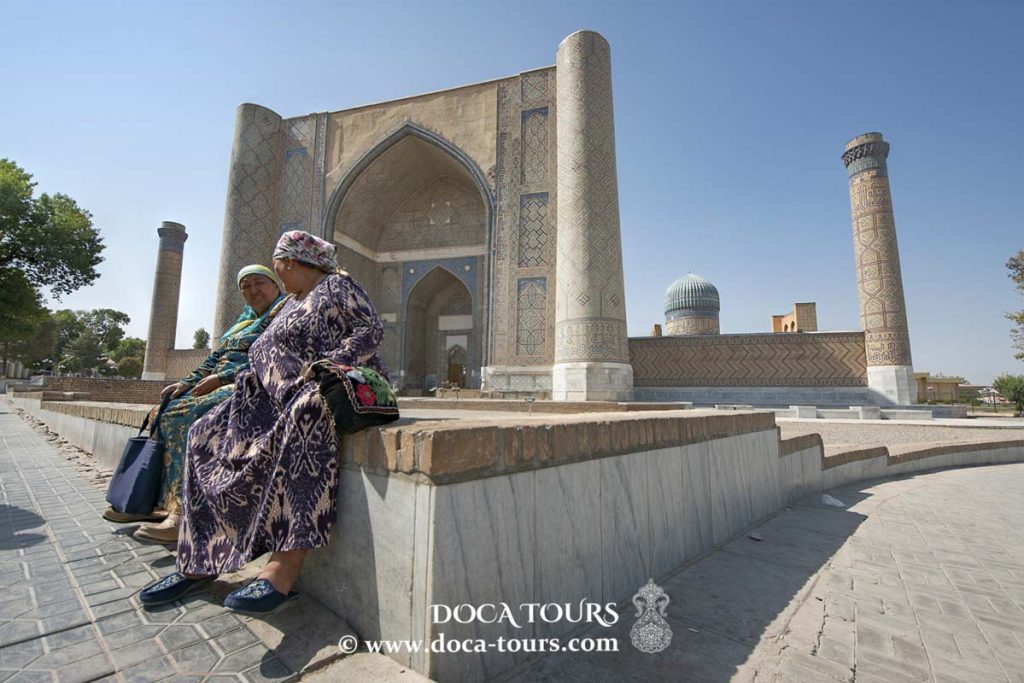
Bibi-Khanym Mosque
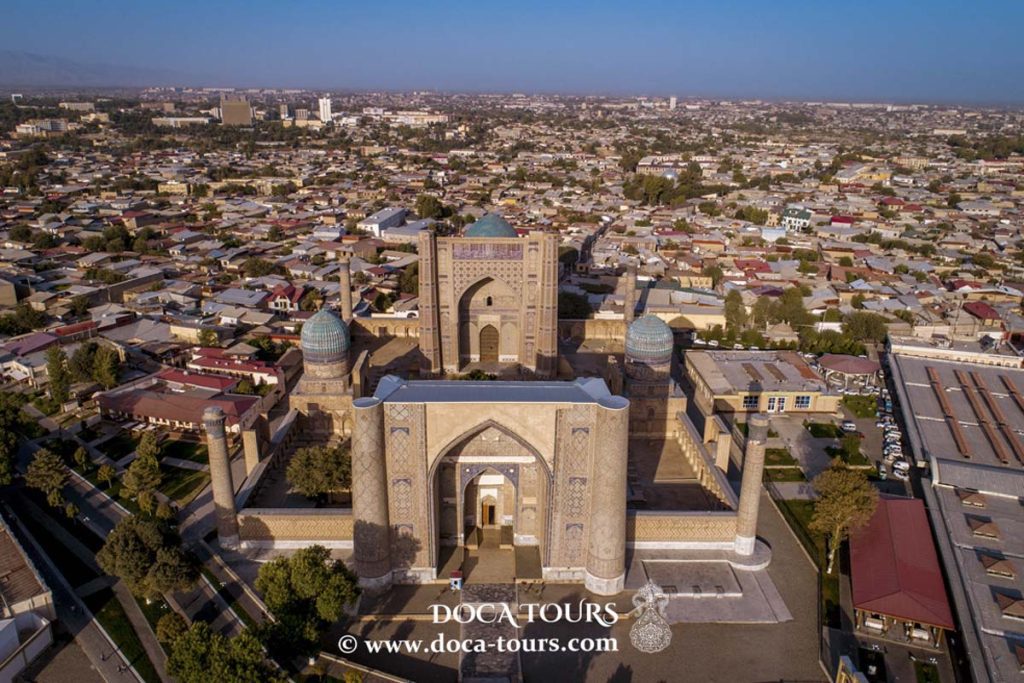
In the late 14th and early 15th centuries, Amir Timur commissioned the construction of the iconic Bibi-Khanym Mosque, intended as the Friday mosque for Samarkand, where thousands of Muslim men would gather for prayer. The name “Bibi-Khanym” translates to “Holy Lady.” According to legend, it was built by Timur’s senior wife, Saray-Mulk-Khanum. In reality, the mosque was constructed over five years under Timur’s orders after his campaign in India.
This period marked the emergence of a monumental and ceremonial architectural style in Central Asia, reflecting Timur’s famous saying: “If you doubt our greatness, just look at our structures.”
Construction involved skilled craftsmen and stonemasons from Azerbaijan, Fars, Khorasan, and India. Indian elephants were brought in to assist with heavy lifting. Today, five structures remain: the entrance portal, the main mosque building at the courtyard’s center, two smaller side mosques, and minarets. After extensive research by historians and archaeologists, the mosque’s original design has been reconstructed.
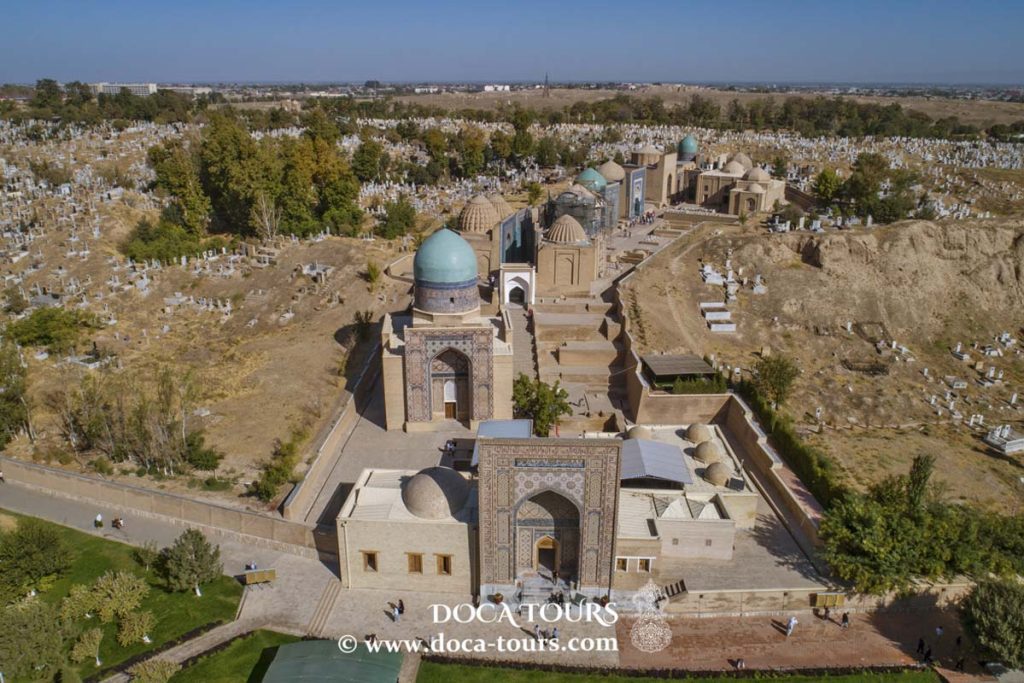
Shah-i-Zinda
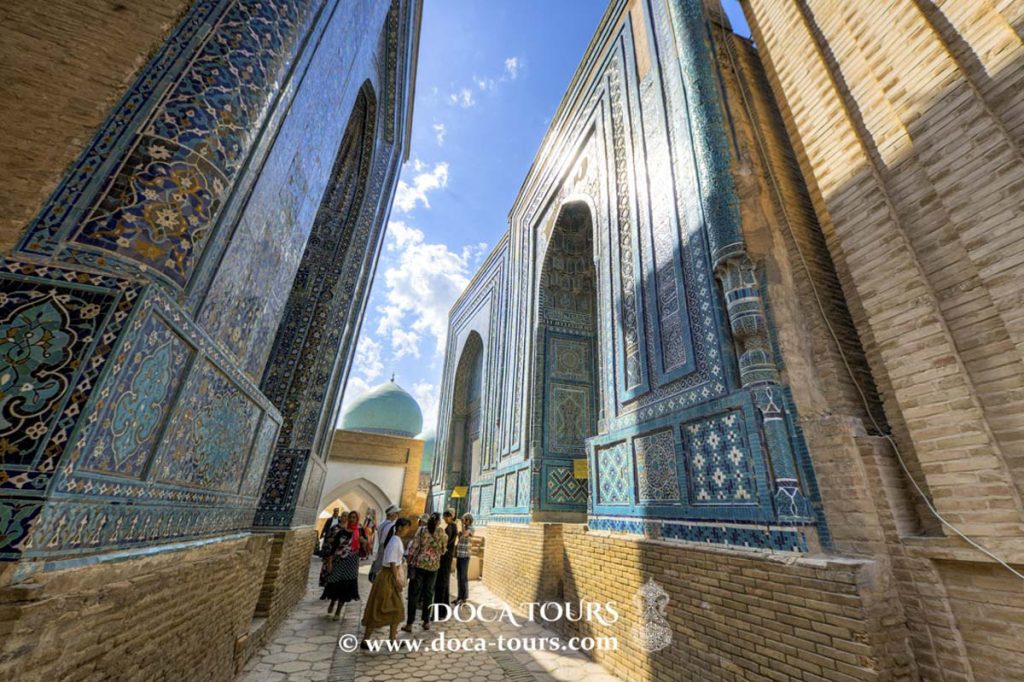
The Shah-i-Zinda Necropolis is a breathtaking complex of ancient monuments, often described as a “string of pearls” among Samarkand’s historic sites.
The name “Shah-i-Zinda” translates to “Living King” and refers to a legend about Qusam ibn Abbas, a cousin of the Prophet Muhammad, who is said to have died in battle against infidels.
A mausoleum was built over his grave in the 11th century, becoming the centerpiece of the Shah-i-Zinda necropolis. It is one of the most revered pilgrimage sites in Central Asia.
The ensemble, located on the southern edge of the ancient city of Afrasiab, developed over more than a thousand years. It served as a burial site for rulers, aristocrats, and influential individuals. Today, it is a 200-meter-long “street of mausoleums,” stretching from south to north. Modern cemeteries flank either side, and burial spots are scarce. The elite of Samarkand continue to be interred here, and nearby lies the grave of Uzbekistan’s first president, Islam Karimov.
Ulugh Beg Observatory
Ulugh Beg was not only the founder of the observatory but also the creator of Samarkand’s astronomical school, attracting the most talented astronomers of his time. These included:
Qadi Zadeh al-Rumi, Ulugh Beg’s teacher, known as the “Plato of his era.”
Ghiyas ad-Din Jamshid, a prominent mathematician and astronomer.
Ali Qushji, a gifted student of Ulugh Beg, referred to as the “Ptolemy of his era.”
The observatory, completed in 1428–1429, is a testament to the advanced architecture, science, and culture of 14th–15th century Central Asia.
Outstanding Achievements of Samarkand Astronomers
One of the most remarkable accomplishments of Samarkand’s astronomers was their creation of the star catalog “Zij-i Sultani” (Zij—astronomical tables or star catalog). The term Gurgan in the title means “son-in-law of the Khan.” The significance of Ulugh Beg’s Star Catalog lies in its recording of the coordinates of 1,018 stars, which Ulugh Beg observed over 20 years. He was the second astronomer after Hipparchus to compile such a comprehensive star catalog.
After Ulugh Beg’s death in 1449, the observatory ceased operations. His student, Ali Qushchi, later moved to Constantinople, where he completed and published the work of Samarkand’s astronomers.
The importance of Ulugh Beg’s work is reflected in the words of the renowned French astronomer Pierre-Simon Laplace, who said: “He compiled a new star catalog and astronomical tables in Samarkand, the best of those that existed before Tycho Brahe.”
A portion of the Zij-i Sultani was first published in Europe (Oxford) in 1648 in Latin. Since then, the catalog has been repeatedly reprinted in Europe and America.
By the early 20th century, the observatory had been almost completely erased from the face of the Earth, and its location was unknown. In 1908, archaeologist L.V. Vyatkin, using an ancient manuscript discovered by rare manuscripts expert Abu Said Mahzum, identified the site of the observatory. Excavations uncovered the lower foundation of the building (50 meters in diameter) and the underground remains of a sextant arc.
Registan Square
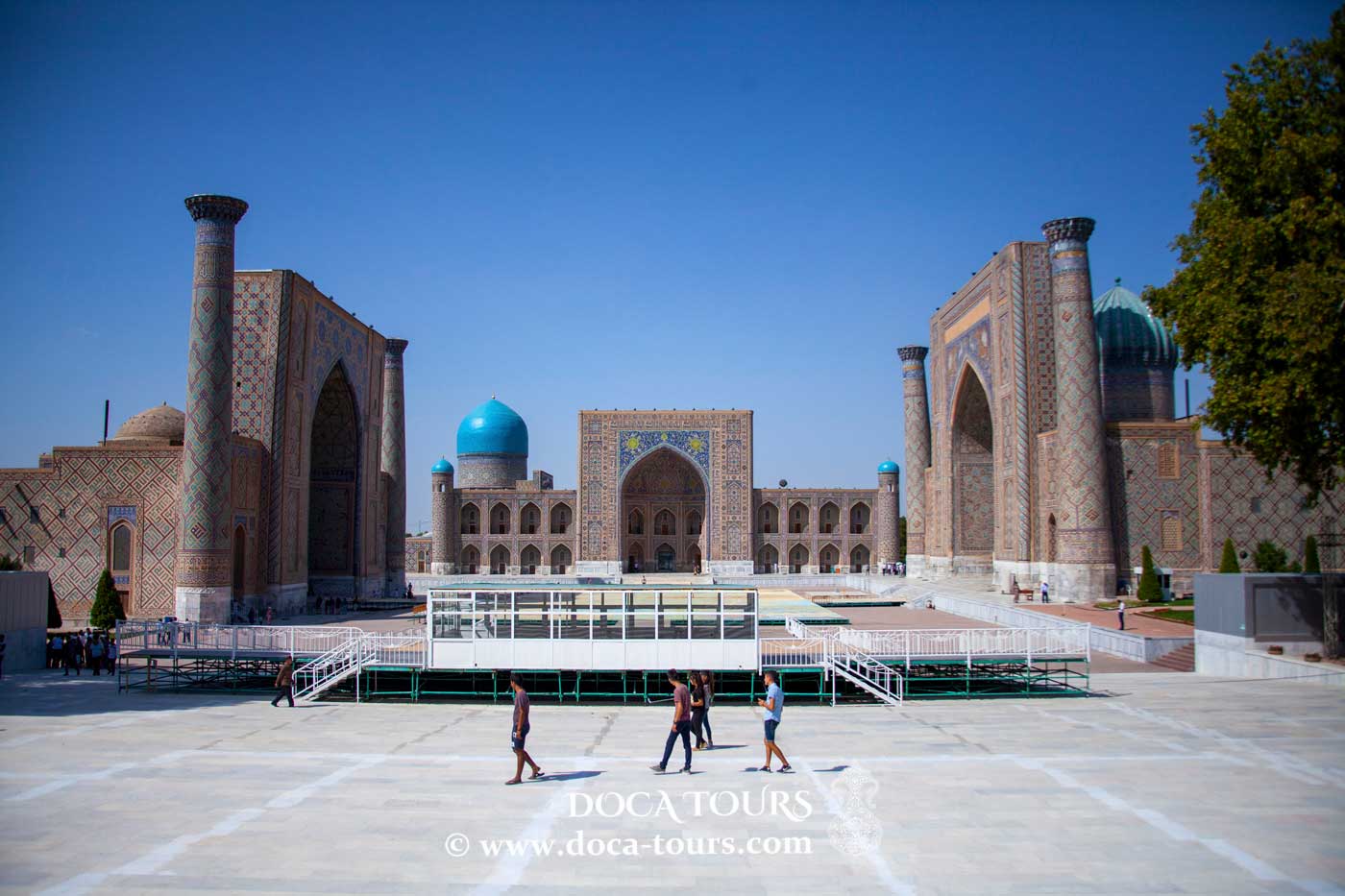
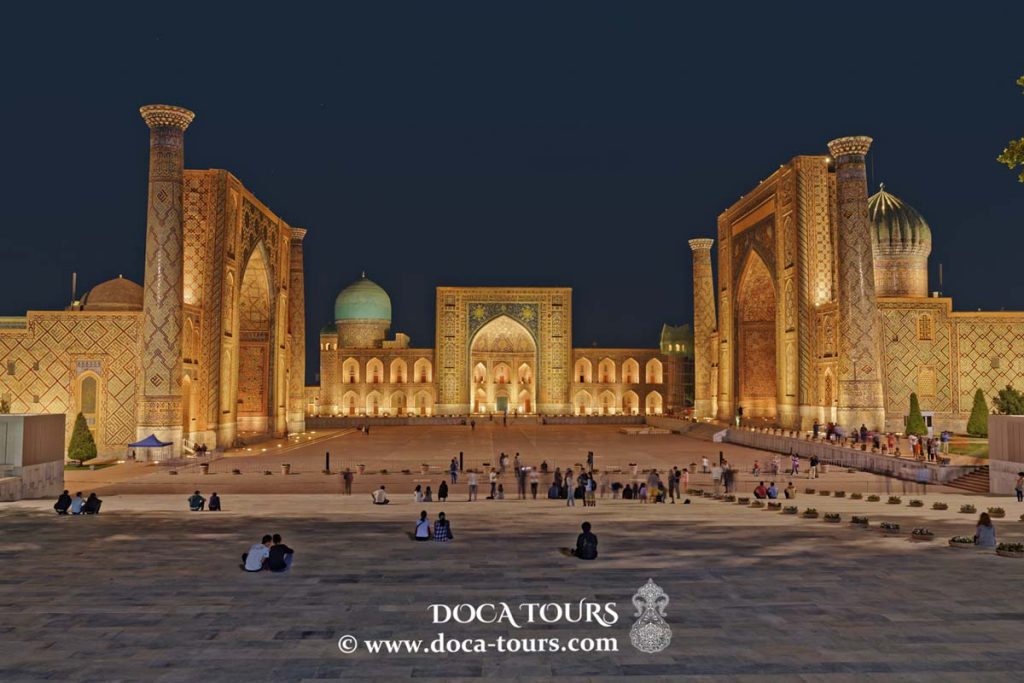
The word Registan refers to the administrative and trade-craft center of an eastern city. Samarkand’s Registan is a brilliant example of Central Asian urban planning, where centuries of the city’s history unfold. As the saying goes, all roads lead to Rome, and in Samarkand, all roads led to Registan. Standing there, you feel transported back in time, almost hearing the calls of merchants, the hum of the bustling bazaar, and the proclamations of heralds announcing the decrees of rulers.
During Amir Timur’s reign, Registan was the city’s main commercial square. Under his grandson, Mirzo Ulugh Beg, the square took on a grand, monumental character.
The present-day Registan Square was developed over two centuries (15th–17th centuries) and features three majestic madrasahs:
Ulugh Beg Madrasah
Sher-Dor Madrasah
Tilya-Kori Madrasah-Mosque
Madrasahs, deriving from the Arabic word madrasa (place of teaching), were Islamic schools. Beyond theology, they taught natural sciences such as mathematics, astronomy, philosophy, and rhetoric. Renowned scholars of the time lectured here. According to some accounts, Ulugh Beg himself gave mathematics and astronomy lectures in his madrasah, engaging in debates with students and scholars.
The Sher-Dor Madrasah is named after the mosaic images of animals on its entrance portal. The name means “the building with lions,” although a closer look reveals that the animals resemble tigers but have manes like lions.
The Tilya-Kori Mosque, one of the world’s most exquisite historical mosques, translates to “Covered in Gold.”
Gur-e-Amir Mausoleum
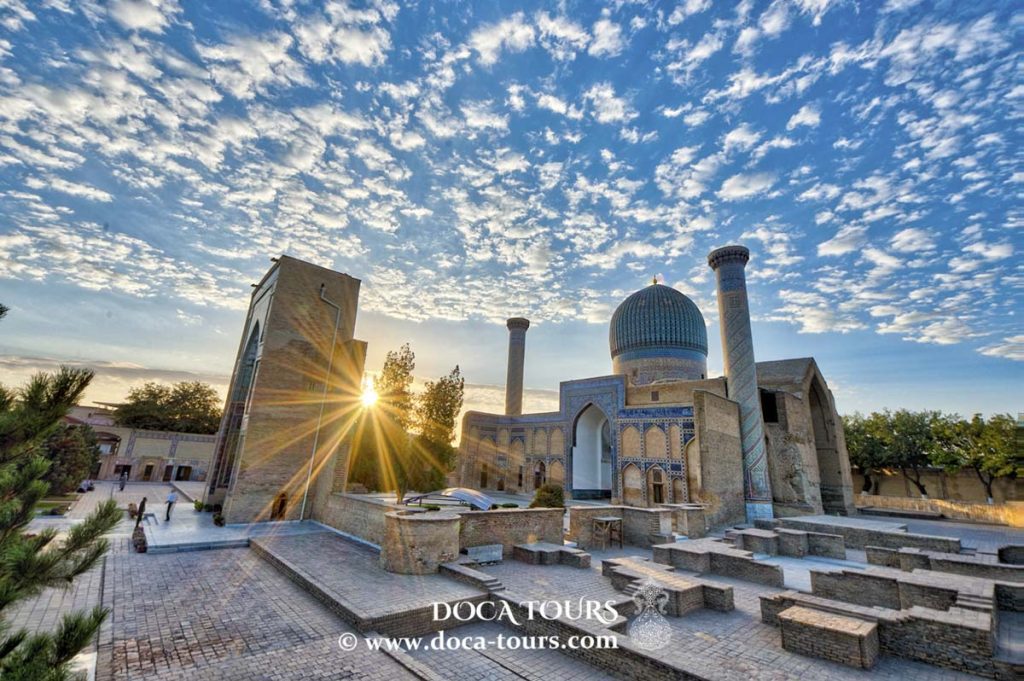
Gur-e-Amir, meaning “Tomb of the Ruler,” is the family mausoleum of the Timurids. Initially, it was intended only for Timur’s grandson, Muhammad Sultan, who died young in 1403. Timur, deeply shaken by the loss of his beloved grandson and heir, ordered the construction of a grand mausoleum.
The complex originally included a madrasah and a khanqah (a hostel for pilgrims), but today only the entrance portal and the mausoleum remain.
The mausoleum’s exterior and interior are monumental and opulent, featuring a massive ribbed dome adorned with intricate blue tiles, luxurious mosaics, and stalactite designs. Inside, the walls are decorated with papier-mâché techniques and gold leaf, complemented by panels of onyx, a semiprecious stone. The tombstone of Timur himself is a monolith of jade, a material of extraordinary rarity in such dimensions. Wherever you look, the Gur-e-Amir exudes grandeur and sophistication.
Culinary Delights
Travelers naturally seek delicious meals during their journeys, and Samarkand is a culinary paradise for gourmets. The city offers restaurants catering to all budgets, from premium dining to mid-range and budget options.
Getting to Samarkand
Samarkand can be reached by three main means:
Airplane
Train
Road travel
Air Transport
Samarkand International Airport is located in the northern part of the city and handles both domestic and some international flights.
There are almost daily flights between Samarkand and Tashkent. As of January 2019, the airport also had connections to several Russian cities, including Moscow (Vnukovo, Domodedovo, Sheremetyevo), St. Petersburg, Yekaterinburg, and Kazan.
The airport provides international connections to Istanbul (Atatürk) via Turkish Airlines. During the tourist season, charter flights from Japan, Italy, Germany, France, and Spain also land at Samarkand International Airport.
Rail Transport
Samarkand’s first railway station was built in 1888 as part of the construction of the Trans-Caspian Railway (1880–1891). This railway was built by the Russian Empire’s military engineers across the territories of modern Turkmenistan and Uzbekistan.
The railway began in Krasnovodsk (modern-day Turkmenbashi) on the Caspian Sea and ended in Samarkand, which served as the final station of the Trans-Caspian Railway.
During the Soviet era, no new lines were added to Samarkand Station, but it remained one of the most important railway hubs in the Uzbek SSR and Soviet Central Asia.
In 2011, Central Asia’s first high-speed railway was inaugurated between Tashkent and Samarkand. The line uses Afrosiyob trains (a modification of the Talgo 250, manufactured in Spain) capable of speeds up to 250 km/h.
The high-speed railway has since been extended to Qarshi and Bukhara, with plans to connect Bukhara to Khiva. The route through the Kyzylkum Desert between Bukhara and Khiva is expected to take approximately four hours.
In addition to domestic routes like Tashkent–Samarkand, Khiva–Andijan, Bukhara–Andijan, Termez–Andijan, and Tashkent–Urgench, international trains also pass through Samarkand’s railway station.
Major international routes include:
Volgograd (Russia)–Tashkent
Saratov (Russia)–Tashkent
Almaty (Kazakhstan)–Nukus
Samarkand’s railway station is located in the northwest part of the city.
City and Intercity Transport
From bus stations in nearly all cities of Uzbekistan and some neighboring countries, transport to Samarkand is readily available.
Public Urban Transport
In 1947, Samarkand introduced a tram system, which operated until August 1973, when all tramlines were removed.
In 2016, a decision was made to reintroduce trams. The first tram line opened on April 15, 2017, followed by the second line on March 21, 2018.
Today, public transport in Samarkand includes buses (manufactured at the Samarkand Automobile Plant) and minibuses.
The city also has taxi services, predominantly featuring locally produced Chevrolet vehicles. Samarkand taxis are painted yellow, resembling the iconic taxis of New York City.
A Final Question
To conclude, we would like to revisit the question we posed at the beginning of this discussion:
What does Samarkand symbolize for the people of Uzbekistan?
Thank you very much for your attention.
Subscribe to the channel and don’t forget to like our videos.
#travel, #note, #architecture, #history, #asia, #islamic, #historic, #mosque, #old, #relief, #arabic, #constantinople, #column, #color, #ceiling, #blue, #backdrop, #arabesque, #stony, #text, #words, #arab, #ancient, #worship, #allah, #cupola, #detail, #rock, #message, #ramadan, #plate, #pattern, #ornament, #mossy, #minaret, #language, #dome, #god, #gemstone, #gem, #script, #eastern, #east, #stone, #faith, #writing, #samarkand, #building, #uzbekistan, #banknote