























Video: https://www.youtube.com/watch?v=ac9S3PEDhQM
Khiva is the pearl of the East, one of the most ancient and beautiful cities located in Uzbekistan. This city keeps many secrets and legends. Surrounded by powerful walls, the historic inner city of Khiva was declared a World Heritage Site by UNESCO, and its age is more than 2500 years old.
There are many interesting legends about the origin of Khiva. One of the legends tells that the city was founded by the son of the biblical prophet Noah – Shem. It is believed that after the end of the world flood, Shem wandered in the desert for a long time and decided to lie down to rest. In his dream, he dreamed of three hundred burning torches. This dream, according to Shem, was sent to him as a sign. In that place which was predicted to him in his dream, he erected a fortress in the form of a ship. Then in the center of the city, Shem dug a deep well “Kheivak”, which gave the name to the city.
Other historians believe that it was there that the well-known Great Silk Road passed. It is assumed that at the site of the future Khiva, wealthy merchants who came from various countries, stopped for the night and for food. Travelers, exhausted after a long journey, were refreshed with cool water from a local spring, exclaiming at the same time “Hey wah!” (“Oh, how wonderful”). This joyous exclamation gave the name to this point on the map (Heyvak), which later became the name for the entire city, spread out in the middle of the endless desert.
This well can be seen today in the old part of Khiva. It is actively maintained by the old residents of the city. It is located in the northwestern part of the Ichan-Kala wall. Today, numerous archaeological excavations are being carried out in the area of this well which made it possible to discover individual elements of the dome structure and the original skeleton of the well.
During its centuries-old history, this legendary city on the Great Silk Road has gone through times of ups and downs, was subjected to destructive raids by foreign invaders, and was revived anew, becoming more beautiful. Khiva was conquered by the Arabs, Seljuks, Persians, the ruling dynasties were constantly changing, and in 1220 the city was wiped out by the hordes of Genghis Khan.
The city became the capital of the Khiva Khanate in 1598. After that, it began to develop rapidly and soon became one of the largest religious centers of the Muslim East. In the 18th-19th centuries, many beautiful architectural monuments, religious and secular structures were built here. In 1873 Russian troops took Khiva. The second rise of Khiva dates back to the beginning of the 20th century, when the city was already developing under the Russian Empire.
Khiva is divided into two separate parts: Ichan-Kala (Inner City) – a unique place with an overwhelming density of attractions per square meter, which has not only great historical but also aesthetic value; Deshan-Kala (Outer City) is the part where lives the majority of the population and where exist all modern buildings but glimpses of Khiva’s greatness as a center of Islamic power still remain.
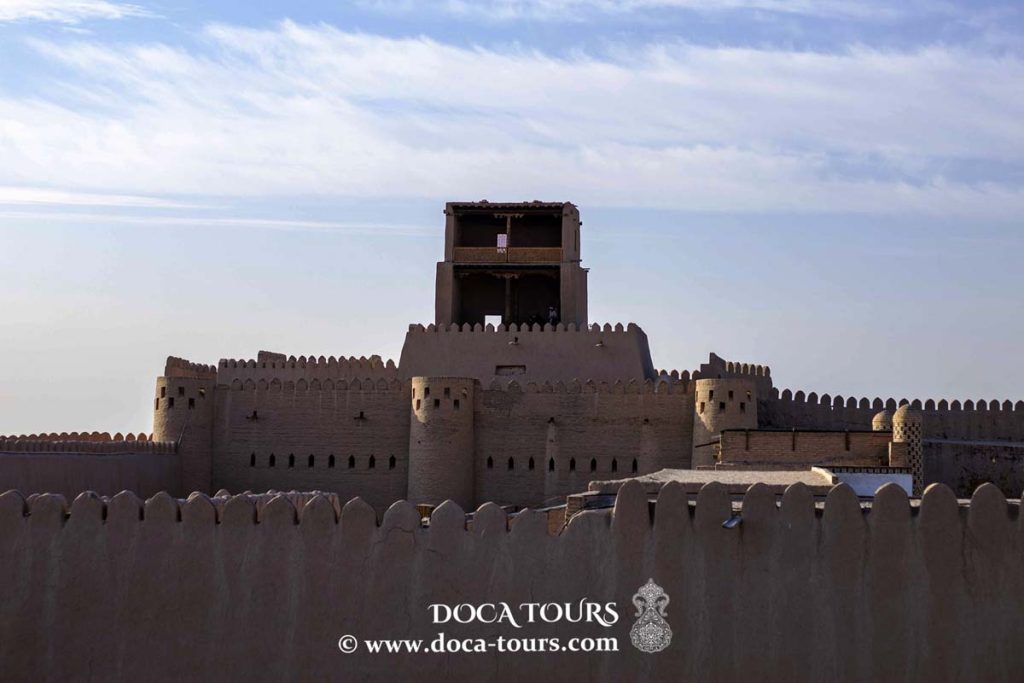
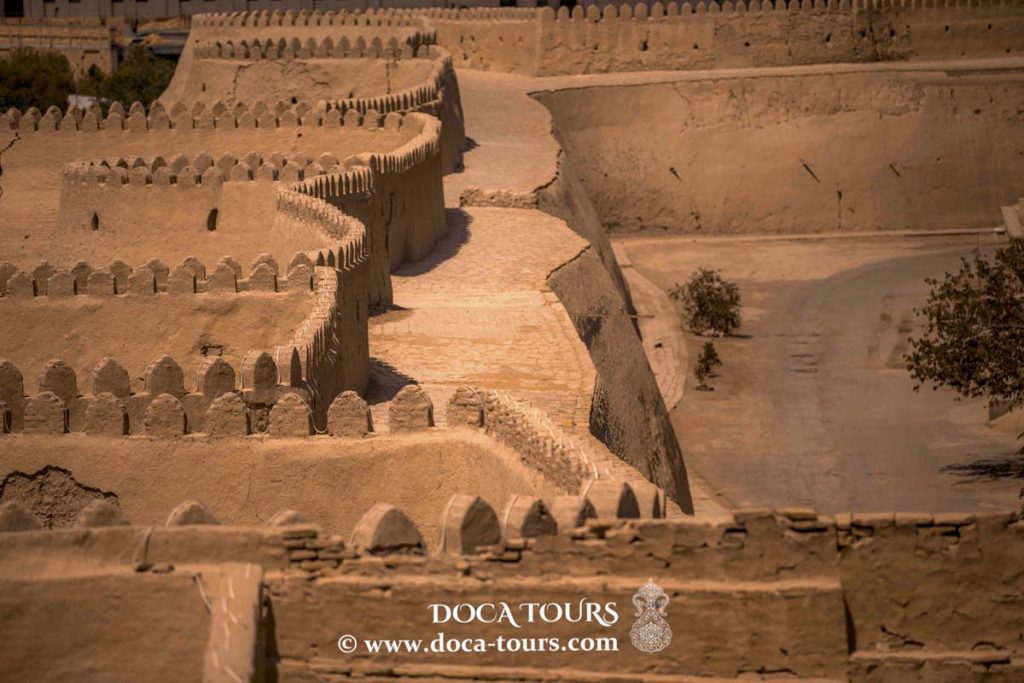
The historical part of Khiva – Ichan Kala is surrounded by a medieval fortress wall, the length of which is 2250 meters, the height is from 8 to 10 m, and the width is from 6 to 8 m. The top of the fortress is crenellated with narrow embrasures. There were special watch towers above the gates from which it was possible to reflect the enemy’s blow. Every 30-40 meters there are semicircular projections in the form of defense towers. Initially, in front of the wall there was a moat filled with water, which served as a protective function, traces of which are visible today in front of the southern part of the wall.
The territory of Ichan-Kala is 26 hectares in the form of a rectangle elongated from north to south and has 4 gates: Western gate – Ata Darvoza, Eastern gate – Palvan Darvoza, Southern Gate – Tash Darvoza, Northern gate – Bakhcha Darvoza.
The western gate is considered the main entrance to Ichan Kala, where you can directly purchase entrance tickets. The ticket office is open from 8: 00-18: 00 (эйт эй эм то сикс пи эм). There are 3 types of entrance tickets for foreign tourists:
Economy ticket – gives access to enter the territory of the ancient city of Ichan Kala, but does not give access to visit the inner parts of historical sites.
Standard – this ticket gives you the opportunity to visit all historical sites on the territory of Ichan Kala, except for the watchtower, minaret and city walls.
VIP (Recommended): – Includes all historical sites of Ichan-Kala, including the watchtower, minaret and city walls.
In addition to the main ticket, a ticket for entering the Pakhlavan Mahmud mausoleum is paid separately.
All tickets are valid for two days and are sold at the western and eastern gates of Ichan-Kala. Each time you enter a museum or historic site, you will need to scan the QR code on your ticket.
Tourists who have visited Ichan-Kala claim that it will take at least two days to leisurely see all the sights and stroll along the narrow streets of the ancient city of Khiva. Today, we will tell you about the most interesting structures and buildings that you must visit when arriving in Khiva.
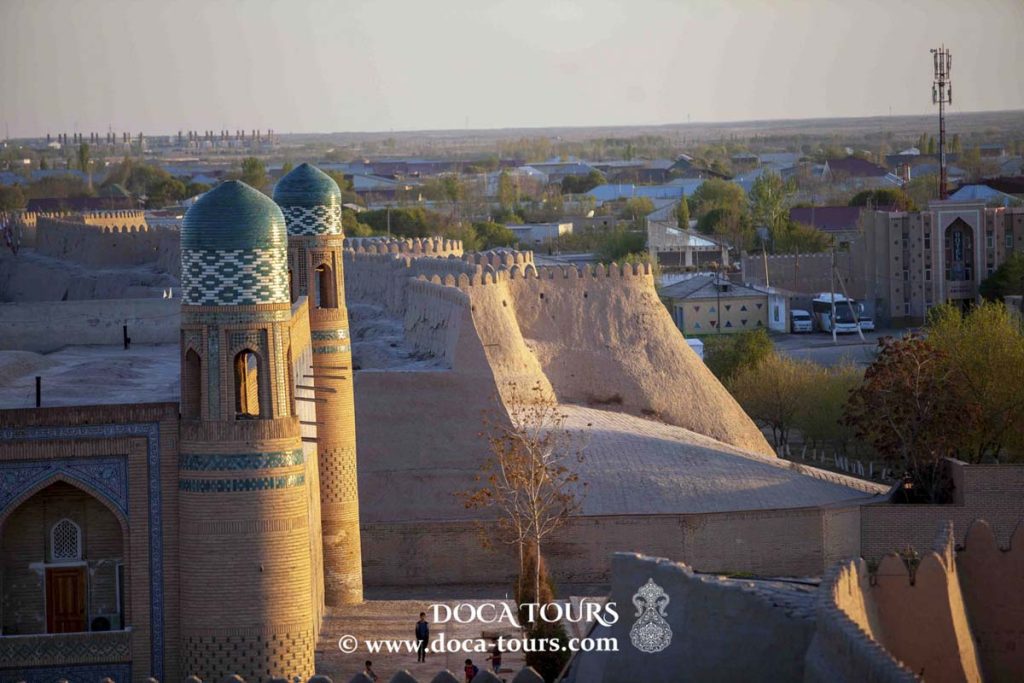
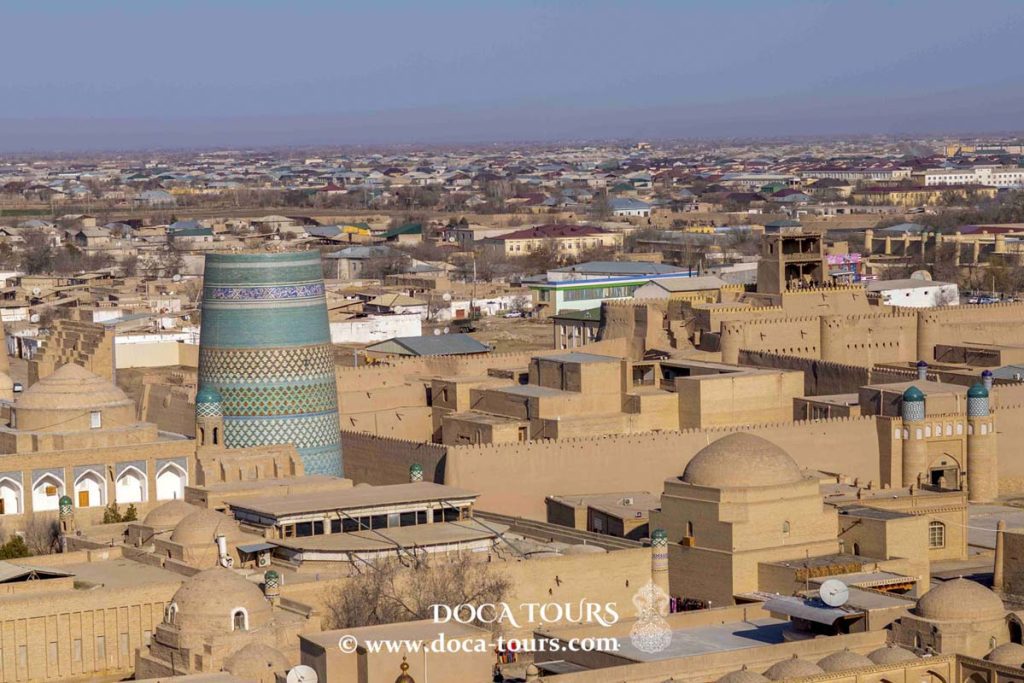
Even before you enter Ichan-Kala, you will see the famous Kalta-Minor minaret from afar. This beautiful minaret, decorated with turquoise tiles, was built between 1851 and 1855 by Muhammad Amin Khan. The khan had a dream: to demonstrate the power of his khanate, he wanted to build a minaret 80 meters high, which would exceed the famous Kalon minaret in Bukhara. Unfortunately, he was killed in battle before construction was completed, leaving the Kalta Minor minaret unfinished at 29 meters (95 feet). The name “Kalta Minor” means “short minaret”.
The magnificent decorations of the minaret are the work of the best masters of Khiva. When it became clear that the minaret would remain unfinished, they wanted to complete the construction. Today you will not find another minaret in Central Asia with such a bright or colorful decoration as the Kalta Minor minaret – this is a truly unique architectural beauty.
Next to the minaret, there is the Madrasah of Muhammad Aminkhan, which was one of the largest madrasahs – Islamic schools – in Central Asia. Madrasah impresses with its size and graceful architecture. Currently, the madrasah building serves as the Orient Star Khiva Hotel, which is one of the best places to spend the night in Khiva if you want to be right in the center of the Old City. Inside of the hotel complex, there is a currency exchange and café.
In the northern part of the complex of Muhammad Aminkhan, there is the Kunya-Ark Citadel, which was the residence of the khans. The citadel was built at the end of the 17th century by Arang Khan. By the end of the 18th century, the citadel was separated from Ichan-Kala by a fortress wall, as a result of which it became a “city within a city”.
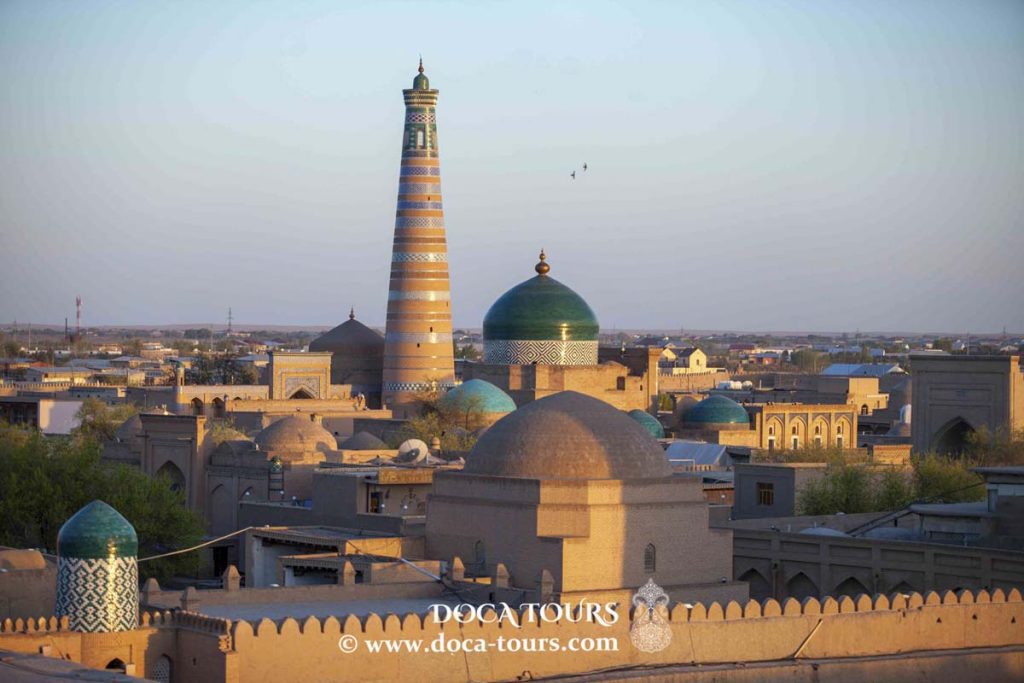
The citadel housed a harem, a reception hall, a khan’s office, two mosques, a mint, and utility rooms. The square at the entrance to the citadel served as a place for parades and military training. Nowadays, the Ark citadel has a museum of Ancient Khorezm, the Interior of the Mint, the Exposition of coins and banknotes of Uzbekistan, as well as an exposition of ceramic products by Khiva masters.
In the northwest corner of the reception hall, an exit is made through the corridor leading to the harem and to the Ak-Sheikh-bobo hill. This is the highest point of Kunya-Ark, which was used as a watchtower of the citadel. Don’t forget to climb upstairs for the best views of Ichan Kala just before sunset. An exciting view you will not want to miss! Please note that the watchtower closes immediately after sunset.
Opposite the Kunya-Ark citadel located the madrasah of Muhammad Rakhim Khan, which was one of the most famous and largest madrasahs in Khiva. It was built in 1876 by the order of Muhammad Rahim Khan, who was an enlightened monarch and patron saint of scientists and poets. The madrasah had classrooms, an extensive and rich library, winter and summer mosques. The courtyard with four ayvans consisted of hujras in which the students of the madrasah lived. The facade of the madrasah is decorated with blue and white majolica, which is also very widely used in the decoration of tympanum and columns.
In the inner part of the madrasah, there is the Museum of the History of Khiva Khans, where you can see original photographs of the last 3 khans, as well as other exhibits.
The next attraction on the list of the most visited places of Ichan Kala is the Friday Mosque – Juma. The mosque is one of the oldest structures on the territory of the museum-reserve and dates back to the 9th-10th centuries. The peculiar architecture uncharacteristic for other mosques – the absence of portals, domes and galleries, is the reason for the uniqueness of the mosque throughout Central Asia. According to legend, the mosque was originally built as a temple for the Zoroastrians and was later converted into a Muslim mosque.
The interior of the mosque deserves special attention, the ceiling is supported by 213 carved columns, 25 of which are ancient (10th-15th centuries). The mosque is adjoined by a minaret, which was built in the 18th century and was used to call people to prayer. The height of the minaret is 33m, the diameter is 7m. Unlike other minarets of Khiva, it has almost no decorations. Inside of the minaret, there are 81 steps that lead upstairs, from where opens a magnificent panorama of the entire city.
One of the best examples of 19th-century`s architecture is the Tash Khauli palace of the Khiva khans. The palace was built on the initiative of Allakulikhan, whose reign is characterized by the strong power of the khan, successful international politics and progress in trade with Russia. The construction of the palace took 8 years.
Tash-Khauli consists of three main parts: a harem, a mekhmonkhana (a room for khan’s receptions and feasts) and an arzkhana (an official administrative building), as well as five small courtyards and 163 rooms. The complex is surrounded by a blank fortress wall, the top of which is crowned with battlements. There are small guldasta towers with through lanterns at the corners. The majolica wall cladding was made by the famous master Abdullah Jin using colored ceramic glazes “ishkor”, the colors of which have not faded for centuries.
The entire southern part of the harem was intended for the four wives of the khan; concubines and servants lived in the remaining rooms. Naturally, the wives of the khan were allocated the most beautiful and comfortable rooms. The chambers of each of them consisted of a single-column high aivan, a spacious room located behind the aivan, and a small room that served as a barn (treasury) or anjamkhana (room for storing jewelry and personal belongings).
The buildings of the Mekhmonkhana and Arzkhana of the Tash-Khauli Palace were restored anew in 2001 and opened for tourists. Currently in these courtyards, the interiors “Divanbegi”, “Mirza” and “Yurt” are operating.
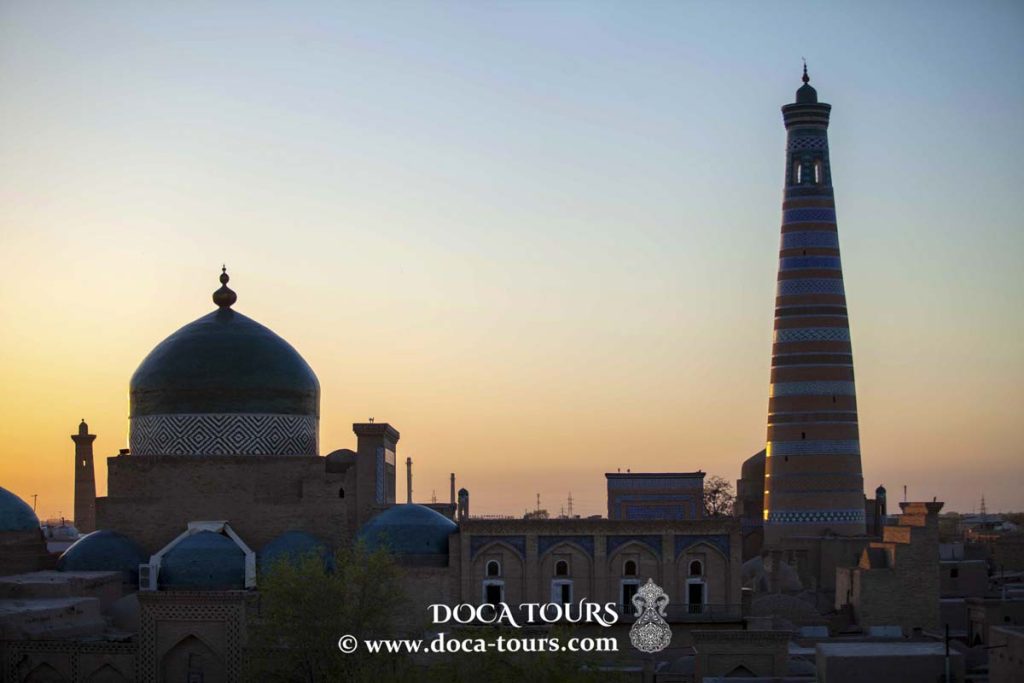
Among the numerous architectural monuments of Khiva, the Islam-Khoja complex has particular importance. The complex consists of the highest minaret and the smallest madrasah. The complex was built at the beginning of the 20th century by order of the Prime Minister of Khiva Islam Khoja. Islam Khoja was responsible for far-reaching reforms in the khanate. He was primarily known for the construction of the first European hospital named after Tsarevich Aleksey. Moreover, on his order were built a post office, a telegraph station, a pharmacy, a cotton gin, and he also sought to carry out school reform.
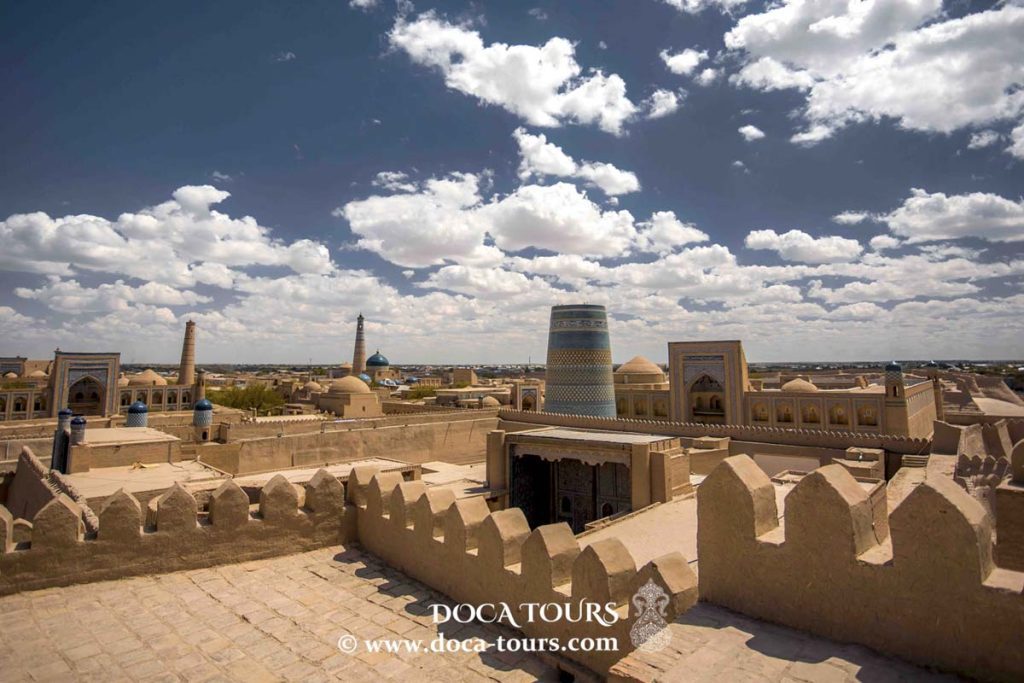
The madrasah has a large domed hall, forty-two hujras-cells. The craftsmanship of architects can be seen in contrasting combinations of architectural forms, skillfully used in a limited space. The mihrab niche is decorated with majolica and ganch carvings. The facade is finished with glaze. At present, at the premises of the madrasah operates an exposition of the Museum of Applied Art of Khorezm, which shows the best examples of the works of Khorezm masters.
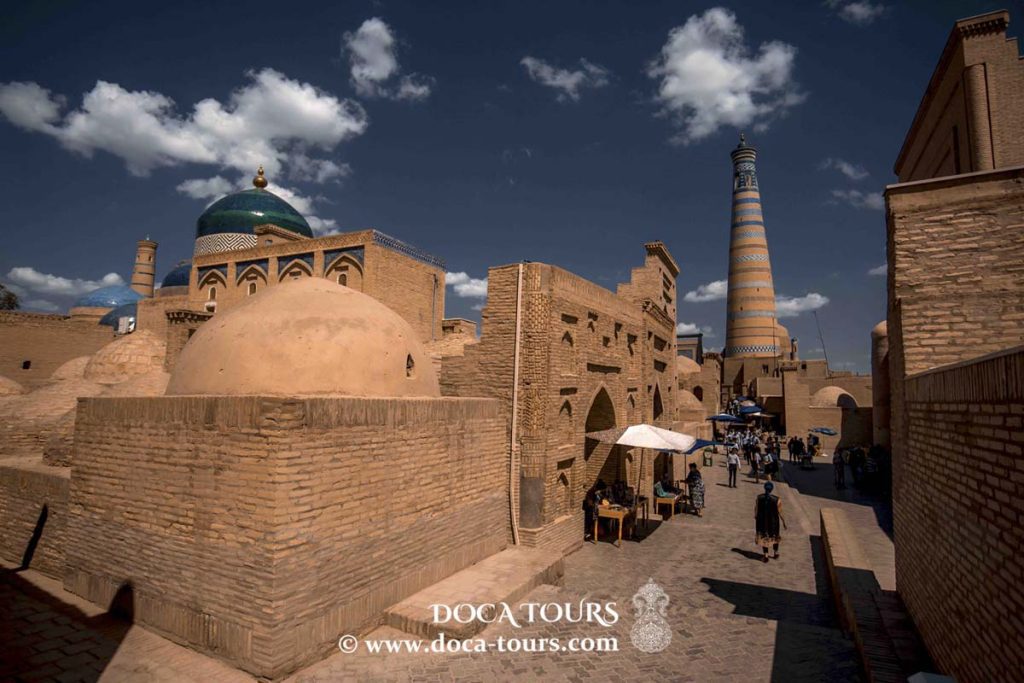
Islam Khoja minaret is one of the main symbols of the city of Khiva. The height of the tallest minaret in Khiva is 56.6 meters, and the diameter of the base is 9.5 meters. Made according to the old standards of the architecture of the 14th century, with a wide base and noticeably tapering towards the top. The tower was intended to call believers to prayer. The upper platform of the minaret at a height of 45 meters is the highest viewpoint of the panorama of Khiva. Local old-timers claim that – “There are decorations of four seasons and twelve months on the Islam Khoja minaret ”. Climbing the minaret is not an easy task. The steps are quite steep, the passage is narrow, the entire ascent keeps in constant tension, and however, as soon as you climb to the dome of the minaret, you will have much more reason to be proud of yourself.
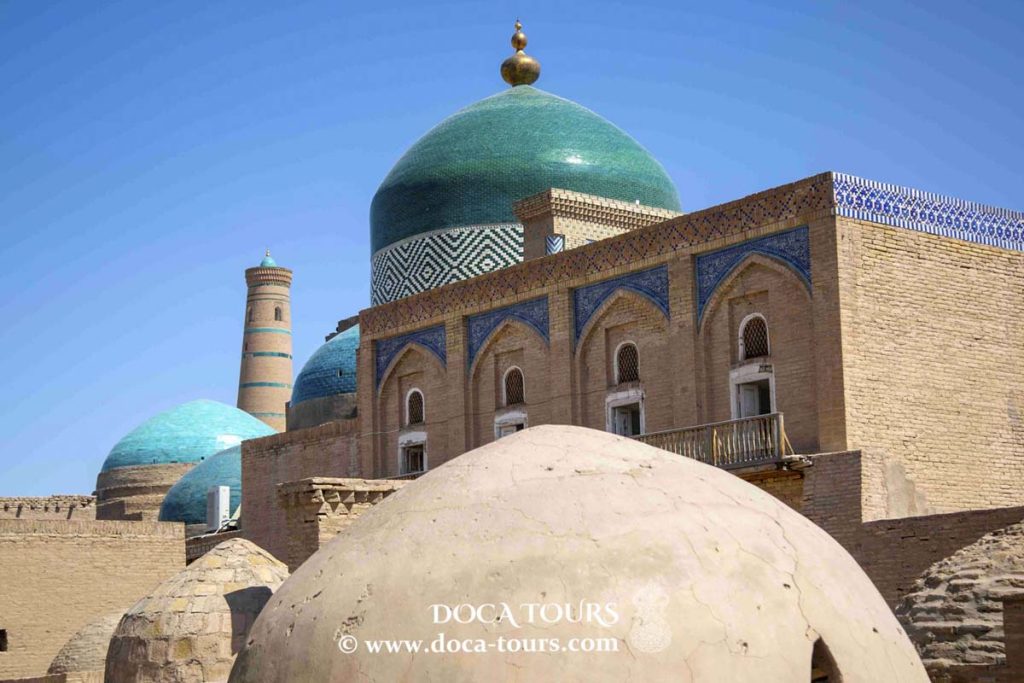
Perhaps one of the best works of Khiva architecture that made in the traditions of Khorezm architecture of the pre-Timur time is the Pakhlavan Mahmud Mausoleum. Pakhlavan Mahmud, who lived in the 13th century, was a local poet from simple craftsmen, who was also famous for his heroic strength of an invincible wrestler and the ability to heal people. The local oral tradition contains a description of many details related to the life and exploits of Pakhlavan Mahmud. Since ancient times, he is revered here as a guru, the patron saint of the city.
According to legend, Pakhlavan Mahmud died in 1322 and, according to his will, he was buried in the courtyard of his workshop. Initially, the building of the mausoleum was modest, but since this place turned into a popular pilgrimage site, in 1810 Muhammad Rahim Khan I decided to radically change the ensemble. He reconstructed the mausoleum so that a necropolis of the ruling dynasty arose at the feet of the Khiva saint. They began to bury members of the khan’s family there, and the territory of the mausoleum expanded to the east and south.
Thus, in the mausoleum, in addition to Pakhlavan Mahmud himself, Abulgazi Khan (1663), Anusha Khan (1686), Elbars Khan (1740) and Muhammad Rahim Khan I (1825) were buried.
Gradually, the mausoleum turned into a majestic structure, with the largest dome in Khiva, covered with blue glazed tiles with a sparkling gilded top. During the reign of AllahKulikhan, the building was decorated with majolica cladding.
The mausoleum of Pakhlavan Mavhmud is still a favorite place for local people and pilgrims. If you are in Khiva, be sure to visit the mausoleum. We are sure that this place will leave only good memories for you.
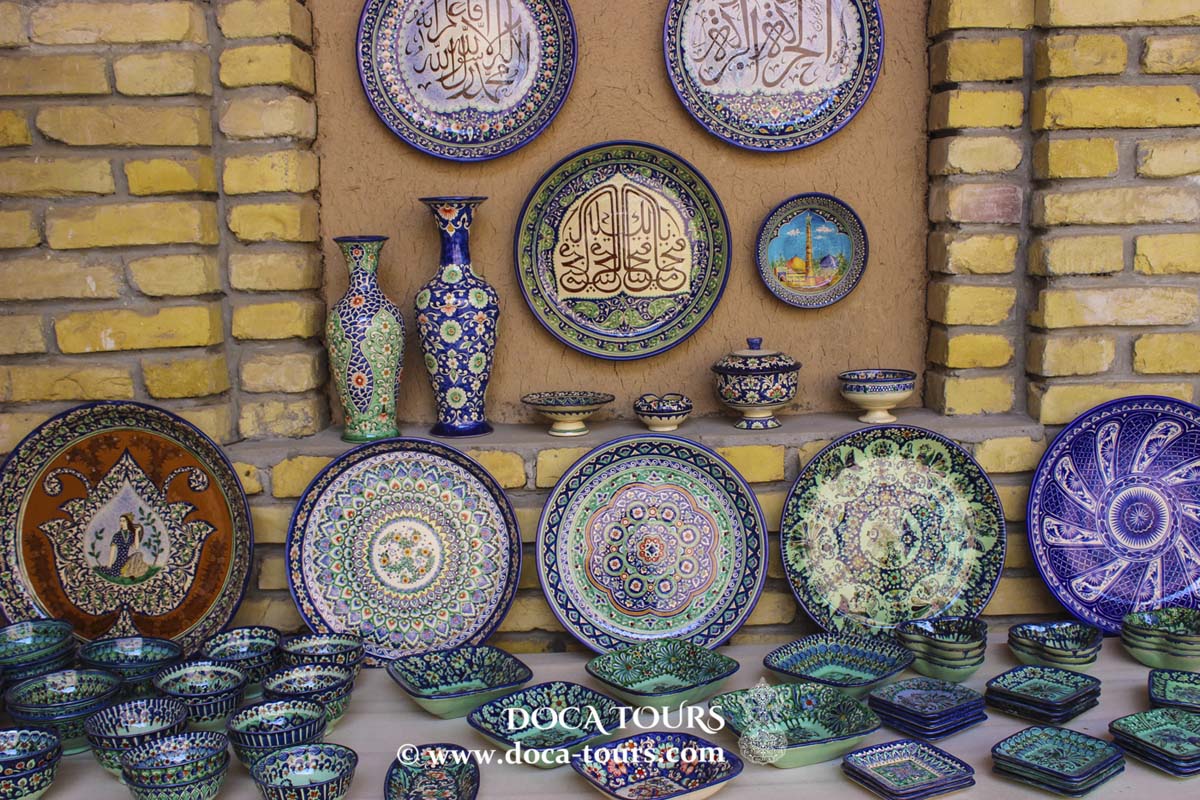
In addition to the mentioned sights, there are many more interesting monuments and buildings in Khiva, the list of which can be enumerated for a long time. After sightseeing, stroll through the narrow streets of the old city, among the clay houses, where fresh bread is still baked or weddings are celebrated. Craftsmen, like their ancestors, make hand-craft silk, carpets, metal products, wood carvings, and more.
Stroll through the old town to find local souvenir shops, embroidered bags and woodwork. Do not forget to taste the local cuisine, because Khorezm also has its own “iconic” dishes, which are sometimes difficult to find close analogues in neighboring regions. Khorezm cuisine is, perhaps, one of the most important attractions that will become a discovery for all gourmets, and Khiva will forever remain in the heart of every traveller.
Welcome to Khiva
Thank you very much for your attention.
Subscribe to the channel and don’t forget to like our videos.
#uzbekistan, #architecture, #khiva, #landmark, #minaret, #travel, #building, #city, #asia, #tourism, #mosque, #ancient, #central asia, #silk road, #islam, #history, #culture, #religion, #tourist, #historic, #traditional, #wall, #itchan kala, #old, #heritage, #mosaic, #tower, #attraction, #fortress, #gate, #destination, #town, #buildings, #trip, #historical, #muslim, #madrasah, #unesco, #arabic, #journey, #ornament, #uzbek, #central, #oriental, #chiva, #xorazm region, #pattern, #blue, #art, #islamic #Khiva #Khorezm #Uzbekistan #CentralAsia #Silkroad #Tours #voyage #traveling #Khivatour #Xiva #sightseeing’s #history #Legend #UNESCO #ancient #crossroad #Khivakhanate #Khanate #Hworezm #docatours