KHIVA
- Geographical coordinates: 41°22'42" N 60°21'50"
- Elevation: 98 m
- Former names: Kheyvak
- Popular languages: Uzbek, Russian, Karakalpak
- Official language: Uzbek
- Population: 105,300 (2020)
- Nationals: Uzbeks, Karakalpaks
- Time Zone: UTC+5
- Telephone Code: +998 62
- Postal Codes: 2209XX
- Vehicle Registration Code: 90-94
Khiva, located in Uzbekistan’s Khorazm Region, is a district-level city with a population of around 93,000 as of recent estimates. Archaeological findings suggest that the city was established approximately 2,500 years ago, a milestone celebrated during its 2500th anniversary in 1997. Historically, Khiva served as the capital of several prominent states, including Khwarezmia, the Khanate of Khiva, and the Khorezm People's Soviet Republic. In 1991, Itchan Kala, the historic inner town of Khiva, became Uzbekistan's first UNESCO World Heritage Site. Khiva is also notable for being the birthplace of Al-Biruni (973–1048 CE), a renowned astronomer, historian, and polymath, who was either born here or in the nearby city of Kath.

Etymology
The origin of the name "Khiva" remains uncertain, with various legends and theories attempting to explain its roots:
The Well of Kheyvak: According to tradition, Shem, one of Noah’s sons, wandered the desert after the flood. In a dream, he saw 300 burning torches and, upon waking, viewed it as a sign to establish a city shaped like a ship. Digging a well called Kheyvak, he discovered water with an extraordinary taste. This well, still visible in Itchan Kala, is believed to have inspired the city’s name.
Khwarezm Influence: Some scholars propose that "Khiva" derives from "Khwarezm," modified into Turkic as "Khivarezem," and later shortened to "Khiva."
Alternative or historical names for the city include Persian Xīveh, Orgunje, Kheeva, and Chorezm, among others.
Historical Background
Khiva is one of Central Asia's most ancient cities. Early Aryan inhabitants spoke Khwarezmian, an Eastern Iranian language, until Turkic groups began to dominate the region in the 10th century, leading to a gradual shift in the local population.
The city rose to prominence in the 10th century when it appeared in Muslim travel writings, though evidence indicates it had been inhabited since at least the 6th century. By the early 17th century, Khiva became the capital of the Khanate of Khiva, ruled by the Astrakhanid dynasty, a branch of Genghis Khan’s descendants.
Slave Trade
From the 17th century onward, Khiva developed into a major hub for the slave trade. Alongside Bukhara, Khiva was notorious for being one of the "slave capitals of the world," where thousands of Persians and Russians were sold into slavery. In the 19th century alone, approximately 30,000 Persian captives and countless Russians were enslaved and forced to work on construction projects, including many in Itchan Kala.
Russian Conquest and Soviet Rule
Khiva came under Russian influence in the 19th century during the Russian conquest of Central Asia. General Konstantin von Kaufman captured the city in May 1873, turning the Khanate into a Russian protectorate while allowing it to maintain nominal independence.
Following the October Revolution of 1917, Khiva briefly became the capital of the Khorezm People’s Soviet Republic (1920–1924) before its territory was incorporated into the Soviet Union. Khiva became part of the Uzbek Soviet Socialist Republic in 1924.
Architecture and Urban Design
Khiva is divided into two parts:
- Dichan Kala: The outer town, once surrounded by walls with 11 gates.
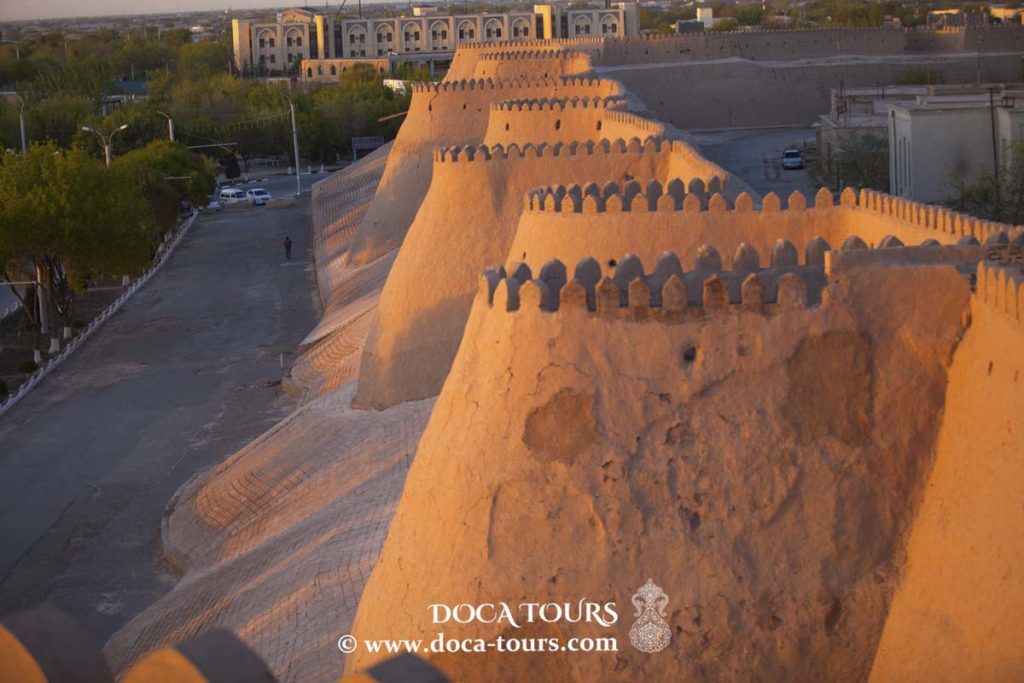
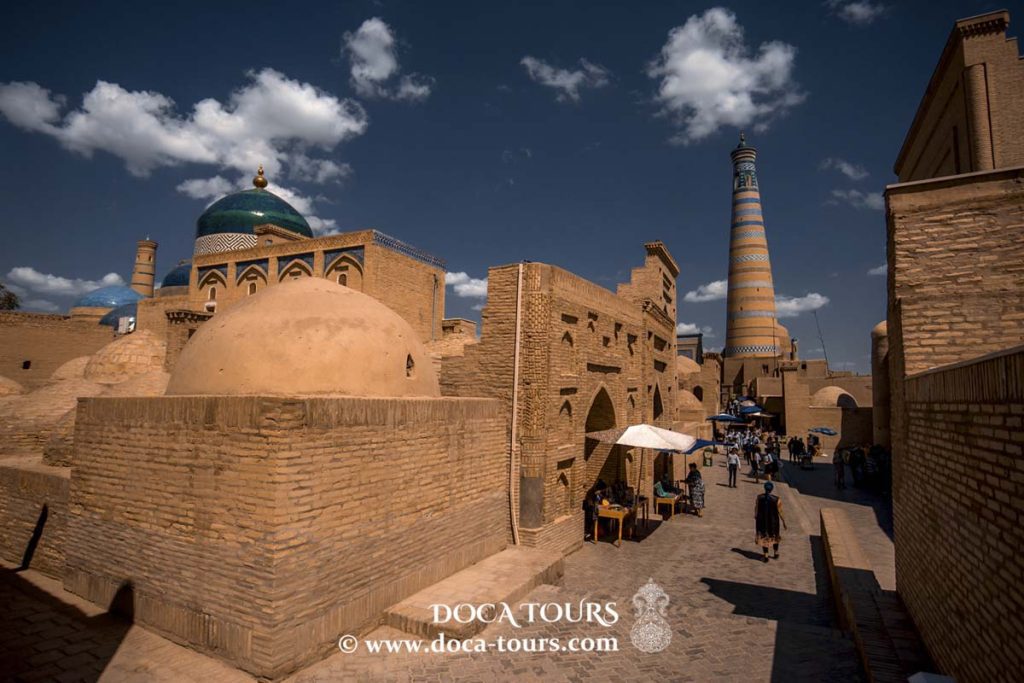
- Itchan Kala: The inner city, encircled by 10-meter-high brick walls whose foundations date back to the 10th century. The crenellated walls visible today were constructed in the 17th century.
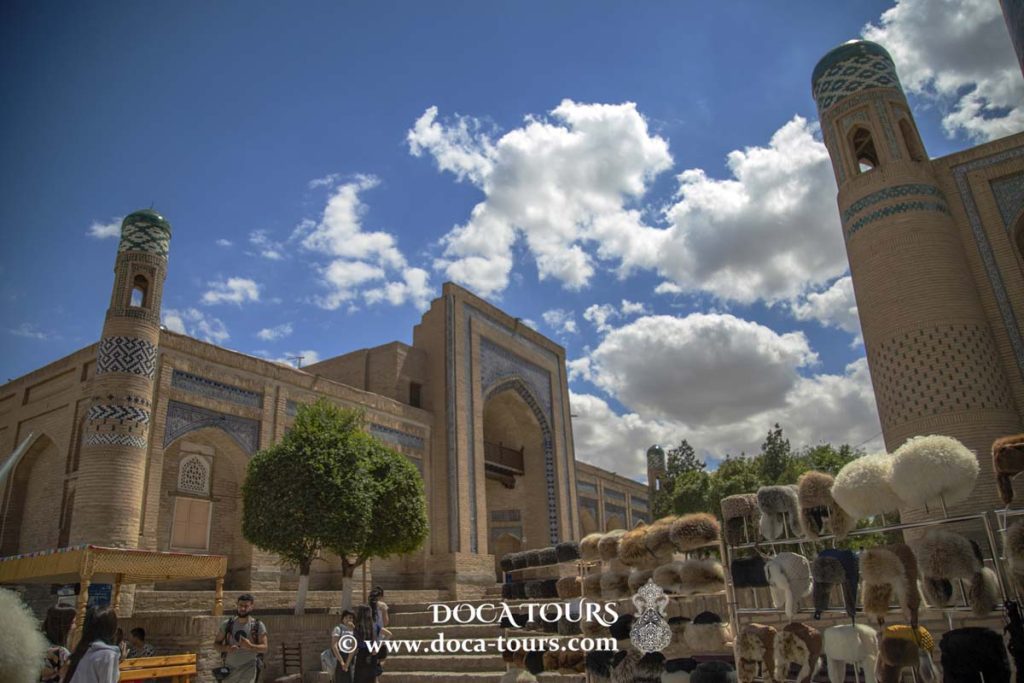
The city’s iconic Kalta Minor, a massive blue tower, was built in 1851 by Mohammed Amin Khan as part of an unfinished minaret project. It remains a striking feature in Khiva’s central square despite its incomplete status.
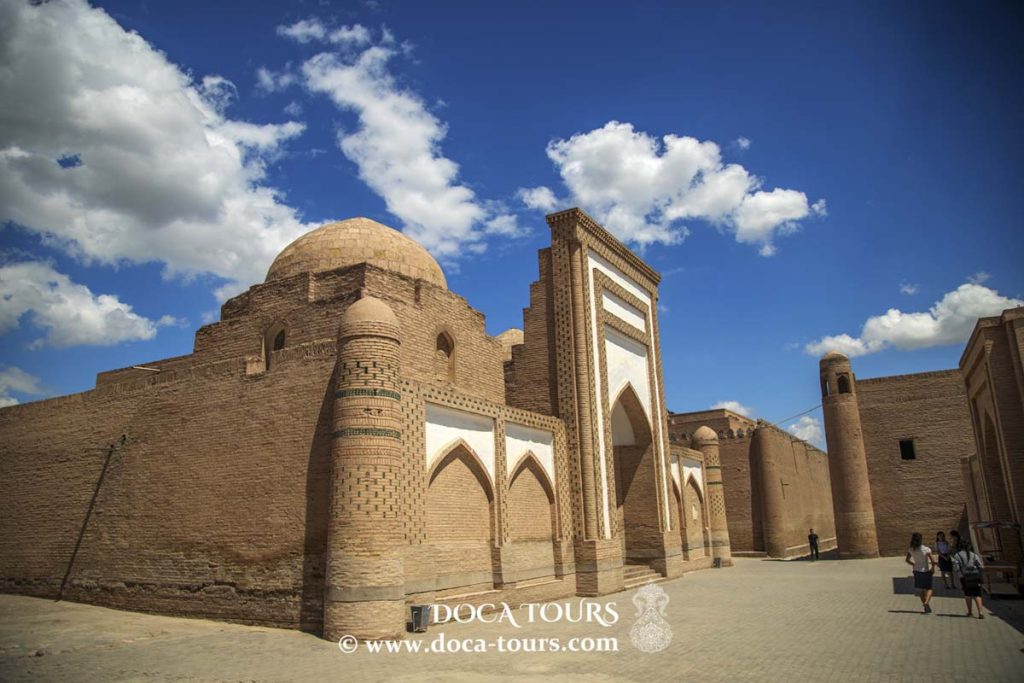
Itchan Kala retains over 50 historic monuments and 250 traditional houses, most from the 18th and 19th centuries. Notable landmarks include:
Djuma Mosque: Originally established in the 10th century and rebuilt in 1788–1789, this mosque features a hypostyle hall supported by 112 ancient wooden columns.
Sherghazi Khan Madrassah: Constructed in the 18th century by enslaved labor, this madrassah is one of the oldest buildings in Itchan Kala and was attended by prominent poets like Raunaq, Kasybayuly, and Magtymguly.
Cultural Significance
Khiva holds a special place in Central Asian history due to its cultural and educational institutions. The city was home to numerous madrassahs and a thriving intellectual community. Among its distinguished historical figures is Al-Biruni, whose contributions to science, mathematics, and history left an enduring legacy.
UNESCO World Heritage Site
In 1991, the historic inner city of Itchan Kala was designated as Uzbekistan’s first UNESCO World Heritage Site. This recognition highlights Khiva’s outstanding cultural and architectural significance, preserving its legacy as a vibrant center of history and culture.
Industry and Production
Khiva is home to a diverse range of industries, including the "KhivaCarpet" joint-stock company, cotton processing and ginning factories, and several carpet weaving enterprises such as the "Khiva Gilami" joint-stock company. Additionally, the town hosts a bread factory, farmer's markets, and numerous cultural, trade, and service establishments.
Educational facilities in Khiva include branches of Urgench University focused on agro-management, the Khorezm Mamun Academy under the Uzbek Academy of Sciences, and the Qoraqum Scientific Research Station. The town also features pedagogical, medical, and tourism colleges, vocational lyceums, a gymnasium, 15 general education schools, two special boarding schools, a regional puppet theater, an art school, two libraries with branches, and a house of culture.
Khiva’s healthcare infrastructure includes a central hospital, maternity hospital, children’s hospital, dental treatment center, polyclinic, central pharmacy, specialized clinics, and other medical facilities.
Cultural and Architectural Heritage
Khiva is renowned for its rich historical and architectural legacy, boasting a wealth of ancient monuments and sites, including:
- Sayd Alauddin Mausoleum
- Pahlavon Mahmud Complex
- Juma Mosque
- Old Ark
- Toshhovli Palace
- Nurullabai Palace
- Muhammad Aminxon Madrasah
- Muhammad Rahimxon Madrasah
- Islamkhodja Minaret and Madrasah
- Olloqulixon Madrasah
- Anushakhan Bathhouse
- Kalta Minor Minaret
Several historic gates, including Polvon Gate, Ota Gate, and Bogcha Gate.
These monuments, many of which are located in Itchan Kala, the city’s walled inner town, make Khiva a globally recognized cultural treasure.
Tourism
Khiva is a major destination for global tourism, attracting over 200,000 visitors annually, including approximately 7,000 international travelers. The "O'zbekTurizm" national company operates in the town, alongside numerous private guesthouses catering to visitors. Khiva is also home to vibrant cultural events and publications, including the "Khiva-Sharq Gavhari" magazine (established in 2001) and the "Khiva Tongi" district newspaper.
Transportation is well-established, with a trolleybus line connecting Khiva to Urgench since 1997. Additionally, bus and minibus routes link the town with major cities such as Tashkent, Bukhara, Navoi, Samarkand, and others in the region.
Archaeological and Cultural Significance
Khiva holds a distinguished place in global heritage as a key hub of world civilization and a pivotal site on the historic Silk Road. Known as a "museum city," it features an unparalleled collection of architectural masterpieces, most prominently concentrated in Itchan Kala.
Key Features of Itchan Kala
This "city within a city" is encircled by towering fortress walls, with gates on each side representing the cardinal directions. The main thoroughfare runs from the western gate to the eastern gate, lined with monumental buildings such as:
Kalta Minor Minaret: This striking, unfinished tower was originally designed as a grand vertical landmark. Its exterior is adorned with wide and narrow belts of glazed bricks, making it a standout feature of the city.
Muhammad Aminxon Madrasah: The largest preserved madrasah in Khiva, known for its twin hudjras (student living quarters) and intricate decorations using colored brick and majolica.
Konya Ark (Old Fortress): This area includes the palace of Muhammad Rahimxon I, featuring richly decorated interiors with carved and painted ganch. The harem building nearby contains luxurious chambers and living quarters.
Juma Mosque: Originally built in the 10th century and reconstructed in 1788–89, this mosque is famed for its hypostyle hall supported by 210 wooden columns, many of which date back to the 12th to 15th centuries. Each column is uniquely carved, showcasing exquisite craftsmanship.
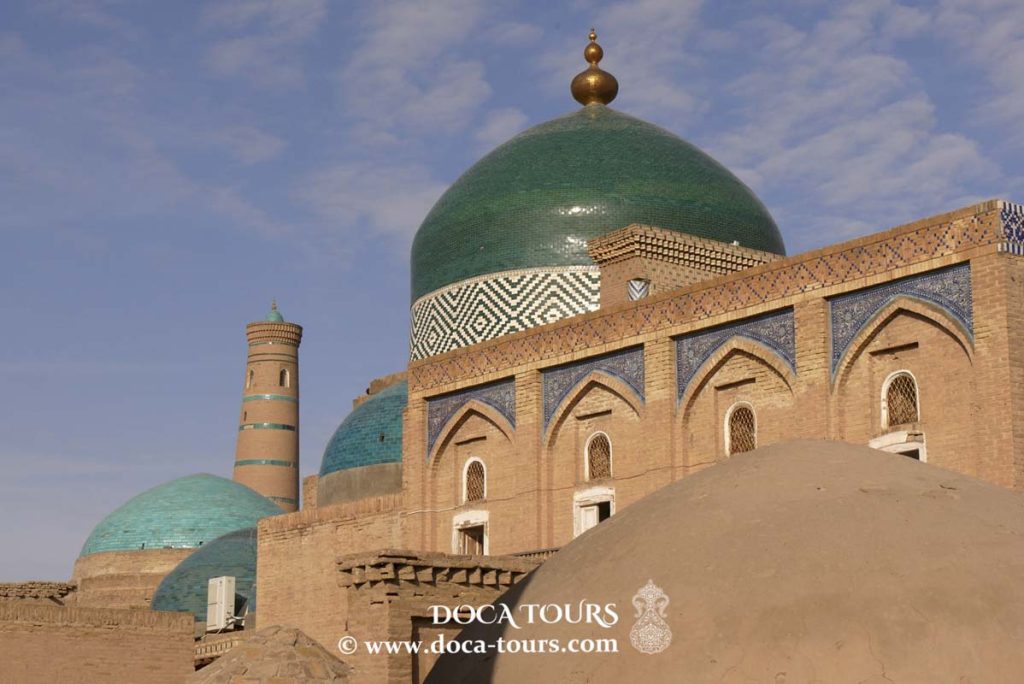
Pahlavon Mahmud Memorial Complex: Dedicated to the revered poet and patron saint of Khiva, this complex is a spiritual landmark in the city.
Islamkhodja Minaret: Standing 45 meters tall, this minaret is topped with a dome and a lantern, offering a commanding view of the city.
Beyond Itchan Kala
In the outer city, Dishan Qala, numerous other ancient monuments and historical structures can be found, further enriching Khiva's cultural significance.
Modern Infrastructure and Publications
Khiva maintains a thriving local economy supported by its industries, markets, and cultural institutions. The town's blend of historical preservation and modern development has earned it recognition as a key center of tourism, culture, and education in Uzbekistan.
Sister Cities of Khiva
Khiva has established sister city relationships with several cities worldwide. These include:
- Ankeny, Iowa, United States (since 2023)
- Nishapur, Iran
- Yazd, Iran (since 2020)
- San Lorenzo del Escorial, Spain (since 2019)