























Key takeaways
- Registan Square history spans more than 500 years, from Ulugh Beg's madrasah of the 1400s to its 1646-1660 completion.
- The square holds three madrasahs: Ulugh Beg, Sher-Dor, and Tilya-Kori, each a landmark of Timurid and later Central Asian design.
- Samarkand, with the Registan at its heart, joined the UNESCO World Heritage List in 2001 as Crossroad of Cultures.
- The name Registan means sandy place, a reminder of the market and gathering ground that once stood here.
- Golden hour light and the open west side give photographers the cleanest shots of all three facades.
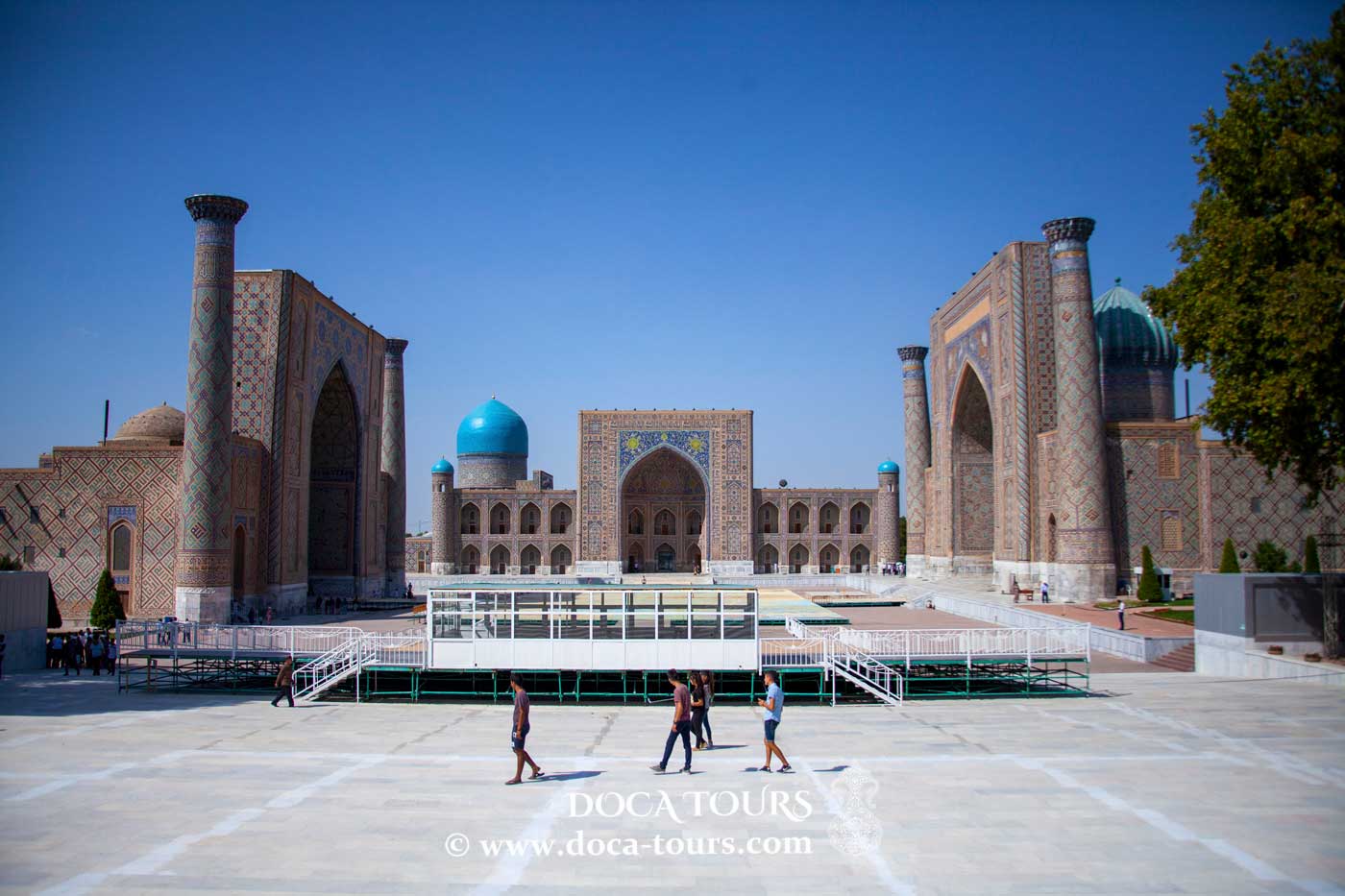
Registan Square is the ceremonial heart of Samarkand. Three towering madrasahs frame the plaza, built in stages between the early 1400s and 1660. For more than five centuries the square has done many jobs: market, royal parade ground, center of learning, and now the most photographed monument on the Silk Road.
This guide walks through the full Registan Square history: how a sandy medieval market became a stage for Timurid power, why its three colleges still stand, and how to see them well. If you are shaping a wider trip, it helps to place Samarkand alongside Bukhara and Khiva on a Silk Road route.
Where does the Registan Square history begin?
The Registan began as a commercial crossroads long before a single tile was laid. The name itself means sandy place, a nod to the open ground of sand where six roads met and merchants spread their goods. In the medieval city this was the place people came to trade, hear royal decrees, and gather in numbers.
Samarkand sat on the trade routes that linked China, Persia, India, and the Mediterranean. That traffic made the city wealthy and gave its rulers reason to build on a grand scale. The square's role as a civic forum set the stage for the monumental architecture that followed.
By the time of the Timurid dynasty, the Registan was ready for transformation. The rulers who came after Timur, known in the West as Tamerlane, chose this spot to display learning and faith as instruments of state. The first great building would come from his own grandson.
The three madrasahs: Ulugh Beg, Sher-Dor, and Tilya-Kori
Registan Square holds three madrasahs built in two distinct eras. The Ulugh Beg Madrasah was constructed between 1417 and 1420, in the last generation of the Timurid golden age (UNESCO World Heritage Centre). The Sher-Dor and Tilya-Kori followed two centuries later, closing the plaza into the ensemble seen today.
Ulugh Beg was more than a prince. He was an astronomer and mathematician who ran one of the great observatories of the medieval world. His madrasah on the west side became a leading center of science, where astronomy and mathematics were taught alongside religious subjects. That intellectual legacy is part of what makes the Registan singular among Islamic monuments.
The Sher-Dor Madrasah, built roughly between 1619 and 1636, faces Ulugh Beg's college across the square. Its name means lion-bearing, after the striking mosaics above its entrance arch that show tiger-like lions chasing deer beneath a rising sun with a human face. Figurative images like these are rare in Islamic architecture, which is partly why the facade draws so much attention.
The Tilya-Kori Madrasah, completed around 1646 to 1660, fills the north side and gave the square its balanced, three-sided form. Its name means gilded, and the interior of its mosque is covered in gold leaf that glows under the dome. The building served as both a college and the city's main mosque after the older congregational mosque fell into ruin.
For a fuller picture of the city around these monuments, it is worth setting aside a full day to explore Samarkand beyond the square itself.
What makes Timurid tilework so distinctive?
Timurid architecture turned entire buildings into surfaces for color, and the Registan is its showcase. The three madrasahs together form one of the most complete surviving statements of Timurid and later Central Asian design, which is central to why Samarkand earned World Heritage status.
Turquoise rules. That deep blue sits against cream, white, and gold across every surface. Craftsmen used several techniques to get there: glazed brick laid in geometric patterns, cut-tile mosaic for the finest detail, and majolica panels painted with flowers and script. Arabic calligraphy runs across the portals, blending sacred text into the ornament.
Scale matters as much as detail. The entrance portals, called pishtaqs, rise far above human height and frame the viewer against vast mosaic walls. Ribbed domes and slender minarets complete the composition. The effect is meant to overwhelm, and it still does. According to Encyclopaedia Britannica, Samarkand reached its architectural peak as the Timurid capital in the 14th and 15th centuries, and the Registan is the clearest surviving record of that ambition.
Legends and restoration across the centuries
The Registan survived earthquakes, neglect, and near collapse before reaching the condition visitors see today. By the 20th century its minarets leaned badly and whole sections of tile had fallen. A long program of Soviet-era restoration through the middle decades of that century straightened the towers and rebuilt lost facades, including a dramatic effort to correct one leaning minaret with cables and a pivot.
Legends cling to the square as tightly as the tiles. The tiger-sun mosaic on the Sher-Dor has inspired stories for centuries, since showing living creatures on a religious building broke with convention. Local tales also surround Ulugh Beg, the scholar-king whose scientific work ran ahead of his time and whose reign ended in tragedy.
Not every repair pleased historians. Some restoration added color and detail that may have been more vivid than the originals, a common tension in conserving ancient monuments. Even so, the work saved buildings that might otherwise have been lost. The ensemble's protection was secured when Samarkand joined the UNESCO World Heritage List in 2001 as Samarkand, Crossroad of Cultures.
Visiting tips and photography advice
Plan your visit around the light. The square opens to the west, so late afternoon sun falls full on the Tilya-Kori and side facades, while early morning gives soft light and thin crowds. Evenings are different again. An illumination show lights the three buildings against a dark sky, and that is when the most dramatic photographs happen.
Buy a single ticket that covers all three madrasahs and allow at least two hours. Step inside each courtyard, not just the plaza, since the interiors hold the gilded Tilya-Kori mosque and craft workshops in the old student cells. Climbing one of the minarets, where access is permitted, gives a rooftop view across the ensemble.
A few practical notes for photographers:
- Shoot wide from the viewing terrace on the open side to frame all three buildings together.
- Return at blue hour for the lit facades, and bring a small tripod or steady surface for low light.
- Look for detail shots of the tile panels and the Sher-Dor lions once you have the wide angle.
- Dress respectfully, since these are working heritage and religious sites.
Timing your whole Uzbekistan trip matters too. Spring and autumn bring the kindest weather, as our Best Time to Visit Uzbekistan: Season-by-Season Guide explains in detail. A knowledgeable local guide turns the Registan from a beautiful backdrop into a readable history, which is one reason many travelers join a guided Silk Road tour of the region.
The clearest next step is to see the Registan in person, ideally with the context a guide provides. Doca Tours runs guided Uzbekistan and wider Central Asia itineraries that center Samarkand and its monuments, so you can stand in the square knowing exactly what you are looking at and why it has mattered for 500 years.
Frequently asked questions
What does the word Registan mean?
Registan translates as sandy place or sand place. The name points to the market square and gathering ground of sand that occupied the site before the madrasahs were built.
How old is Registan Square?
The oldest building, the Ulugh Beg Madrasah, was built between 1417 and 1420. The ensemble took its final three-building form by 1660, so the square spans more than five centuries of history.
Why is Registan Square famous?
It is one of the most complete surviving statements of Timurid architecture, with three monumental madrasahs facing a single plaza. Samarkand, including the Registan, was inscribed on the UNESCO World Heritage List in 2001.
Can you go inside the madrasahs at the Registan?
Yes. Visitors can enter the courtyards of all three madrasahs. Former student cells now house workshops and craft stalls, and the Tilya-Kori mosque interior is open to view.
When is the best time to photograph the Registan?
Early morning and the hour before sunset give warm, even light on the tilework. Evenings are good for the illumination show, when the facades are lit against a dark sky.