






























Video: https://www.youtube.com/watch?v=xii2bpUPFXo&t=8s
The Turkmen wedding is a beautiful widespread holiday with centuries-old traditions, a special role of older relatives, a feast for the whole world, an impressive number of guests and celebrations for more than one, and sometimes three or four days in a row. For Turkmens, a wedding is a very important stage in life. Since ancient times, the Turkmens have honored the traditions of their ancestors; therefore, the ceremonies of the Turkmen wedding, in many ways, have remained unchanged today, although the new realities of the time, of course, have made certain adjustments to this celebration.
It takes at least three days to have a wedding in accordance with both − old and new rites. And taking into account the observance of all preliminary ceremonies – at least five. Weddings can now be held at any time of the year, whereas before the wedding season was highly dependent on the agricultural life of the population. The wedding is played as a well-rehearsed festive performance; it concentrates on the experience of the people, the experience of everyday life, moral and spiritual.
Preparing for a wedding requires some effort, both physical, moral and material. Young people mostly marry for love. Sometimes it happens that a distant relative is taken as a bride. Previously, the bride was not asked whether she wants to get married or not. Now parents, of course, match their son or daughter, asking their permission to see each other, agreeing on a future wedding and about the time.
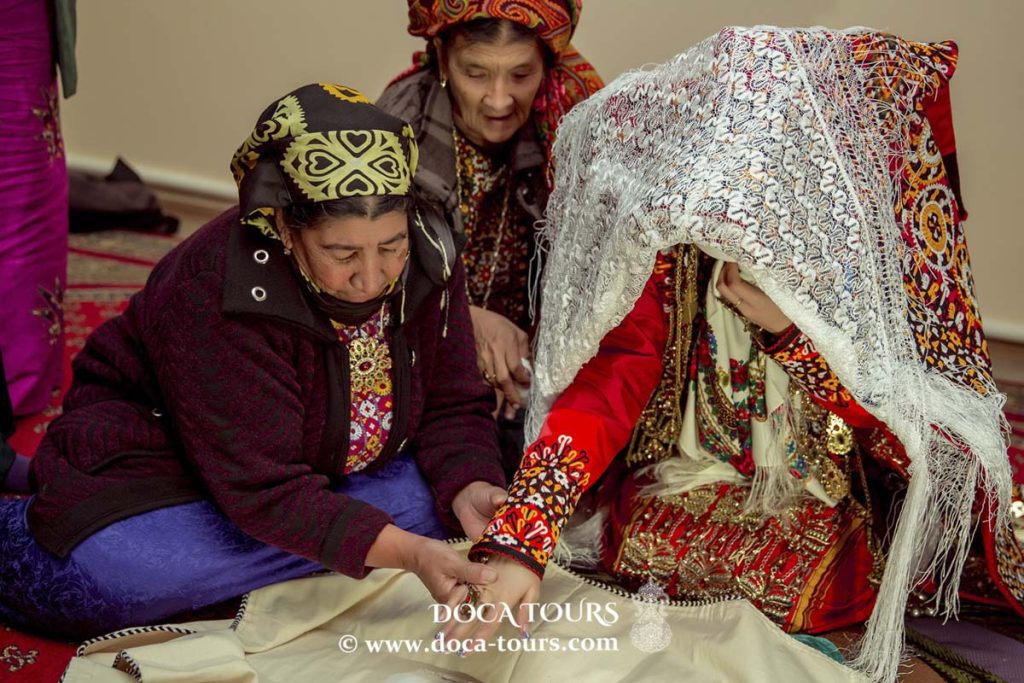
The day before the wedding, a ceremony called atgulak takes place in the groom’s house. The literal translation of the word Atgulak from Turkmen language means “horse ear”. Previously, these were scarves, now the gifts of the groom’s mother to her new relatives (the bride’s family), which are collected by the females of the family. In the courtyard, in big cauldrons, they cook traditional Turkmen dishes – pilaf, dograma, yarma, bake katlama, chelpek, and pisme.
As a gift, women bring wedding gifts, sweets in bundles of scarves of various sizes, fabric cuts, carpets, rugs. When they leave, they receive gifts that are equivalent to what they brought. The guest, touching their gifts, says the words: “Bizede hudai etersin” which means: «May we also have weddings in our house». This scarf or piece of fabric is a sign of celebration and prosperity. Sweets, small coins and toys, gifts for relatives and wedding guests are everywhere. The ceremony lasts about 3-4 hours, and then the guests go home.
The next day of the morning, the bride is dressed up and prepared for the arrival of the groom. Despite its extreme conservatism, a wedding dress is always distinguished by rich ornamentation and decorations.
Previously, certain days were chosen for cutting and sewing a wedding dress which was considered successful among Muslims. The well-being of the bride depended on this. The dress was cut and sewn in the bride’s house from fabric obtained from the groom’s house. On this occasion, her close friends gathered in the house. This dress was cut by a woman respected in the village, a mother of many children, starting with a blessing.
Braids, camel hair laces, a pig’s tooth, silver plates in necklaces made of beads with eyes were sewn into all types of wedding clothes. “Dagdan” made of wood and a triangular bag with coal and salt were sewn to the connecting plate “ara herbi” between the false sleeves of the ritual cape. Salt, according to many nations, has a protective value. The cuts of the material were taken away for luck by those women who presented at the cutting.
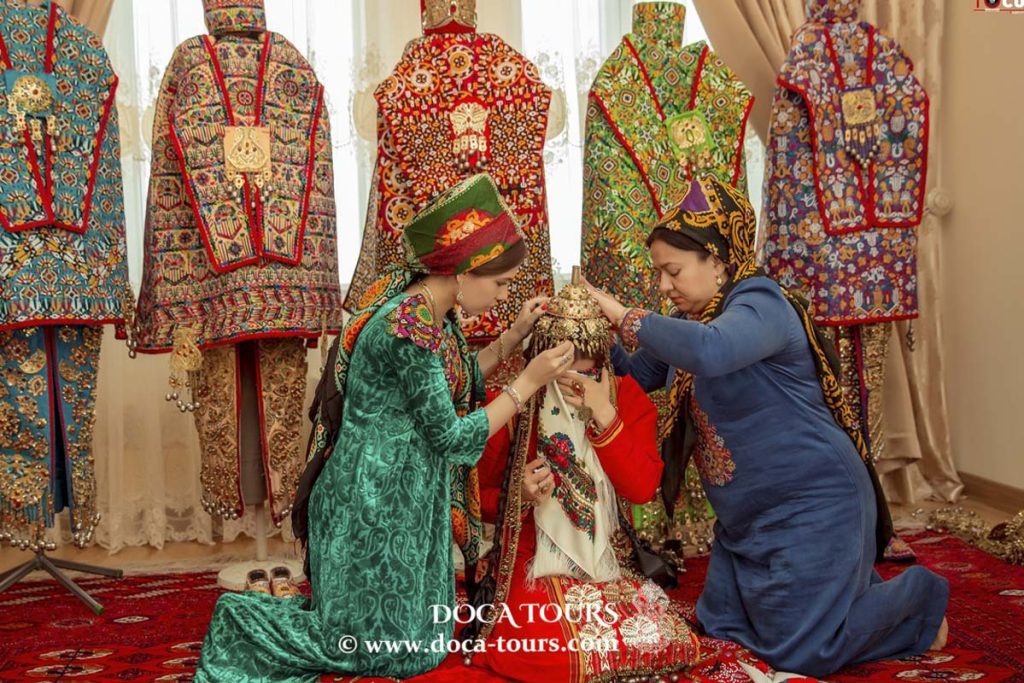
It was widely believed that the bride attracts all kinds of evil spirits, so she must be protected by all available means. In an effort to almost completely hide the face and figure from prying eyes, the bride was covered with a head cape.
The traditional costume of a Turkmen woman cannot be imagined without jewellery which once served as a kind of amulets that protected from diseases and infertility.
Nowadays, jewellery is most often rented and made of copper, which is much lighter than silver jewellery, thus making the bride’s outfit 20 kg lighter. In total, the outfit can weigh up to 60 kg (gulyaka, belt, brooches, bracelets, a kuppa / gubpa must be worn on the head), rubber galoshes with bells are on the bride’s feet, and a gelen-kurte is worn over her head. Kurte is a head robe with sewn-on sleeves, which was worn over to married women and the colour of which symbolized the status and age of a woman. Red – worn by brides, black – worn by young women who already had children, yellow – dressed after 40 years, white – worn at 61 and worn until the end of their lives.
Before crossing the groom`s threshold, the bride at home on the wires says goodbye to dear parents, siblings, relatives. After the farewell song, the Yenge (daughter-in-law) calms the bride (also with a song), wishes her happiness.
In most cases, the bride is taken by the eldest daughter-in-law and the groom from the parental home in a car that is decorated with bows, ribbons, yuzerlyk grass (it is believed that it can protect the young from the evil eye). Basically, special decoration for the car in the national style is made (silver and gilded jewellery with carnelian or coloured glass, decorated with camel wool threads). The cars accompanying the newlyweds are decorated mainly with scarves, less often with bright ribbons. A headscarf in Turkmenistan is a sign of happiness and rich life.
Daughters-in-law in every possible way hinder and make obstacles to the groom, before taking the bride. For this, they receive a ransom in the form of gifts and money.
Riding in cars around the city is considered a new phenomenon in the Turkmen wedding, which, apparently, is also a borrowing of a widespread European tradition. If previously the wedding carriage went straight home to the groom, now the young people definitely go for a drive, in many special places a wedding photo session is arranged.
Upon the arrival of the bride, the groom’s relatives shower her with sweets so that her life will be joyful. Guests, hoping that happy events will also occur in their lives, try to pick up sweets.
In the groom’s house, the ceremony called Betachar takes place which is the ceremony of opening the bride’s face. The ceremony is necessarily accompanied by the traditional song “Oraida”. In the house of the groom’s father, where guests gather, they bring the bride in national dress and put her behind a chemyldryk (curtain) on a sheepskin. On both sides of the bride, taking her by the arms, stand courteous, well-bred daughters-in-law. Betachar represents the bride’s acquaintance with her husband’s relatives, their good advice and wishes for the future in family life. The singer-improviser (bakhshi) who characterizes respectable relatives in poems, calls on the bride to bow to everyone; in response to this, the husband’s close relatives give a “gorindir” (a gift “for seeing the bride`s face”). “Betachar” ends with manuals, wishes, advices. After the traditional “betachar”, the mother-in-law (kainana) come to the bride, kisses her daughter-in-law and expresses her best wishes to her. Yenge of the bride treats everyone with meat and sweets.
The custom of wishing numerous offspring to a young family has not lost its relevance either. When the bride arrives at her mother-in-law’s house, the guests put a small child on her knees, and the bride’s relatives present the baby with children’s hats, sewn by the bride. Sometimes alchiks (a bone, a joint from the leg of young cattle) are sewn onto the four corners of the bride’s blanket – this is how the groom’s parents ask for a grandson.
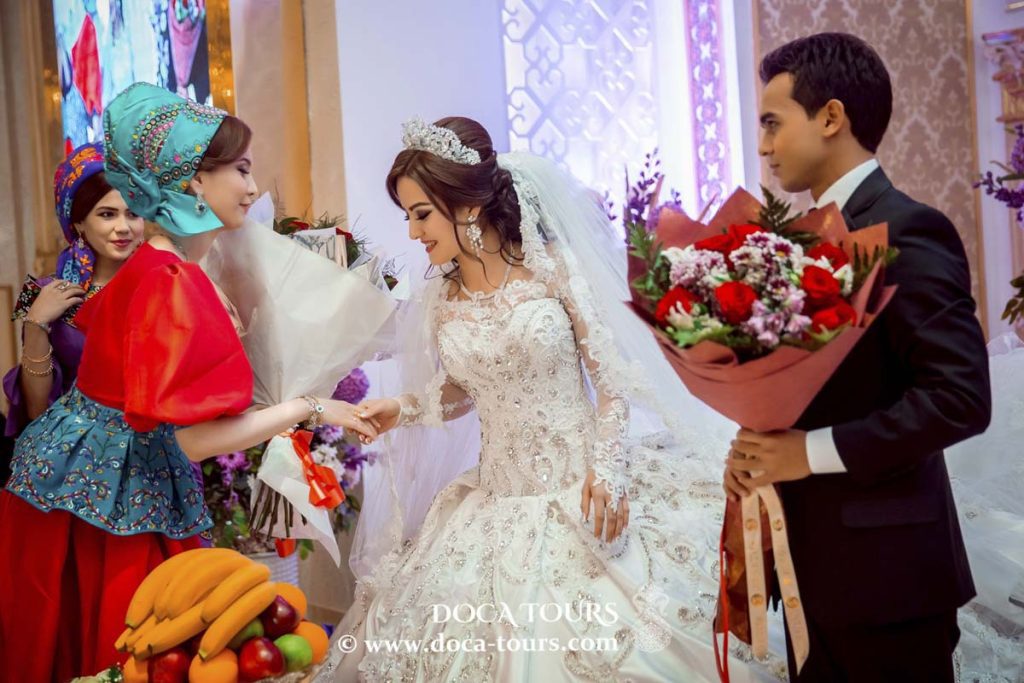
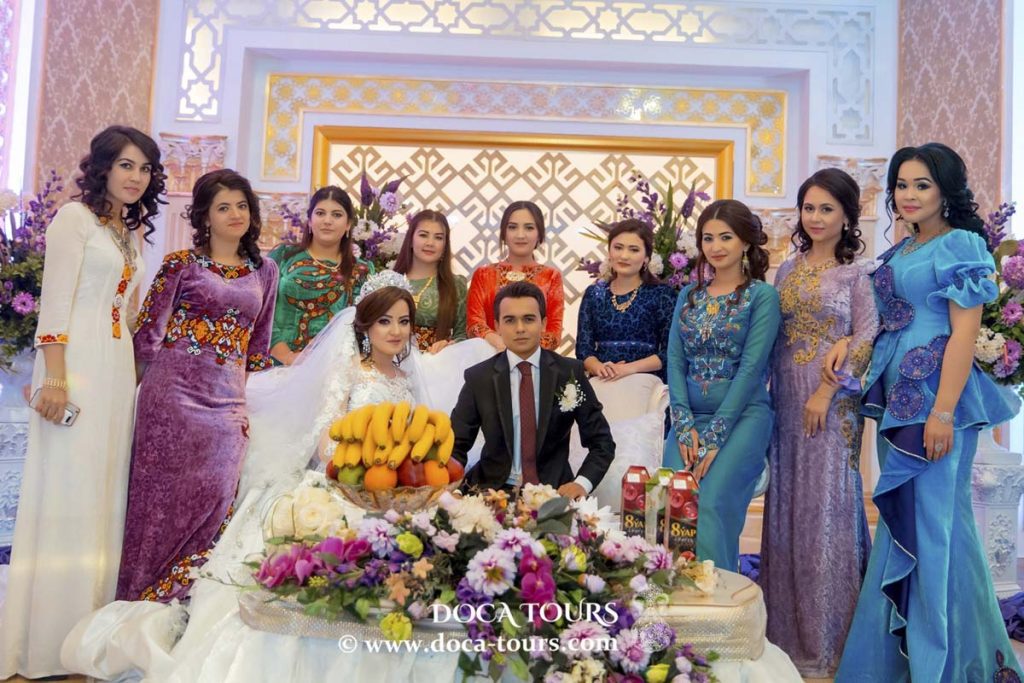
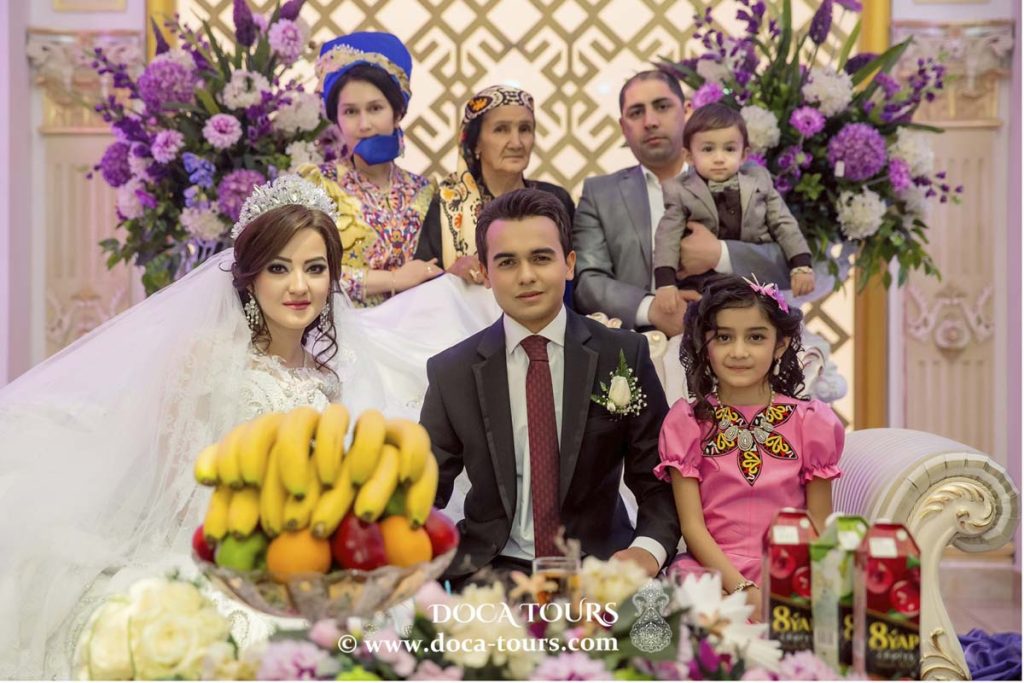
The wedding celebration begins in the evening, no earlier than six o’clock. All relatives of the groom and the closest members of the bride’s family are invited to “Toy-Merkany” (special restaurant). The total number of guests can reach from 500 to 1000. The more people at the wedding, the further the message of the hospitality and generosity of the organizers will be spread. The restaurant also welcomes the showman, DJ, singers and dancers who perform for the guests.
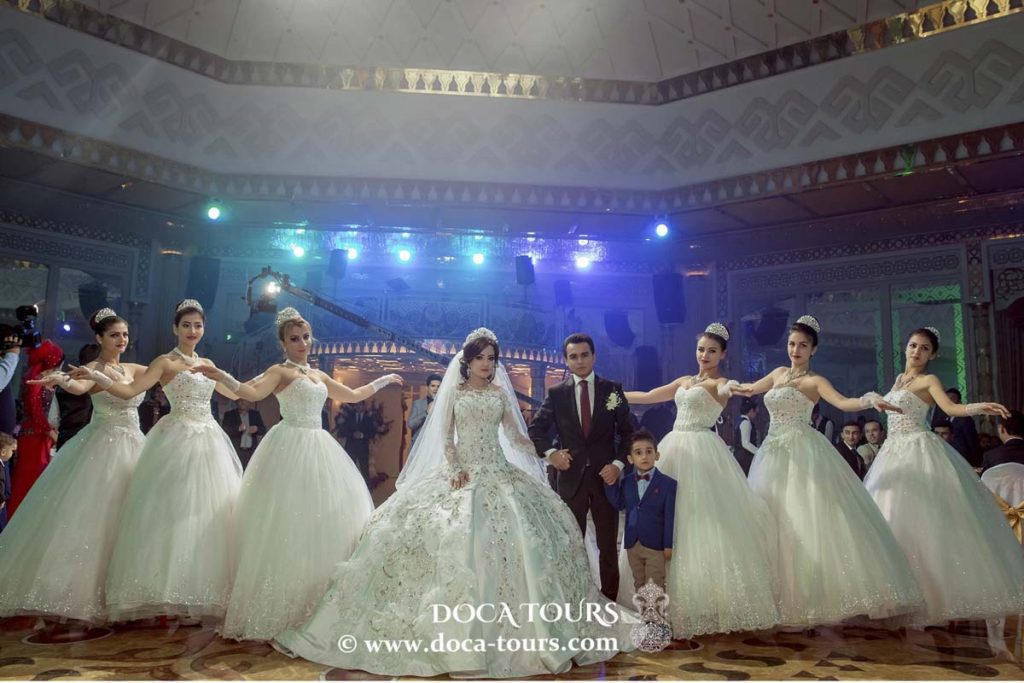
For the evening celebration, the newlyweds mostly wear European clothes. The groom is in a black tailcoat, the bride is in a white dress with a veil. In the meantime, the guests are having fun, dancing, singing songs, arranging various contests and competitions. The music sounds as loud as possible so that people in the most remote corners of the city know where the celebration is and join in. It is very important that all the free spaces on the tables are filled with treats.
The official registration of marriage may take place during the day festivities or during the evening celebration. A staff member from the registry office is invited to do this, who, in front of all the guests, will officially register the marriage of the newlyweds.
The wedding cake awaits when the groom and the bride will cut it and first of all they will treat their parents, and then all the guests. This is a kind of new ceremony that symbolizes respect for parents and guests.
Thus, the celebration of the wedding with cheerful songs and dances lasts until almost midnight. Then, the young are usually sent home, the guests continue to celebrate. The couple is accompanied by close friends and relatives often peer friends (classmates or groupmates).
Upon arrival home, the bride again changes her clothes into a national wedding costume and is tested in the presence of relatives, and friends of the groom from among young men, women, boys, girls and others. She has to untie the gushak belt of the groom (gushak chezdurmek), take off his shoes (edik chykartmak), a robe (don chykartmak), and a hat from his head (telpek chykartmak). The guys who present at this ceremony prevent the bride from untying her gushak, taking off her shoes and hat. In this case, the groom’s yenge usually comes to help. She also helps the bride if she alone could not cope with untying the groom’s belt, taking off shoes and hat. When the rite comes to the end, according to custom, the groom expels all those who present at this rite, “beating” them with a belt, previously it was a whip. With the help of these ritual actions, on the one hand, the bride was subjected to certain tests for maturity, intelligence, dexterity, skill, and on the other hand, it was tested how brave, strong, courageous and clever the groom was in front of his future wife.
Today we have told you only about some of the wedding traditions of the Turkmen people, but even based on this, we can confidently say that Turkmen weddings are the most colorful, the most sincere and the warmest.
We wish you all the best. See you on the next releases. Bye Bye
Thank you very much for your attention.
Subscribe to the channel and don’t forget to like our videos.
#traditional, #culture, #ethnic, #beautiful, #asia, #wedding, #woman, #asian, #dress, #costume, #ornament, #young, #female, #dance, #people, #turkmen, #celebration, #portrait, #national, #jewellery, #caucasian, #kazakhstan, #almaty, #tatar, #sholpy, #astana, #kyrgyz, #love, #kyz, #baursak, #uzatu, #playing, #tajikh, #steppe, #saukele, #dombra, #chinese, #uzbek, #nauryz, #kazakh, #uzbekh, #korean, #tajic, #latino, #japanese, #kamajay, #kamazhai, #thai, #red, #fashion