


























Video: https://www.youtube.com/watch?v=bJxm-Xs0u8M
In 1802, the Jews of the Belarusian city of Shklov received a letter written in Hebrew [hi:bru:] from unknown address. The letter read:
“Peace and blessings to the entire Jewish community. I am sending you greetings. I heard from the Bukhara merchants that a lot of Jews live in the cities of Russia. Here ‚in Kizil-Gar‚ we do not know which Jews you come from. For our commercial affairs, we need to be in Russia, but we heard a rumor that our coreligionists are very much oppressed and persecuted there. If you believe that we will not bear harassment and loss, then please notify us.
Peace to you, to all your children and your loved ones. He who calls upon Israel a blessing – Benjamin Set.
Shklov’s Jews responded to this letter also in Hebrew – “to our fellow believers and faithful servants of the Most High”:
“How surprised we were, having received greetings from the Jewish brothers from a distant land, who did not inform us about their place of residence and about their country, so we do not know whom to answer. Even though the city of Kizil-Gar is mentioned in the letter, we do not know in which country it is.’’

After a long search we found your country and the surrounding lands: this is Bukhara – Big and Small, bordering on the east with China, from the south – with the country of the Great Mogul, from the west – with the Caspian Sea, and from the north – with Sungari and Kirghiz-Cossack steppes.
Come to us, blessed by God, and we will be honored to see you. May the Almighty save you from all fears and horrors, and together we will thank Him”
Because of their long-suffering history, Jews have lived almost in all corners of the world. Constant conquests, persecution and oppression forced them to migrate, adapt and take root in new lands and in new cultures. Jews have lived in Central Asia since ancient times. This subgroup is also called: “Bukharian Jews”.
Bukharian Jews are one of the most ancient communities, formed over 2 thousand years ago. They are representatives of the Sephardic sub-ethnic group of Jews.
In Central Asia, Jews appeared already in the first centuries AD. , however, due to the lack of written sources, the only material about their life in the antique period is oral stories preserved in Jewish families. The earliest written information about Central Asian Jews dates back to the 12th century and belongs to “Benjamin of Tudela”, who visited this region in the Middle Ages. Detailed references are also contained in the works of European scientists and travelers of the 18th-19th centuries, such as: Vambery, Eversman, Khanykov, Meyendorff and others.
One of them tells that the first Jews in Central Asia appeared even before the city of Bukhara, more than 2500 years ago. Achaemenid ruler – Cyrus the Great in the 6th century BC conquered Babylon and allowed the captive Jews to return to their homeland – Judea. However, some of them decided that it would be safer for them to stay in Persia. Thus the Persian Jews appeared. Subsequently, through Persia, they moved to the cities of Central Asia.

Scientists’ hypotheses also differ, but almost all of them are close to each other. It is believed that the ancestors of Central Asian Jews moved here from Persia. The settlement of various regions of Central Asia by Jews did not occur simultaneously, but lasted for centuries, and with unequal intensity. Having found themselves on the territory of Iran during the period of the so-called Assyrian captivity (VI century BC), the Jews gradually settled the neighboring territories.
It is necessary to take into account the fact that the Central Asian regions had long been in the possession and under the influence of various Persian empires, and the Jews dependent on the Persians, perhaps forcibly or voluntarily moved to Bactria and Sogd.
It is said that ten Jewish families were the first to move to Bukhara, who were skilled dyers that gradually created a separate industry in the Bukhara Emirate – workshops for dyeing fabrics and yarns.
Jews successfully adapted in Central Asia, fully assimilated the culture and languages of local people. The native language of the Bukharian Jews became their own dialect, based on the Tajik language.
The position of the Jews in the Bukhara Emirate was not always prosperous and comfortable. They often met with all kinds of persecution and oppression. There was a whole list of rules and regulations that only concerned Jews.
Bukharian Jews had to pay a special tax for the preservation of their lives and the right to practice their religion. Moreover, at the time of the presentation of this tax, the Jew, who gave money to officials, received two slaps on the face. But, according to some historians, these slaps could also be paid off with the help of a separate tax.
In Bukhara, Jews were forbidden to ride horses, at most donkeys. If a Muslim walked towards a Jew, he had to bow before him and let him pass, otherwise he could be punished by beatings for disrespect.
They were forbidden to wear silk clothes and gird themselves with traditional scarves. They had to gird themselves with a rope, wear fur hats instead of turbans, so that every Muslim could see that he was a non-believer.
Despite the discriminatory laws, the Diaspora of Bukharian Jews developed rapidly, being intensively engaged in trade and many types of crafts.
In the beginning of the 20th century, only in Bukhara lived about 8000 Jews, which made up 12% of the city’s population, and, voluntarily, they never assimilated with the local population and practiced their own religion.
But history knows facts that at different times and under different rulers, Bukharian Jews were forced to accept Islam. In Central Asia there were entire settlements of forcibly converted. They were called “chala”, which is translated from Tajik as: “defective.” These people lived in isolation, in separate quarters that chose their wives only among their own. Officially they professed Islam, but secretly observed the laws of Judaism. In the 19th century, the Chala community grew due to a new wave of forcible converts, and some of them would rather die than renounce their faith.
After the conquest of Central Asia by Tsarist Russia, the Russian Tsar recognized the Bukharian Jews as equal, along with all other people in the Turkestan General Government.
The legal inequality of Central Asian Jews was eased. They were allowed to buy houses and settle in the new part of Samarkand, Tashkent, Kokand and other cities.
This was the heyday for Bukharian Jews. They owned factories, ginning workshops, distilleries in various cities of Central Asia.
It was at this time, in the end of the 19th century, that the term “Bukharian Jew” appeared in official Russian documents. This was the name given to the Central Asian Jews who were subjects of the Bukhara Emirate – territories that were vassals of the Russian Empire.
After the October Revolution of 1917, the liquidation of the Bukhara Emirate, and the national demarcation in Central Asia, the term “Bukharian Jew” became generally accepted for all local Jews, regardless of their place of residence.
At the beginning of the Soviet period, the Central Asian Jews of Uzbekistan were first designated as: “maida millat” (small nation), and later they simply ceased to distinguish them into a separate subgroup and in the statistical data of subsequent censuses they were included in the column: “Jews” together with European Ashkenazi Jews.
The traditional and monopolized sphere of activity of the majority of Central Asian Jews was the dyeing craft. When in the late 19th – early 20th centuries cheap fabrics from Russia began to be imported to the Central Asian market in large quantities, the local dyeing craft became unclaimed.
Among the Central Asian Jews were skilled jewelers, shoemakers, tailors, hairdressers, doctors. There were famous musicians and dancers who performed at feasts not only in their own community, but also among Muslims. The best of them became the Emir’s court singers and musicians. Women worked as laundresses, cooks for wealthy Muslims. There were many merchants among Central Asian Jews – from small peddlers and hawkers to large entrepreneurs.
In the cities, Central Asian Jews worked in silk-weaving, textile, garment factories, in cotton ginning, oil mills, ditch and brick factories, as well as in handicraft artels.
The traditional form of settlement of Bukharian Jews until the 1920s were mahallas (quarters) with kenisso – a synagogue, mikvah – ritual ponds, baths, own bazaars and cemeteries. There were religious schools at synagogues. Social life was revealed in the compulsory attendance of all men, starting from the age of 13, to the synagogue, where meetings were held to discuss various issues related to the community. They elected foremen (kalontars). Also various ritual ceremonies were held and refreshments were arranged here.
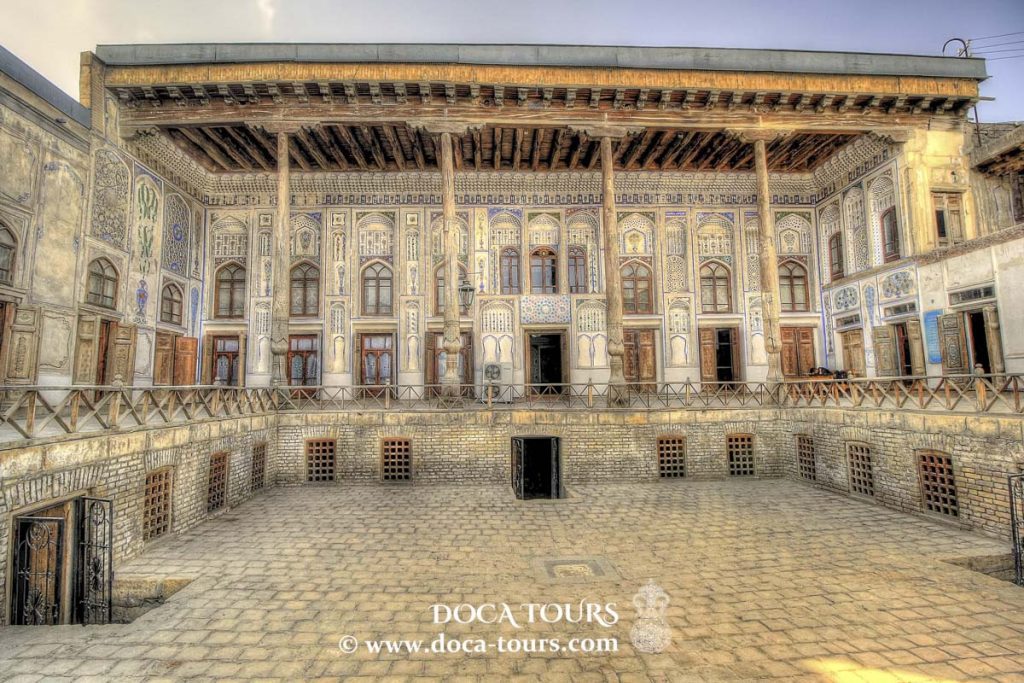
The houses of the Central Asian Jews consisted of residential and household parts located along the perimeter, usually small courtyards. The blank walls of houses with small gates overlooked the street. Guesthouse (mehmonhona) was the most elegant room in the house, often serving as a living room and synagogue. In the houses of the rich people, in front of the guesthouse, a high verandah (aivan) with wooden carved columns and painted ceilings was arranged.
Since the end of the 19th century, the houses of large entrepreneurs in Central Asia were built according to the European model. And today, some Bukharian Jews live in solid houses, inherited from their ancestors, which were built with very high quality.
For example, in Samarkand, in 1894, Jews owned 47 houses in the center of the city, in the so-called “Russian part”. At that time, the cost of the house exceeded 1,500 rubles. To compare this price with the present, one can mention that: 1 kg of meat then cost 10-12 kopecks, and one cow cost 9-10 rubles. The average worker’s salary was 4-5 rubles per month. Thus, it becomes clear that only rich people could afford to buy or build a house.
The most striking example of the houses of the rich Jews of Samarkand is the luxurious mansion built in the beginning of the 20th century, in which none other than the last Tsar of the Russian Empire, Nikolay II, was supposed to stay.
An old two-story house made of baked bricks, where the Samarkand Regional Museum is located today, was built at the expense of the merchant of the first guild Abram Kalontarov, one of the wealthiest people in Samarkand of that time. Only for the construction and decoration of the living room was spent 16,000 rubles in gold, and the total cost of building of the mansion cost Kalontarov 130,000 gold rubles, which was considered an incredible amount in the realities of that time.
The style of the mansion harmoniously combines European and Eastern architectural traditions. The house was built by the Russified Austrian architect Otto Nee and the interior was created by the leading architects of Samarkand.
In 1916, the mansion of the merchant Abram Kalontarov was ready. Such “royal” luxury in the construction of the mansion was due to the following fact. Abram Kalontarov knew that the Emperor of the Russian Empire Nikolay II was going to make a trip along the Trans-Caspian railway and visit Samarkand as well. The merchant planned to invite the king to his home and that is why he conceived the construction of this unique mansion. However, the king was not destined to see this house, the First World War began in 1914, and then, as we know, other events followed that prevented the king from making this journey.
In the 20s of the last century, A. Kalontarov signed a dedication to transfer the building to the new Soviet government. From 1925-30, when Samarkand was the capital of the Uzbek SSR, government offices were located here, and from 1981 to the present, the expositions of the regional local history museum are located in this unique house.
Other examples of such houses are:
A two-storey house, built in 1913, with a facade in the classic Empire style, located today on Jami Street. Currently, a kindergarten is located in this magnificent mansion of Pinchas Abramov.
Pagiel Leviev’s sons owned houses in the new city. The most striking of them was the mansion on today’s Shohrukh Mirzo Street (opposite the former cooperative institute), where a printing house named after Morozov functioned for many years in Soviet times, and now it houses political and public organizations.
Shalomo Sofiev owned the best hotel in the city, the Grand Hotel, located on Mirzo Ulugbek Street.
Several houses in the Russian part of the city belonged to the merchant Natan Isaakovich Iskhakov. In 1914 the Iskhakovs owned a huge house located opposite the Grand Hotel. Today the city’s architecture department is located there.
David Kalontarov owned a grand mansion, which now houses a branch of the National Bank on Firdavsi Street.
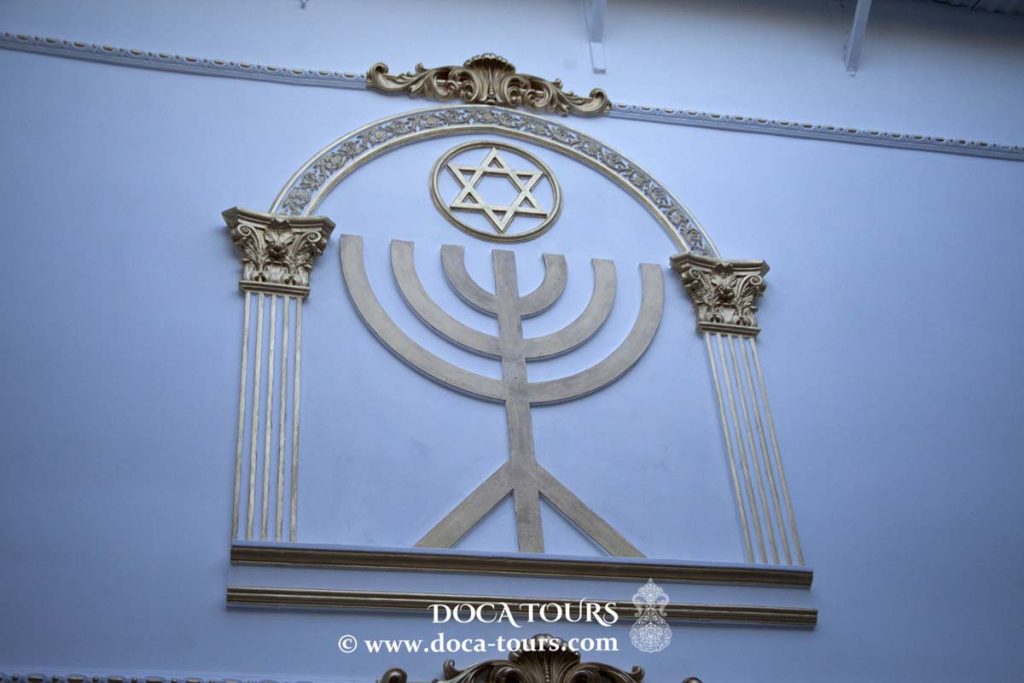
Many luxurious houses were also built in Bukhara by Bukharian Jews, the oldest of them dates back to the second half of the 19th – early 20th century. On the inner walls of houses, one can see preserved inscriptions in Hebrew, the dates of construction, and the names of their owners. Typical symbols were the “Star of David”, a hamsa (an amulet in the shape of a palm) and a mezuzah (an excerpt from a prayer on parchment, placed in a case) – fixed on the doorposts of doorways. The ceiling beams have been decorated with beautiful carvings and decorations.
A good example is the house located on Sarafon Street, built in 1900. A couple of years ago, it was restored with the help of UNESCO specialists. The features of the houses of the Jewish quarter have been preserved here. Architect Zoya Arshavskaya (Jerusalem Hebrew University) recalls: “When you enter a house from the street, you find yourself in a dark space, from where you go up a narrow staircase to a courtyard with a hatch in the center – this is to illuminate the lower floor.” Now it houses a restaurant.
Another one, today, has been rebuilt as a private hotel “Lyabi Khauz”. This house belonged to Mirzo David, was built in 1900 and is lined with baked bricks. Like in other houses, the living room served as the family synagogue. The lower floor in such houses served as a refrigerator; above it there was a courtyard, bedrooms, a kitchen, extra rooms and a living room (mehmonkhona).
Other examples of beautiful houses of Bukharian Jews are: hotel Komil Boutique, hotel Sasha and Son and others.
There are some buildings in Tashkent and Kokand too, that belonged to Bukharian Jews.
In 1905, at one of the central crossroads of Kokand, a large, luxurious house in modern style was built by the architect G. Svarichevsky. The house belonged to millionaire merchants, the famous Vadyaev brothers. Today, this building houses the government’s office of Kokand.
Another mansion where the Simkhaev family lived in Kokand has also survived; it now houses the Oil Industry College.
In Tashkent, the famous buildings are the passage of the Yaushev brothers not far from the former Central Department Store, opposite the Opera and Ballet Theater of Alisher Navoi and the building of the republican library, which was also built by the Vadyaev brothers.
During the Soviet period, there was a new cultural development of the Central Asian Jews. Since the 1920s a native Jewish national bureau was functioning. The Jewish Pedagogical Institute, which trained teachers for the regions where Jews lived; there were specialized Jewish educational institutions: 10 schools, 4 preschool institutions, 2 labor schools, 3 boarding schools, 6 workers’ clubs, 3 libraries. Over time, a significant stratum of the intellectuals of Central Asian Jews was formed, employed in almost all spheres of education and culture (teachers, engineers, doctors, musicians, singers, actors). One of the most famous Jews who made a public career was A. M. Abdurakhmanov, who was the Minister of Justice of Uzbekistan (1930s).
In the 1930s many books were published in the Bukharian-Jewish language. A whole galaxy of musicians, artists and composers emerged from the diaspora of Central Asian Jews, for example, artists Emanuil Kalandarov and Yuri Elizarov, musicians Ilyas Mallaev and Mukhabbat Shamaeva, as well as the world famous ensemble from Bukhara “Shashmakom”.
After the collapse of the USSR, there has been a sharp decline in the diaspora of Central Asian Jews. This is due to the fact that the “iron curtain” fell, and people were able to move freely.
In 2000, the number of Bukharian Jews in Central Asia did not exceed 3500 people. But communities of Bukharian Jews still exist in large cities of Central Asia, the largest of them are: in Bukhara, Samarkand and Tashkent.
A significant number of Bukharian Jews emigrated to Israel, the USA, Germany, Austria and other countries.
Today, the largest community of Bukharian Jews in the world lives in Israel – about 150 thousand people. About 60 thousand Bukharian Jews live in the United States and Canada, 50 thousand of them in New York – this is the second largest diaspora of Bukharian Jews in the world.
Although the Bukharian Jews, today, almost completely left Central Asia, they will forever remain in the history of this region. Their culture and traditions will remain an integral part of Central Asia. And they, in turn, do not forget their historical roots and often come to honor the memory of their ancestors who are buried in this land.

Thank you very much for your attention.
Subscribe to the channel and don’t forget to like our videos.
#religious, #uzbek, #jews, #old, #asia, #medieval, #synagogue, #heritage, #history, #tombstone, #religion, #stone, #prayer, #travel, #fence, #bukhara, #grave, #bukharan, #memory, #judaism, #city, #jewish, #monument, #selective focus, #selective focus on, #graveyard, #central, #architecture, #cementary, #memorial, #cemetery, #europe, #jew, #uzbekistan, #necropolis