

























Ulugh Beg’s Treasure. It is neither gold nor jewels, but an immense library of rare books and manuscripts. However, this priceless treasure, mysteriously lost after Ulugh Beg’s death, remains undiscovered to this day.
The search for Ulugh Beg’s library began when the Russian army conquered Samarkand. In 1869, Alexander Kun, a Russian orientalist and special envoy to the Governor-General of Turkestan, initiated the search for the library within the city. In his report, he mentioned that he was searching for a repository of books beneath the ruins of a massive minaret. Why did the scholar focus his search there? Were there historical clues indicating where the treasure might be hidden?
Alexander Kun likely based his search on the works of an Armenian historian from the era of Amir Timur. These records mentioned that Timur “gathered all the Armenian and Persian books and sent them to Samarkand, storing them in a tower. Anyone who dared to remove a book from the repository faced the harshest punishment.”
Thus, the library we call Ulugh Beg’s treasury was actually founded by Amir Timur. After the death of the Sahib Qiran, this library, containing rare books and manuscripts, was inherited by his grandson Ulugh Beg, who enriched it with new additions.
Many legends surround the library. According to one, Amir Timur filled a tall minaret with valuable books he brought to Samarkand. Another legend states that during an earthquake, the minaret collapsed, leaving the ruler’s treasure of books buried beneath the rubble.
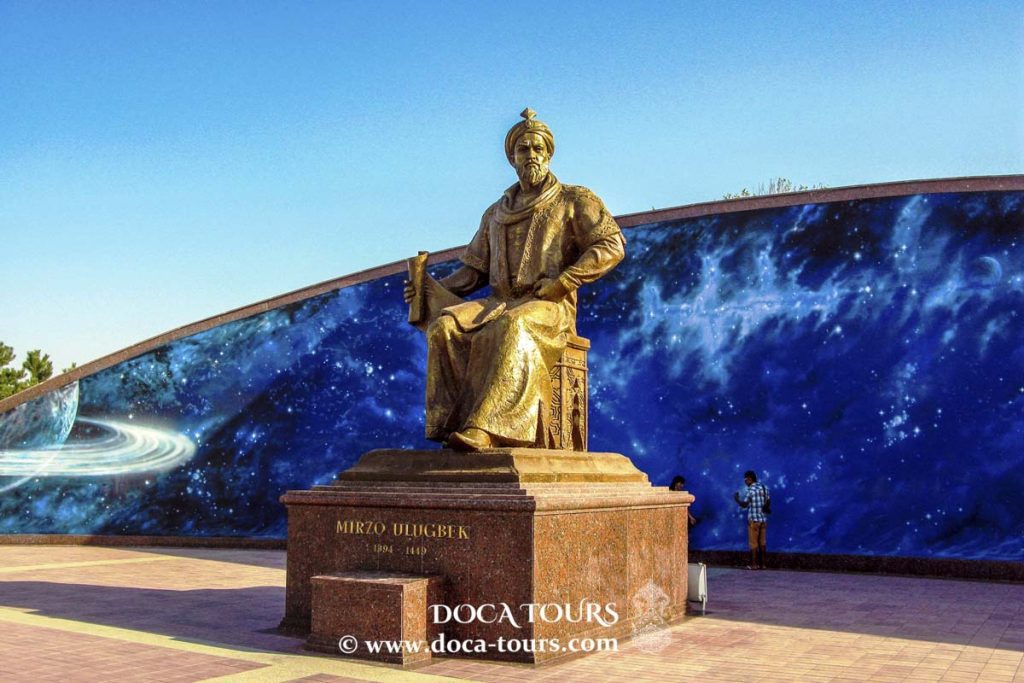
There is credible evidence that the library truly existed. Ulugh Beg’s student, the mathematician Ali Qushji, wrote in the preface to his Treatise on the Science of Arithmetic: “I wrote this work for the library of the greatest and most noble Sultan Ulugh Beg Guragan.”
Although Alexander Kun’s efforts to find the library were unsuccessful, he continued to believe in the existence of Ulugh Beg’s treasury. Scholars have never doubted the library’s reality. The only question that remains is whether it has survived to the present day.
In 1889, the English writer M. Wallace also attempted to find the lost library of Ulugh Beg, but his efforts were fruitless as well. Before him, renowned European scholar-travelers like Vambery and Schuyler had also sought the books.
What kind of books were stored in this library that captivated so many scholars? According to the Armenian historian’s records, Timur brought back not only treasures from his campaigns but also rare books. Considering that Timur’s empire included regions like Iran, Iraq, Turkey, Syria, and India—home to ancient civilizations like Persia, Assyria, and Babylon—one can imagine the priceless manuscripts he might have brought back.
Sources suggest that the emir’s library contained chronicles, legends of the world’s peoples, books of Indian magicians adorned with fish scales, papyrus scrolls, Babylonian clay tablets, and thick folios with diamond clasps. There were also scientific and artistic works, as well as medicinal recipes.
However, after Ulugh Beg’s tragic death, the library vanished without a trace. What happened to the treasures that Great Timur left to his grandson? Where could it be?
After Ulugh Beg’s death, many scholars and poets fled Samarkand. Ulugh Beg’s closest disciple, Ali Qushji, also sought to leave the capital but was initially detained. Only 20 years later did Ali Qushji return to his homeland in Turkey, to the city of Istanbul. He took with him mainly the scientific works of his teacher, which allowed Europe to learn about the scholar and astronomer Ulugh Beg.
The fate of the library is closely linked to the name of Ali Qushji. It is believed that when reactionary forces indifferent to science came to power, Ali Qushji hid the library. Of course, it would have been impossible to smuggle such a large collection out of the capital unnoticed. Therefore, scholars assume that the library was hidden somewhere within the city or its surroundings.
Another Theory. According to the assumptions of the researcher of Eastern manuscripts, Fakhriddin Marufi, Ulugh Beg, on his way to Mecca, understood that he would not return to Samarkand and wanted to dedicate the rest of his life solely to science. For this, his library was essential to him. Moreover, Ulugh Beg did not believe that the library would remain safe in the capital.
Before leaving Samarkand, he instructed his loyal disciple to secretly remove a caravan of books from the city under the cover of night and head toward Shakhrisabz. The plan was for Ali Qushji and Ulugh Beg to meet in Shakhrisabz and then continue their journey to Istanbul. At that time, Istanbul was considered a major scientific center, and a scholar like Ulugh Beg would have been received there with great honor. However, the meeting between teacher and disciple never occurred. Ali Qushji, waiting for Ulugh Beg in Shakhrisabz, learned of his teacher’s tragic death. The ruler was assassinated, and the political situation was unstable. Understanding that he could not continue his journey without resources, Ali Qushji, after hiding the library somewhere near Shakhrisabz, returned to Samarkand.

But what is the basis of Marufi’s hypothesis? Why does he believe that Ulugh Beg’s treasures are hidden in Shakhrisabz?
Over the years, the library of Eastern manuscripts has received several hundred unique books from residents of Shakhrisabz, Kitab, and especially from the village of Bashir. The origins of these books remain unknown. This theory might deserve attention as it aligns with other assumptions suggesting that Ulugh Beg’s library should be sought in these areas, about 70 kilometers from Samarkand.
Local historian V. Ratzek, in his book, proposed that Ali Qushji, along with the caravan of valuable books, hid in the village of Bashir. While speaking with locals, the historian noted a story told by an elderly man. The man recounted an incident he had witnessed as a child: while digging a hole for a barn, adults encountered a large flat stone about two meters deep. Upon moving the stone, they discovered an underground passage. Inside were various chests, large bags, and several scrolls. Fearing that they might bring misfortune upon the village, the elders replaced the stone and reburied the site. However, when expedition members later searched the indicated spot, they could not find the underground passage.
There is another hypothesis about the lost treasure: it might have been hidden in one of the underground tunnels of Samarkand. While these tunnels are not yet well studied, this version cannot be ruled out, especially considering that Ulugh Beg stayed at the Kuk-Saray Palace before leaving for Mecca.
Elderly residents of the city have said that underground tunnels 2-3 kilometers long extend from the palace. Historian A. Kuzmichev discovered entrances to two such tunnels leading to Timur’s palace. However, the entrances are heavily obstructed, making access impossible.
To this day, scholars remain divided in their opinions about Ulugh Beg’s treasure. Some believe that the rare library did not survive and that after Ulugh Beg’s death, the books were simply scattered.
Yet we continue to hope for its existence. Every piece of land in the ancient and eternally vibrant city of Samarkand is a witness to its deep history. Samarkand hides countless secrets in its depths, and one day, to everyone’s amazement, Ulugh Beg’s great treasure might emerge from its hiding place.
Thank you very much for your attention.
Subscribe to the channel and don’t forget to like our videos.
#ancient tomb, #samarqand building, #mosaic wall, #mosque, #muslim pattern, #no people night, #old necropolis, #open door, #outdoor tourism, #persian ornament, #samarkand vilayat, #shah-i-zinda, #middle east, #shakhi zinda, #sherdor madrasa, #shohizinda, #silk road, #stone, #symbolism, #tillya kori madrasah, #timurid, #ulugbek madrasasi, #uzbekistan architecture, #arabic design, #monument, #medieval religion, #mausoleum attraction, #blue, #cemetery landmark, #central asia, #ceramic, #colorful style, #culture, #decorative doorway, #destination, #dome, #entrance gate, #facade, #famous art, #geometric exterior, #heritage, #historic travel, #history, #holy light, #islam tourist, #islamic city, #living king, #majolica element, #registon square, #uzbek