






























Video: https://www.youtube.com/watch?v=o7GMWqkFero
Recently I was invited to a morning pilaf (in Uzbek Nakhor Oshi) in a small village located not far from Samarkand. I went to this family celebration readily and decided to shoot everything on video and share my impressions with you.
As you know, Uzbek weddings are distinguished by their special centuries-old traditions and customs. Uzbek weddings are also known for their pomposity and large number of guests.
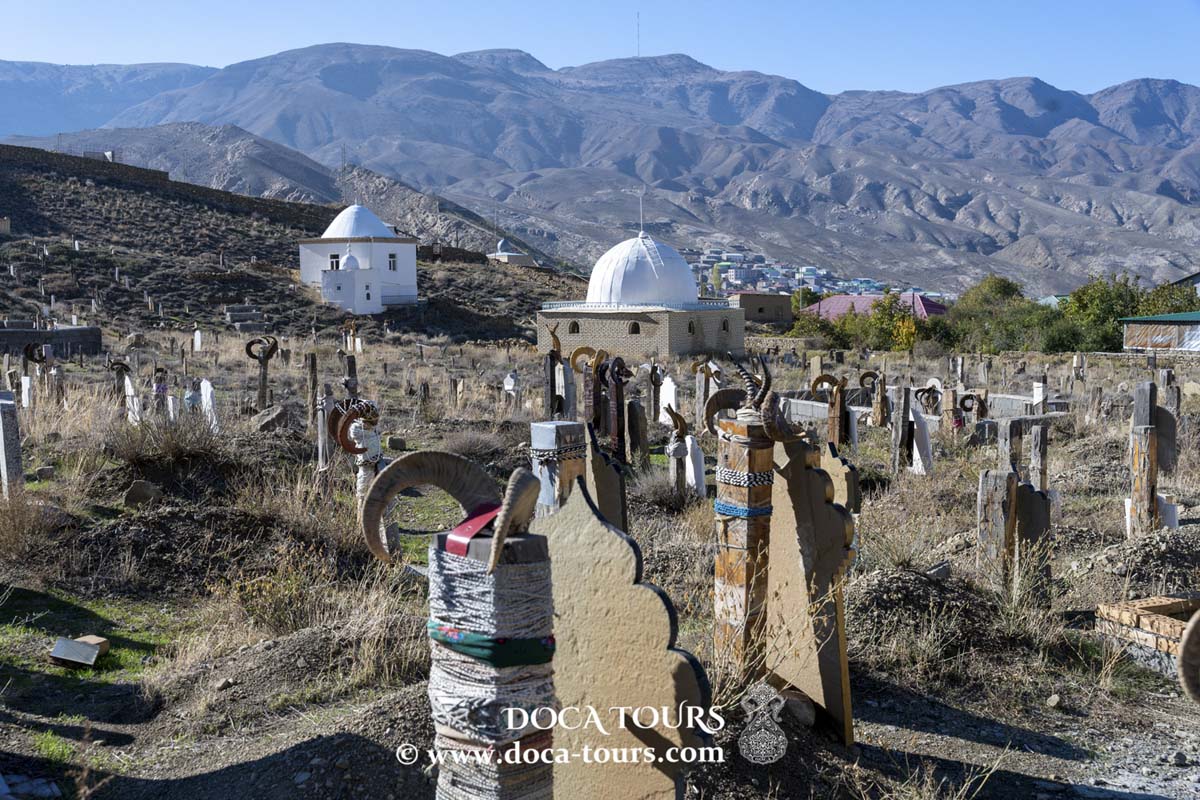
However, this celebration seemed especially exotic to me, since it took place in a special mountainous area known throughout the country. A famous pilgrimage site – Khazrati Dovud cave is situated in this village. According to legends, Khazrati Dovud is the very King David, who is recognized in three religions: Judaism, Christianity and Islam.
It is believed that Saint David ruled in ancient Israel, the capital of which was Jerusalem, for forty years. He died at the age of seventy.
Saint David is also considered the founder of blacksmithing. According to the legends, being a blacksmith, Saint David had only to touch the iron, as it became malleable, and he had only to give the iron the necessary shape. At the sight of such a miracle, people believed that in front of them stood a real prophet.
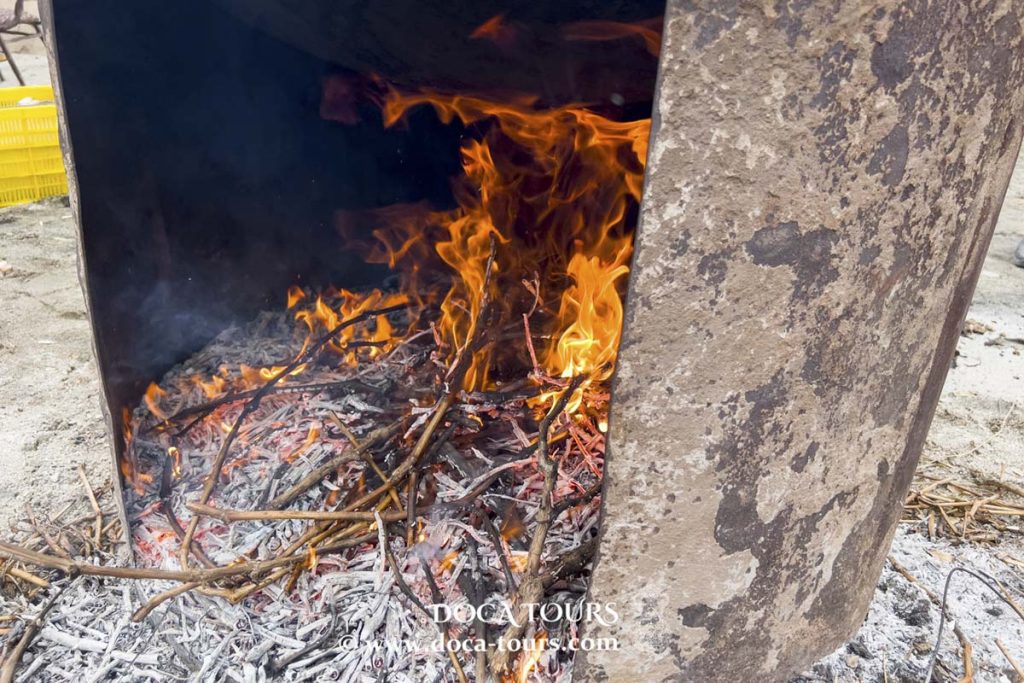
To this day, people professionally associated with iron (drivers, locksmiths, assemblers, railroad workers, etc.) visit the cave of St. David in the vicinity of Samarkand to receive a blessing from him.
Place of pilgrimage, St. David’s Cave, is located near the villages of Aksai and Mekhnatkash, Nurabad district, Samarkand region. It is about 40-50 kilometers from the city of Samarkand.
This cave is located at an altitude of 1200 meters above sea level in the spurs of the Turkestan and Zarafshan mountains. Since ancient times, these surroundings have been shrouded in many legends that have passed down by local people from generation to generation. Pilgrims and travelers have always come here with requests for healing from diseases and fulfillment of their wishes. According to unofficial data, about one hundred thousand people come here every year.
Having reached the top of the mountain, you can see a small mosque for pilgrims. The holy cave itself is located on the opposite slope, where 200 steps lead down. And yet it is not easy to climb more than one thousand three hundred steps. Here you can often observe how the elderly or senile people go upstairs on donkeys or horses.
The length of the cave itself is approximately 50 meters, the width varies from forty centimeters to four meters, and the height starts from one and a half and reaches 17 meters.
But let`s go back to the main topic of my issue: Nakhor Oshi – morning pilaf.
Among Uzbeks and Tajiks, this tradition is one of the components and the main family celebrations, such as: Sunnat-Tuy – celebration on the occasion of the circumcision of a boy, Fotikha-Tuy – engagement and Nikokh-Tuy – marriage.
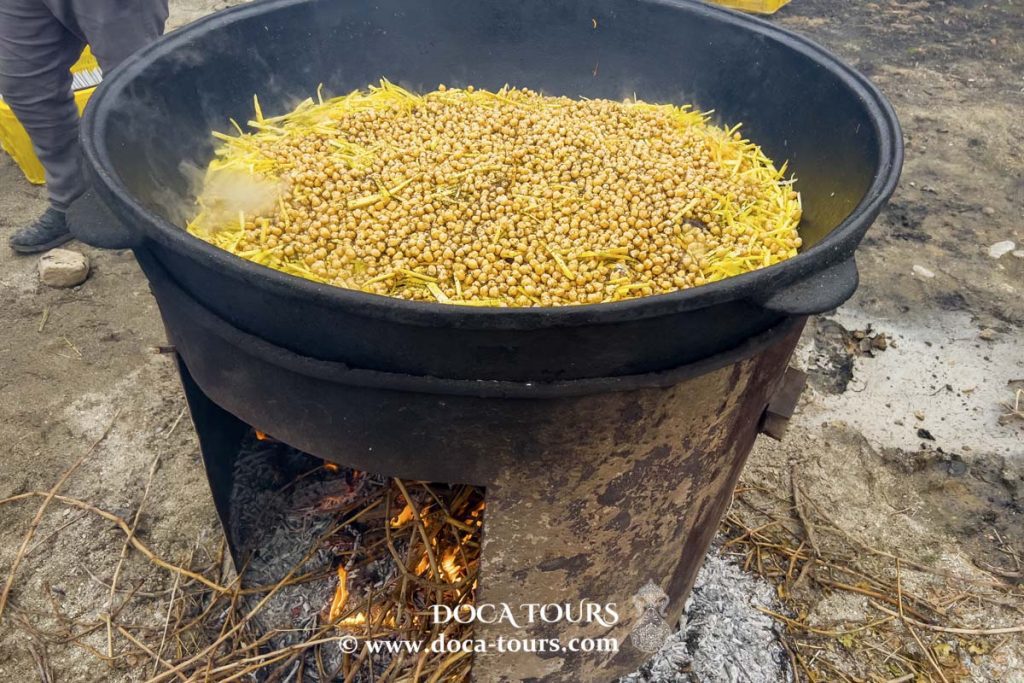
In fact, Nakhor Oshi or Morning Pilaf is arranged for men: close relatives, friends, acquaintances, colleagues of the parents of the heroes of the occasion. Usually women are not invited here. Newlyweds are usually not seen here either. At this time, they are busy preparing for the wedding party. The groom goes to the barber and makes a special hairdo, the bride spends several hours in a beauty salon and picks up a white dress.
At this time, from the very dawn, pilaf is served for hundreds of men.
In each region of Uzbekistan and Tajikistan, the Nakhor Oshi tradition is organized differently. For example, in Tashkent and Samarkand, Nakhor Oshi is usually arranged for several hundred men in special large restaurants – Tuikhona, which look like palaces from inside and outside. Folk music sounds here. Those invited come to pilaf in large parties, congratulate the father of the family, which is celebrating one of the main family celebrations listed above. Guests usually give a small amount of money, eat delicious pilaf and leave. All this does not last long.
During Nakhor Oshi, dance music usually does not sound, alcoholic drinks are not served and, accordingly, no one dances. The men invited are usually over fifty years old. And those who participate in the Morning Pilaf are usually not invited to the main party, which is celebrated on the same day in the evening, where mainly young people, the closest relatives and women are present.
At family celebrations, Uzbeks and Tajiks usually have a lot of guests. Families are large, circles of friends and acquaintances too, because of this, Nakhor Oshi was apparently invented in order to divide the guests into groups. There used to be no restaurants for hundreds of guests, and the houses weren’t that big. So the tradition went: Nakhor Oshi – Morning pilaf for men, and the main party, on the occasion of a wedding or circumcision ceremony is in the evening. Thus, it was possible to calculate a place for everyone and at the same time not forget to invite everyone to the celebration.
Of course, in ancient times, men mostly did hard physical work, plowing fields, building houses, and so on. As you know, pilaf is a very high-calorie food consisting of rice, carrots and meat, prepared using a special technology. By the way, there are still special male chefs – Oshpazs, who cook hundreds of kilograms of pilaf for numerous guests.
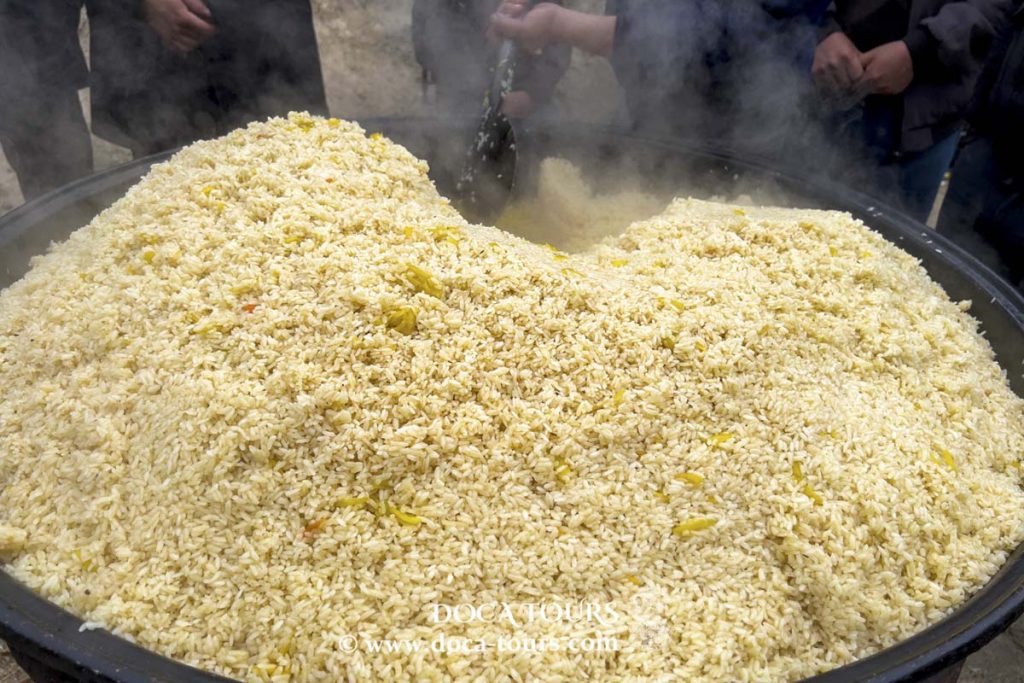
Morning pilaf, just suited the lifestyle of men. And pilaf itself was a delicacy. Not every day one could afford this “royal dish”. Having eaten pilaf right away early in the morning, the men gained strength for the whole day and recalled the hosts of the celebration with kind words.
As for the village where I was invited, here I found some differences in Nakhor Oshi, which are not typical for Samarkand and other large cities of Uzbekistan. Here, the event is celebrated at one`s own house, which significantly saves money. The entire organization of the ceremony involves family members, friends and neighbors – they are not paid anything for their work. Such an organization today is impossible in big cities, since everyone is working and no one has extra time.
The tables are nicely laid. Apart from the main courses, there were many snacks. Professional chefs have prepared two types of dishes: tui-kabob and pilaf. Tui kabob is a delicious dish where the main ingredients are lamb, beef, tomatoes and onions. These are stewed for many hours and tastes like a stew. The meat is very tender, the tomato is sweet, and the broth is divine.
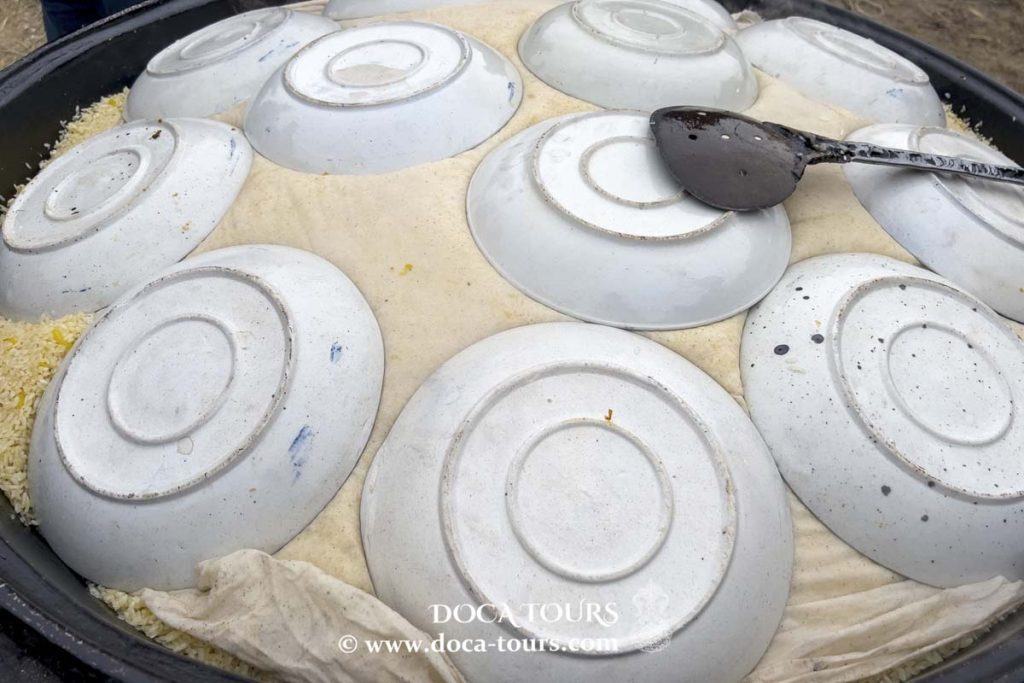
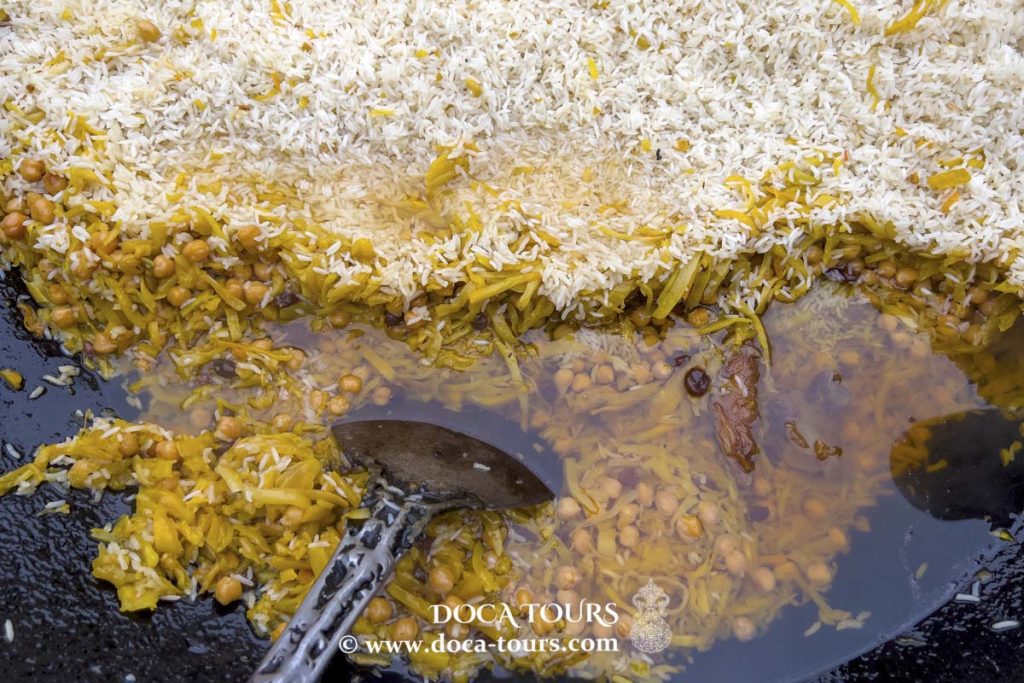
I will not talk for a long time about pilaf, as many of you are already aware of this “royal dish” of the Uzbeks, without which no ceremony and holiday takes place.
Just like in other regions, men come, eat treats and leave, but the celebration does not end so quickly. The musicians play not only folk music, but also dance music. Close relatives and friends stay longer and even dance. And what is completely uncharacteristic for Nakhor Oshi is that separate tables were laid for women and they were also able to take part in the treat and even start a dance. I personally liked this innovation.
After the main guests were seen off and the official part was over, the whole family is relaxed. Finally, they could sit down themselves and eat. The dancing began.
This made me very happy, as they could relax from all the stress associated with organizing the party. The holiday was a success!
Having visited this extraordinary mountainous place, I once again ascertained the beauty of Uzbek traditions and concluded for myself that apart from the similarity of ceremonies, there are also small differences in local traditions, which are the highlight of each region!
And finally, I would like to reveal one more feature of this celebration: on the tables in a box with the BOSS brand there is not perfume, but a forty-degree drink that unites people, distracts them from the routine of life and motivates them to merry dances!
Thank you very much for your attention.
Subscribe to the channel and don’t forget to like our videos.
#wedding pilaf, #samsa, #tashkent pilaf, #national pilaf, #uzbek pilaf, #shashlik, #cake, #wedding, #background, #beauty, #card, #culture, #invitation, #illustration, #design, #decorative, #flower, #banner, #pattern, #ornament, #lace, #baroque, #ornate, #vintage, #symbol, #frame, #template, #element, #decoration, #concept, #ramadan, #ottoman, #royal, #luxury, #print, #kazakhstan, #vector, #abstract, #traditional, #bright, #ramazan, #backdrop, #celebrate, #persian, #art, #laser, #graphic, #style, #muslim, #arabic