


























Video: https://www.youtube.com/watch?v=ILeOH1UQo6o&t=4s
Hello dear subscribers. We are glad to see you again on our channel. Today we will go on an exciting journey back in time to get acquainted with one of the most magnificent historical monuments – Guri Emir. Subscribe to our channel to not miss interesting videos about Central Asia. Let`s get started.
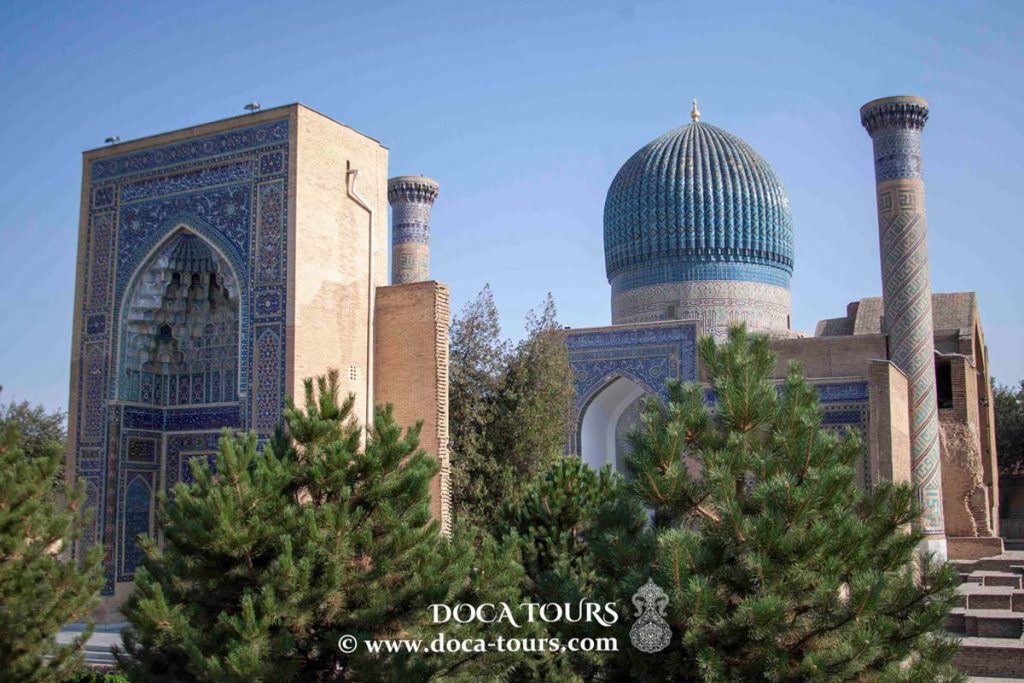
Located in the heart of Central Asia, Guri Emir is one of the most significant and impressive places on our planet. It is the final resting place for Timur, the great conqueror and ruler of the Timurid Empire. Guri Emir was built in the 15th century and is considered one of the most significant architectural masterpieces of Central Asia.
The construction of the mausoleum in Samarkand was started by Timur’s order in 1403. It was originally designed as a burial place for Timur’s grandson, Muhammed-Sultan, who was to become the ruler of Maverannahr after Timur’s death. However, Muhammed-Sultan died before his grandfather.
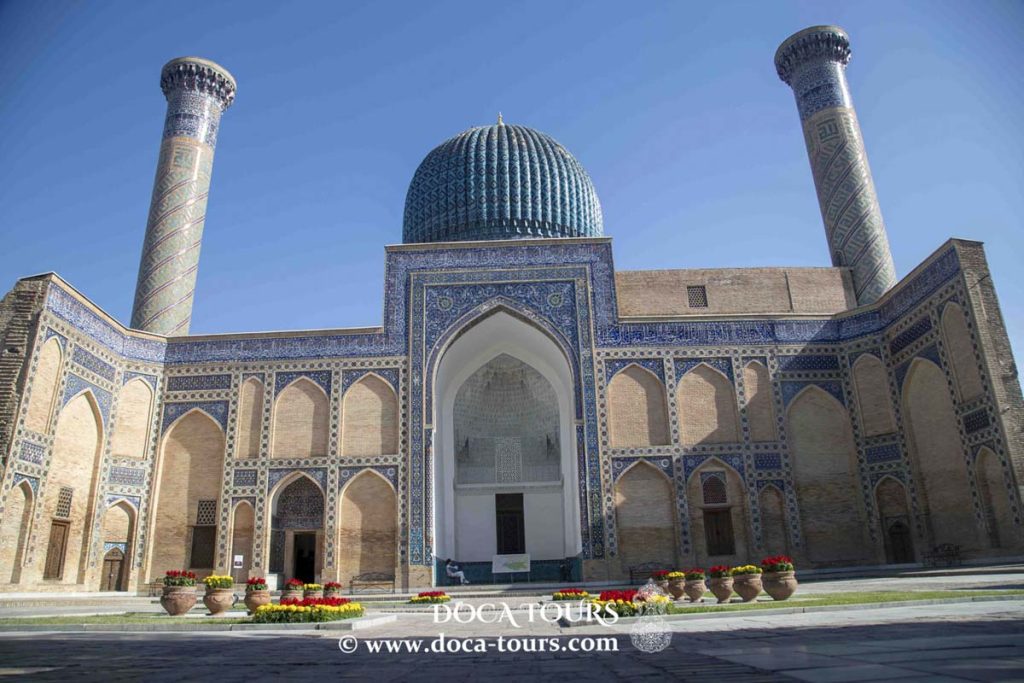
In late 1404, Timur set out on a campaign against China, but in February 1405, he died in the city of Otrar, located in southern Kazakhstan, at the age of 69. Timur’s body was brought to Samarkand and buried in the Muhammad-Sultan Mausoleum. The mausoleum has since become known as Gur-Emir, meaning “Emir’s grave”. In subsequent years, Timur’s sons, grandsons and great-grandsons were also buried here.
The mausoleum was built within the Muhammad-Sultan ensemble, which included a madrasah (Muslim religious school) and a khonako (hotel for merchants and travelers). Both buildings were facing a small quadrangular courtyard surrounded by high walls with a portal on the north side and a deep arched niche on the south side. There were tall minarets at the corners of the courtyard.
There is one famous legend that is associated with its construction.
According to the legend, when Timur decided to build a mausoleum for himself and his family, he invited the best architects and builders from different countries. He gave them the task of creating something unique and majestic, which would become a symbol of his power and greatness.
However, despite their best efforts, the architects could not create a mausoleum that would satisfy Timur. He wanted the mausoleum to be not only beautiful but also majestic so that it would delight all who saw it.
One day, during construction, one of the workers accidentally dropped his hammer on the floor and broke a piece of stone. Timur noticed that there was a beautiful sparkling vein hidden inside the stone. He realized that it was a special kind of stone that could give the mausoleum a unique beauty.
Timur ordered the architects to use this stone to finish the mausoleum. When the mausoleum was built and decorated with this stone, it shone with splendor and amazed everyone with its beauty. People said that the stone was a gift from heaven and it gave the mausoleum a special magic.
Thus, the legend says that Guri Emir was created by the happenstance discovery of this stone, which gave it its unique beauty and grandeur. This legend emphasizes the importance of chance and unexpected discoveries in art and architecture.
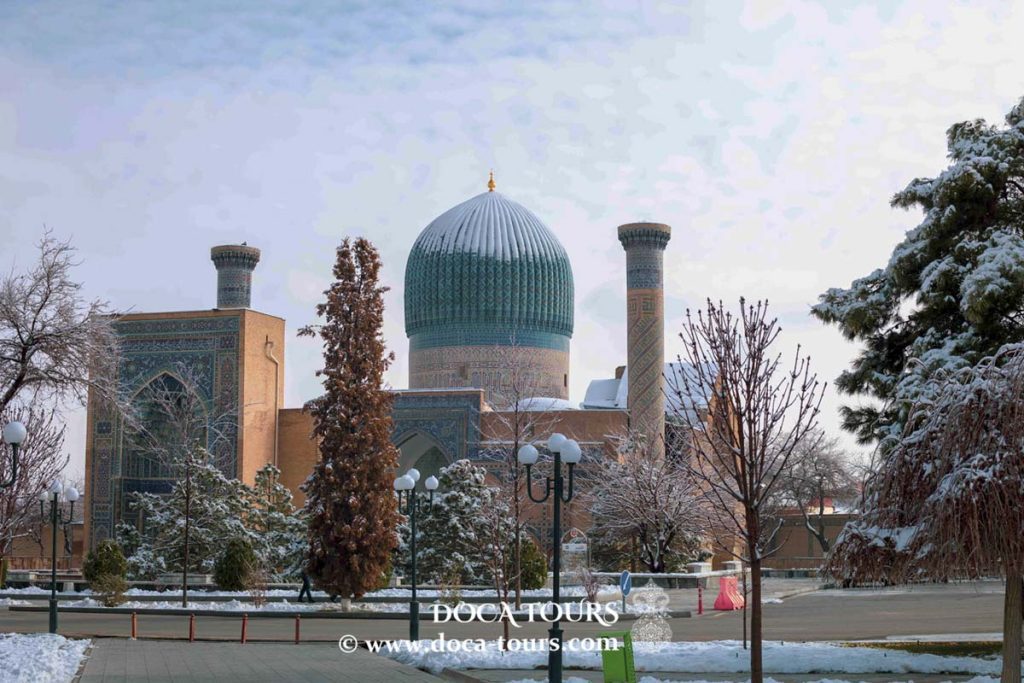
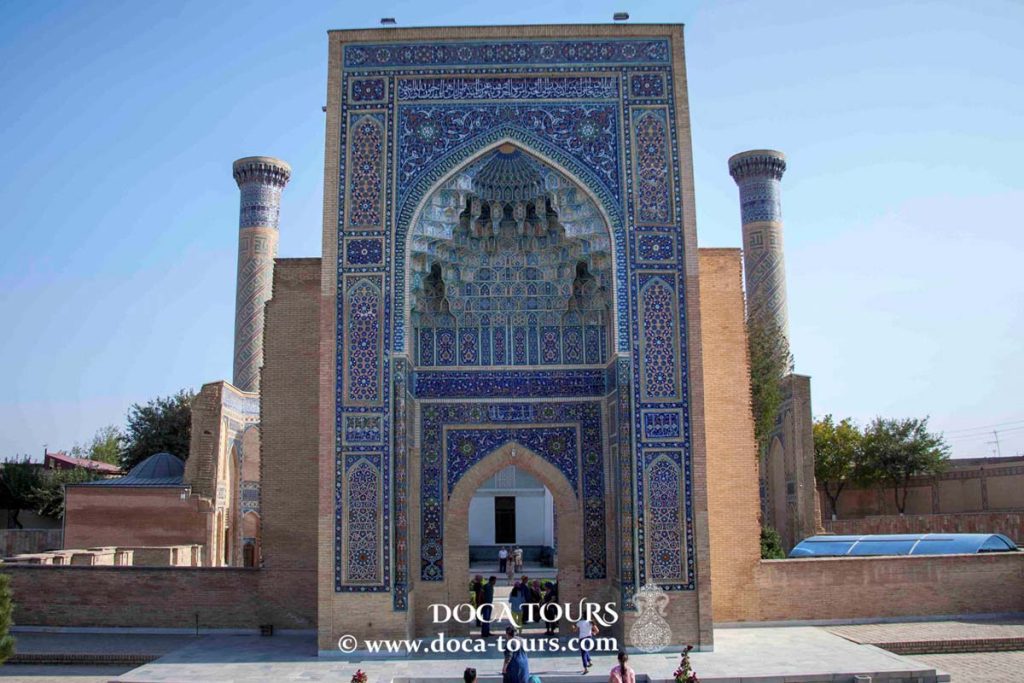
The appearance of the Gur-Emir Mausoleum differs from other monumental constructions of the XIV-XV centuries in Central Asia. It has an octagonal lower volume, which ends with a cylindrical barrel, smoothly transitioning into a uniquely shaped egg-shaped outer dome. The height of the dome is 15 meters and it is divided into 64 facets, which are decorated with blue tiles.
Initially, the entrance to the mausoleum was through a door located in the center of the southern niche of the courtyard. However, after the remains of Mir Seyyid-Bereke, Timur’s spiritual adviser, were transported to Samarkand and buried in the mausoleum, by order of Ulugbek, a gallery was added to the eastern wall of the mausoleum, through which visitors pass inside the mausoleum and visit it now.
Earlier at the entrance to the mausoleum, there was a beautiful plate with an inscription, which informed that Timur was buried there. This plate is now in the Hermitage, a museum in St. Petersburg, Russia.
Also in the Hermitage is one door leaf that was decorated with elaborate carvings, ivory and silver. This door sash is probably part of the historical heritage of the mausoleum.
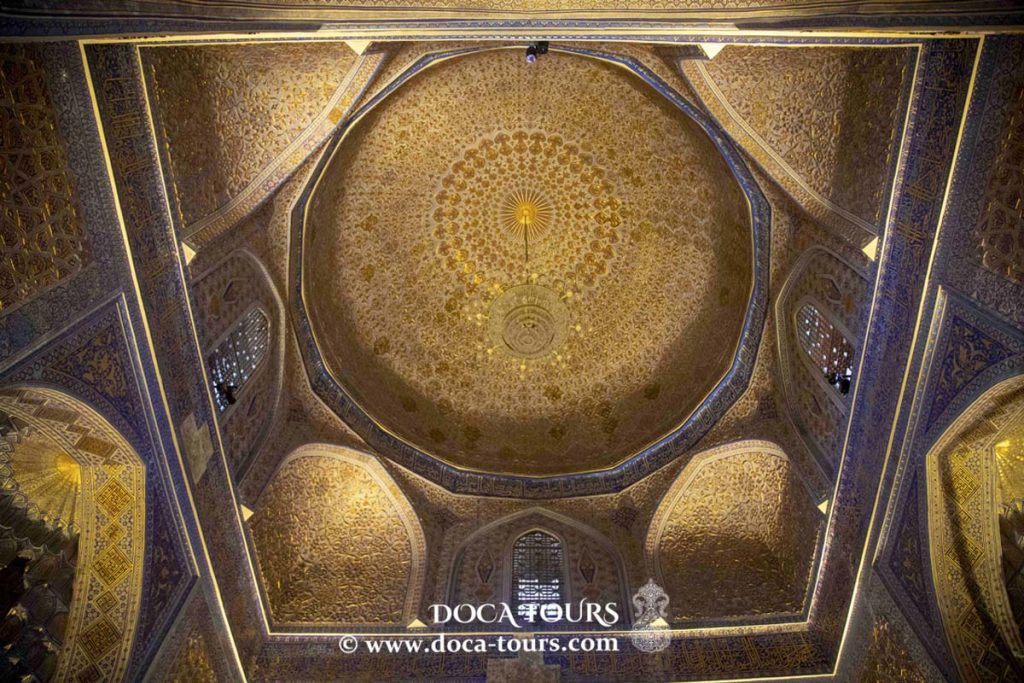
In the mausoleum, niches 9 meters high divide the walls into two corner massive pillars, which rapidly expand upwards and visually extend the entire interior. This creates an impression of grandeur and sublimity of the space.
The interior decoration reflects the characteristic compositional techniques typical for the period of the XIV-XV centuries. Each volume, limiting the interior space, is considered independent and has its own ornamental composition. The construction of this composition is closely connected with the nature of the decorated parts, their area, height of location and architectural features.
The varied decoration of blue-gold paintings in Guri Emir creates an impressive atmosphere inside the mausoleum. They cover all planes from the bottom of the walls to the top of the dome, giving the mausoleum a special beauty and sophistication. The paintings are made using glue colors and papier-mache reliefs. Masters used various mineral dyes such as natural ultramarine for the blue color, copper greens like malachite or chrysocolla for the green color, red ochre with a touch of vermilion for the red color, ochre for the yellow color, burnt bone for the black color and ganch for white color. This decoration creates a majestic image and gives the mausoleum a special attraction.
The plaster under the paintings was multi-layered. A thick rough layer of ganchok, which was a mixture of ganch, clay and sand, was applied to the brickwork and was up to 3 cm thick. Then a finishing layer of gulganch, which was a high-quality ganch with fine grinding and was 1-2 cm thick, was applied. Finally, on top of the finishing layer was made a thin grout-ground for painting, which was up to 1-2 mm thick. This layer provided a smooth surface for painting.
In the paintings of the mausoleum, gold was used in the form of leaves with an admixture of silver. This gold was overlaid on a ground that consisted of a local orange-brown clay known as kizil-kesak. This combination of gold and ground created a special effect and gave the paintings a blue-gold color scheme.
A historian of Timur’s time, Sheref-ad-din Ali Yazdi, described that after Timur’s burial in the mausoleum, the walls were decorated with carpets and koshmas, and Timur’s weapons were displayed. A golden chandelier weighing 50 thousand miskals (1 miskal is 4 grams of gold) descended from the ceiling.
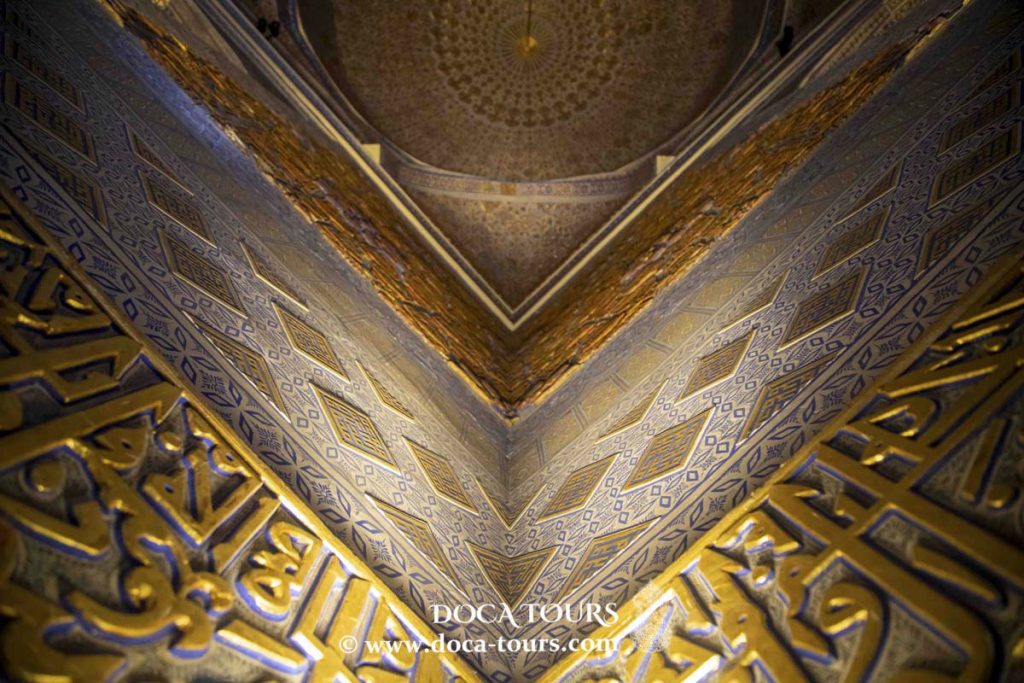
The walls of the mausoleum were decorated with huge panels with a large star-shaped girih. There is one panel in each corner of the mausoleum. The upper part of the walls, at a height of 1.2 meters, is decorated with a Kufic inscription in which the name “Muhammad” is repeated twice. The weaves of the girih are filled with pictorial ornamentation consisting of blue spirals or twigs with leaves, the same as on the marble inscription. The patterns of ornamentation randomly alternate with each other, creating a haphazard alternation.
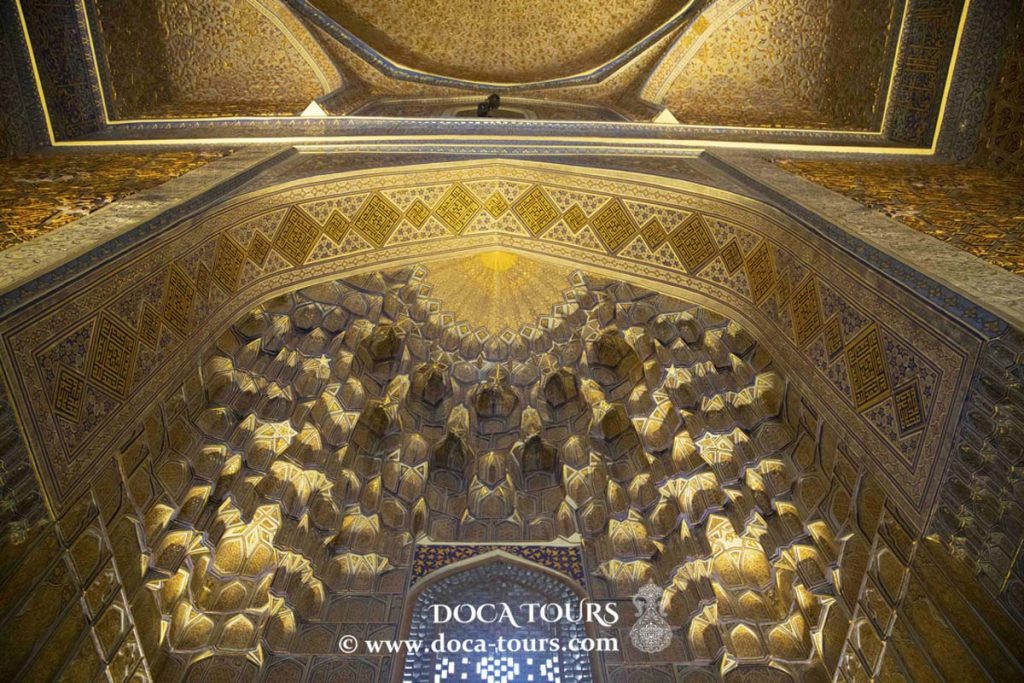
The arched niches of the quatrefoil of the Gur-Emir Mausoleum are crowned with decorative stalactite half-domes. Vertical planes of stalactites are decorated with small golden rhombuses, which form hexagons with a golden spot in the center, as well as blue spirals. The triangular planes of the stalactites are decorated with gold flowers on a blue background. On the soffits of the niches, there are chains of alternating large and small squares made in the technique of ganch reliefs with paper on the surface. On these squares, the words “Muhammad” and “Allah” are depicted in Kufic letters.
The mausoleum also contains colored patterned stained glass in the windows. These are made of multi-colored glass including red, blue, blue, green, cherry, purple and yellow glass. These stained-glass windows add brightness and beauty to the interior of the mausoleum, creating a play of light and color.
Timur’s tombstone, known as a black and green jade tombstone decorated with carvings, was erected during the reign of Ulugbek. It is one of the most famous and majestic elements of the interior of the Gur-Emir Mausoleum. The white marble lattice enclosing the area with tombstones was also installed at that time.
The dead are buried in a crypt, an underground room that is closed after each burial. This preserves the privacy and sanctity of the mausoleum and ensures respect for the deceased and their memory. A white marble lattice surrounds the tombstones over the Timurid burials, creating a majestic and respectful atmosphere.
In Guri Emir, the monuments are placed in the same order as the graves underground. At the very center is the black and green jade tombstone over Timur’s grave. This tombstone is the main and most revered monument in the mausoleum, symbolizing Timur’s greatness and importance.
At Timur’s head, there is the tombstone of Mir-Seyid Bereke, his spiritual mentor. At Timur’s feet is the tombstone of Ulugbek, and to his left there is the tombstone of Muhammad-Sultan, Timur’s grandson. To Timur’s right is the tombstone of Shahrukh, Timur’s middle son, and next to it is the tombstone of Miranshah, Timur’s youngest son. Two small tombstones represent Ulugbek’s younger sons. Behind a grate in a niche, there is the tomb of an unknown man who is honored as a saint.
An expedition by the Navoi Special State Committee in 1941 involved opening the tombs in the crypt of the Gur-Emir Mausoleum to explore their historical and cultural significance.
The expedition was aimed at uncovering the graves in the crypt of the Gur-Emir mausoleum. Timur, who once created the largest empire in the world, stretching from the Aral Sea to the Persian Gulf, from the Indus to the Mediterranean, as well as his sons and grandson Ulugbek, are buried in this mausoleum.
The purpose of opening the graves in the crypt of the Gur-Emir Mausoleum was to verify historical information about the appearance and circumstances of the death of Timur and his descendants. In June 1941, an expedition led by Professor T.N. Kary-Niyazov and consisting of archaeologists Y.G. Gulyamov and V.A. Shishkin, orientalist A.A. Semenov, anthropologist L.V. Oshanin, sculptor-anthropologist M.M. Gerasimov and Sadriddin Ayni conducted an autopsy of the crypt. As a result of the study of the remains, it was found that Timur was buried in a coffin. This is explained by the fact that the ruler died far from Samarkand, and his body was transported here and buried in a coffin in the crypt of Gur-Emir.
Anthropologist and sculptor M.M. Gerasimov used the carefully studied skulls of Timur, Ulugbek, Shahrukh and Miranshah to create sculptural portraits of these historical figures. This method, known as the skull-based reconstruction method, allows you to recreate the external appearance of a person based on their skull and anthropological data.
Guri Emir is a testament to the rich history of Central Asia and its influence on culture and art. This mausoleum was not only a resting place for Timur but also a symbol of his greatness and influence on the region. Today, Guri Emir is a popular tourist spot attracting people from all over the world. You can visit it and enjoy its splendor and historical significance.
Apart from its architectural beauty, Guri Emir also has immense historical significance. During his reign, Timur created a huge empire that had a significant impact on the culture and art of Central Asia. He was a patron of art and science, and his court was the center of cultural and intellectual life. Guri Emir is a testament to this era. Unique works of art have been preserved within its walls, which reflect the richness and diversity of Timurid culture. Frescoes, mosaics and wood carvings all bear witness to the high skill and talent of the artists and craftsmen of the time.
In conclusion, Guri Emir is an amazing monument of architecture and history that deserves attention and respect. It is a testament to the greatness of Timur and his influence on the culture and art of Central Asia. A visit to Guri Emir will allow you to plunge into history and enjoy its splendor. We hope that this story about Guri Emir was interesting to you and will inspire you to visit this amazing place. You will find the most favorable tour packages with DOCA TOURS.
Take a step into the world of history, culture and adventure – come to Uzbekistan with us!
Thank you very much for your attention.
Subscribe to the channel and don’t forget to like our videos.
#guremir #Tamerlan #AmirTimur #Temurlang #Empire #TamerlanEmpire #History #CentralAsia #Silkroad #Samarkand #Bukhara #mausoleum #Shrine #Tours #traveling #Voyage #trip #Turan #Turkestan #holyplace #pilgrimage #tomb #Shakhrisabz #docatours #oybekostanov