























Video: https://www.youtube.com/watch?v=PFYueTUT7EQ&t=150s
Central Asia is a unique region with its own special history, culture, and customs. Perhaps the historical nomadic way of life of the peoples of Central Asia played a significant role in shaping their lifestyle and habits. Today, we would like to show and tell you about an integral part of the nomadic way of life – the yurt.
A yurt is a lightweight, portable, frame dwelling covered with felt. For many centuries, it has served and continues to serve as the home for the Turkic-speaking peoples and Mongols.
The word “yurt” in Turkic languages means “people.” It also carries the meaning of “pasture.” For example, in Kyrgyz and Kazakh, the word “Ata-Zhurt” denotes “Homeland” or “Motherland.”
In the Mongolian language, the word for yurt is “ger” and is synonymous with the word “home.”
The oldest depictions of camels laden with yurt components date back to the 1st millennium AD. They were found on burial statuettes in Northern China. Images of yurts can also be found in Central Asian, Persian, and Turkish miniatures starting from the Mongol conquests of the 13th century.
The construction and design of yurts among the Turkic and Mongol peoples have some differences. For example, Turkmen yurts have double-winged wooden doors. In Kazakh and Kyrgyz yurts, felt curtains are often used instead of wooden doors. Due to strong winds on the steppe, Kazakh yurts are lower than Kyrgyz ones. Mongolian yurts are even lower due to their straight roof poles.
By the way, you might have wondered why yurts are always round. The answer is simple: it’s easier to assemble, and a round structure can withstand even strong winds without damage.
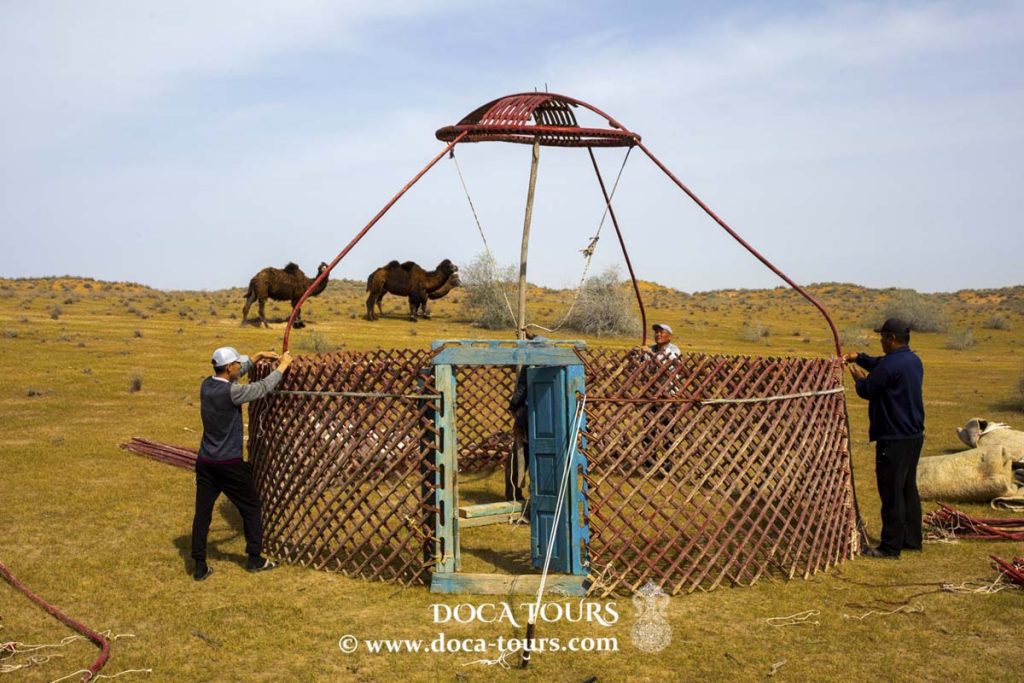
Historically, the yurt has fully satisfied the needs of nomads with its practicality and convenience. It can be quickly assembled and disassembled within an hour by just one family.
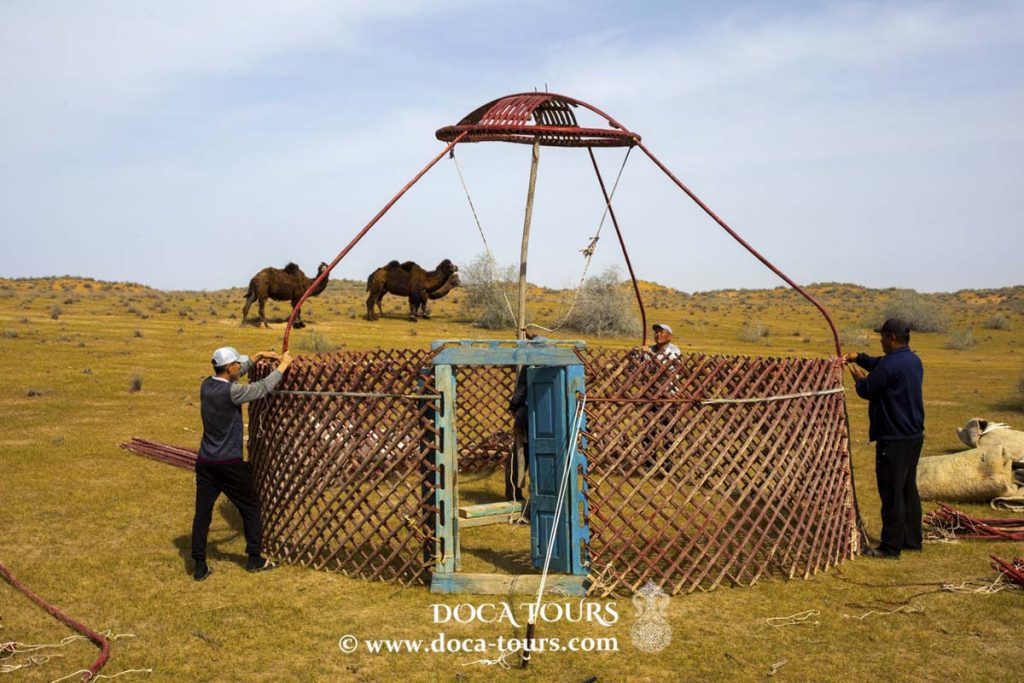
The components of a yurt can be easily transported on camels, horses, or by car. The felt covering the yurt is very durable, natural, and insulating, almost impervious to moisture, wind, and cold. Additionally, felt is highly fire-resistant.
The opening at the top of the dome serves for daylight and also acts as a chimney for the hearth or stove.
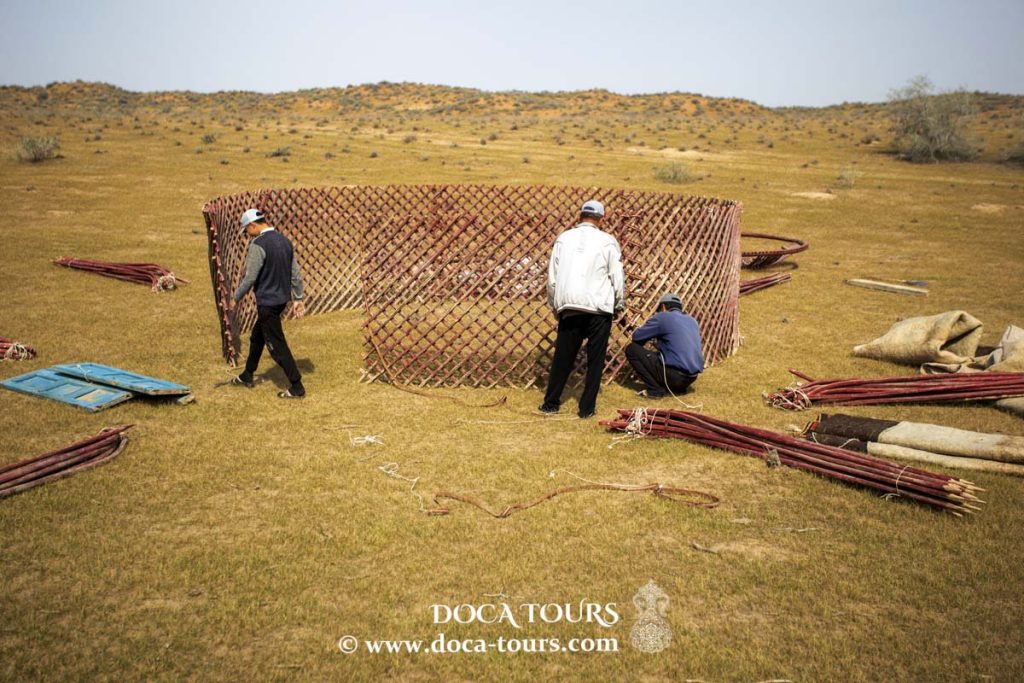
To fasten the lattice walls, animal leather straps were traditionally used. Nowadays, rough rope or woolen cord is also used. Turkic yurts (Kyrgyz, Kazakh, Karakalpak) do not have supporting poles, as they have a high vault and ties around the perimeter of the structure.
Yurts are still used by nomads and livestock herders in Kazakhstan, Uzbekistan, Kyrgyzstan, and Mongolia due to their practicality. Another practical aspect of the yurt is that it allows for easy regulation of lighting and ventilation.
Smoke exits through the open tunduk hole, preventing the accumulation of exhaust gases inside the tent. During the day, it lets in light, and at night, it can be easily closed by pulling a rope.
During hot weather, the side flaps can be raised, allowing the yurt to be ventilated through the lattice walls, providing a cool, shaded living space inside.
The most honorable place in the yurt is called the “tor,” where the most respected guests are seated. It is located directly opposite the entrance.
Traditionally, the yurt is oriented with its entrance facing east. The right side from the entrance is usually for women and household items, while the left side is for men, where weapons, saddles, and other items are stored. Opposite the entrance is the honored place for male guests, and in the center of the yurt is the hearth.
Traditionally, the yurt is entirely covered with felt, which can be of various shades, from white to dark brown or gray.
Today, yurts are also used for tourism purposes in Central Asia. In Uzbekistan, Kyrgyzstan, Mongolia, and Kazakhstan, tourists can stay in yurts and thus get acquainted with the culture and way of life of the nomads.
Thank you very much for your attention.
Subscribe to the channel and don’t forget to like our videos.
#hurt, #building, #scratched, #damaged, #white, #style, #wall, #abstract, #texture, #work, #pain, #industrial, #concrete, #dirty, #background, #urban, #person, #disease, #outdoors, #grey, #construction, #abandoned, #people, #dangerous, #danger, #injured, #injury, #interior, #rough, #broken, #sad, #funny, #weathered, #love, #foot, #surface, #young, #pattern, #painted, #character, #cement, #street, #old, #scratches, #mortar, #cat, #destruction, #divide, #stare, #protect