






































Video: https://www.youtube.com/watch?v=JwZqp2dxnio&t=40s
If you ask a foreigner, “What do you associate with Uzbekistan?” there’s a good chance they’ll answer: “cotton.” Until the 1990s, Uzbekistan was the world’s second-largest producer of cotton. Even today, the country remains in the top 10 for cotton cultivation and export.
The cotton plant, known as Gossypium in Latin, belongs to the genus of perennial plants and the mallow family (Malvaceae). It is cultivated in countries with a subtropical climate or in areas adjacent to the subtropics (between the 30th parallel south and the 40th parallel north).
The tropics are considered the homeland of the cotton plant, where it can reach a height of 7 meters. Cotton has been known to humans since ancient times. Scientists believe that Persians were the first to cultivate cotton, but it was already widely spread in India between the 15th and 10th centuries BCE.
So, how is cotton grown?
Before the plant yields soft fiber, it goes through several stages:
- First, buds form, from which flowers eventually grow.
- After the flower appears, it is pollinated. After pollination, the flower changes its yellow color to violet-pink, which then falls off after a few days, leaving behind a seed capsule. The cotton flower is self-pollinating, making the cotton production process independent of pollinating insects.
- Next, the seed capsule grows, and cotton fibers form within it. Fibers only start growing after pollination. The capsule expands and opens, releasing the cotton fibers.
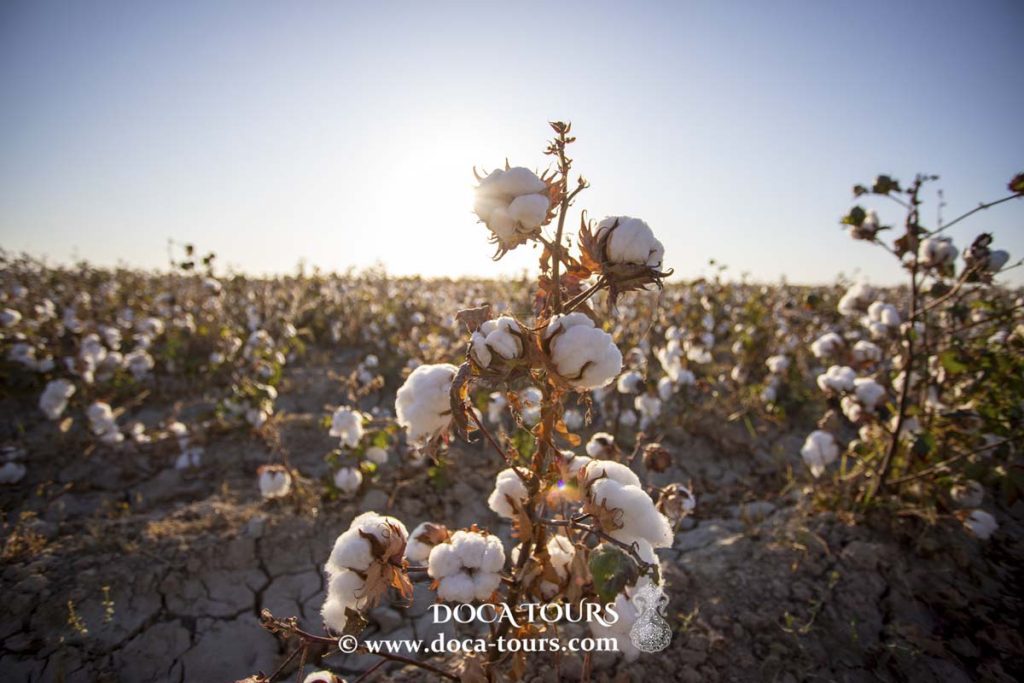
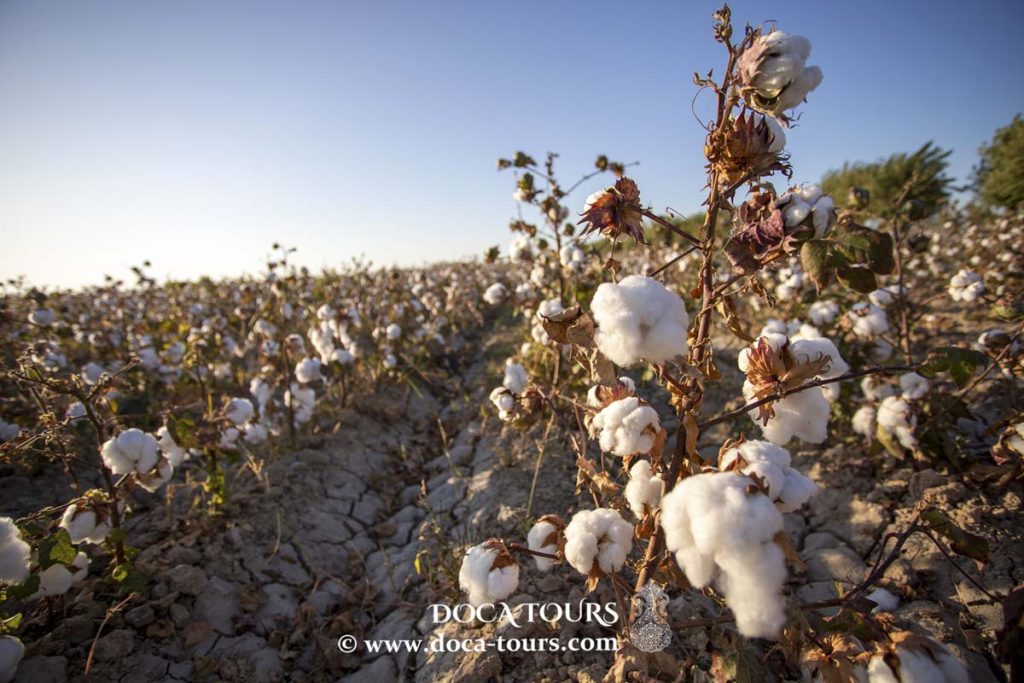
When the cotton boll ripens, it opens. The fiber, along with the unseparated seeds, is collected using cotton-picking machines or by hand. In developing countries, cotton is traditionally harvested by hand. The average cotton yield ranges from 3 to 5 tons per hectare.
The harvested cotton is sent to gins, where the fibers are separated from the seeds.
Of course, the topic of cotton is extensive. Today, we would like to talk about one of the stages of cotton processing. Traveling through Uzbekistan in September and October, it’s impossible not to see cotton fields and cotton collection sites. These are large areas in rural areas, usually enclosed by high walls. Behind these walls, you can see the high mounds of collected “white gold” cotton.
Recently, we visited one of these storage facilities for cotton in the Pastdargom district of the Samarkand region. Such facilities have existed throughout the Republic of Uzbekistan since the time of the USSR.
The season here starts in September. Farmers send up to 100 fully loaded tractors here every day. The facility receives between 350 and 800 tons of cotton per day.
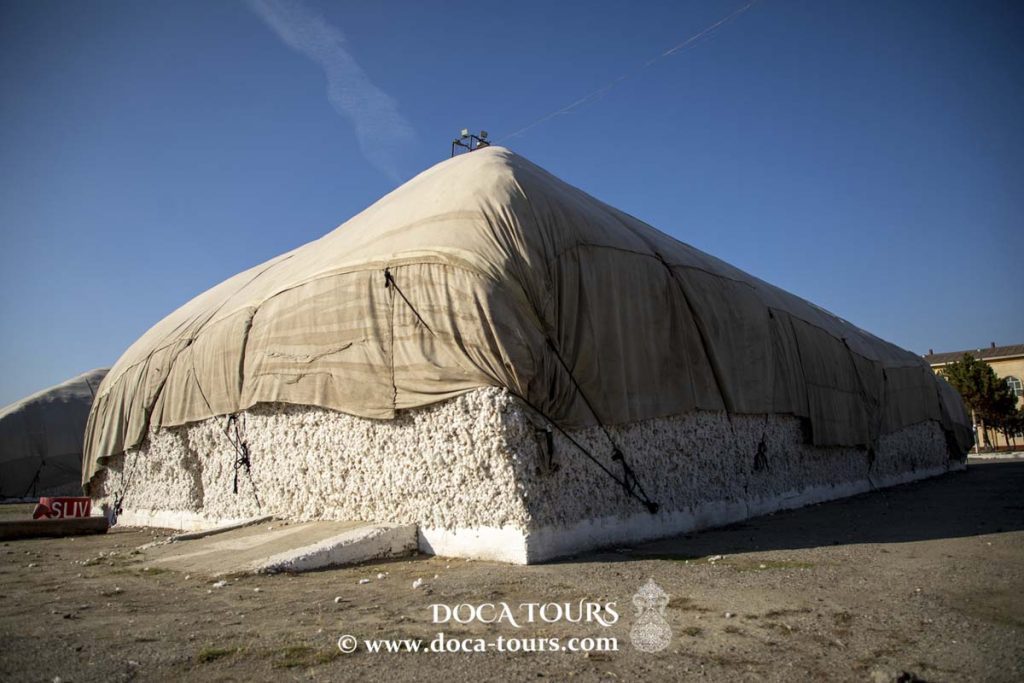
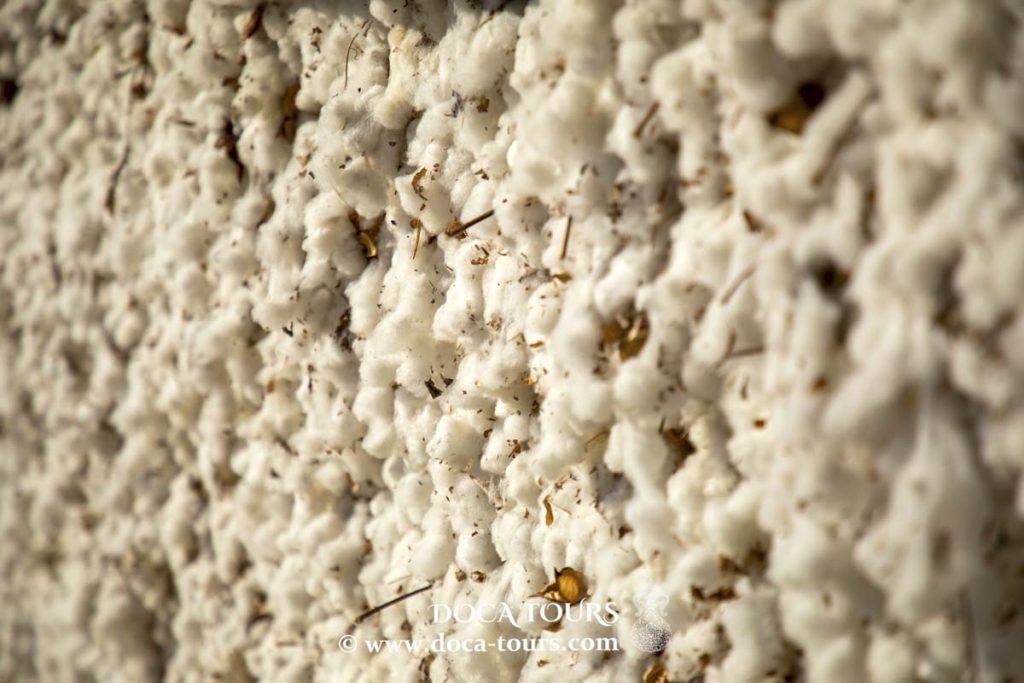
Each cotton-processing facility has 20 to 40 storage spaces for cotton. The mounds of cotton are called “bales.” They always have a standard size: 12×24 meters. One bale contains 300 tons of cotton.
This facility stores 19 bales of cotton. Ten of them are intended for seeds, which will be cultivated for planting the next year’s crop. Cotton for seed production is harvested from the first crop before the cotton fields are sprayed with pesticides. Seed production is processed from January each year.
Here, cotton fibers are separated from the seeds, processed, and stored until the next year. The harvested cotton needs to be dried for three days. There are large drying facilities for this purpose. If it is not dried in time, it will start to rot from moisture.
The remaining cotton is processed and pressed. This is done as follows:
A tractor loaded with harvested cotton dumps it into a special container, which is then moved to a warehouse. Workers then transfer the cotton through a pipe to the next section, where the fibers are separated from the seeds.
After this, the fibers are pressed using special equipment. Each pressed cotton bale weighs between 210 and 220 kilograms.
Work at each cotton-processing facility lasts from September to May. In other words, the facility is active for 9 months a year. Most of the employees who work here spend these three months working in the fields, cultivating cotton.
So, what is produced from cotton?
The cotton plant is a rare example of a zero-waste plant, as it is used entirely. Cotton is used to make dozens of types of fabrics of different qualities and textures, sewing threads, ropes, and cords.
Cottonseed cake is used as animal feed and fertilizer. From the cotton plant, paper, cellulose, varnishes, and cardboard are also produced.
This fiber is found in the paper used for banknotes. Of course, the exact proportions and content of banknote paper are kept in strict secrecy by all governments, but experts claim that at least 50% of any banknote in the world contains cotton.
Additionally, “white gold” is used to produce margarine, soap, glycerin, stearin, mayonnaise, and gunpowder.
Cotton seeds are used for:
• Planting new cotton plants;
Producing oil, which is used in Asian countries for cooking. By the way, the authentic and most delicious Uzbek pilaf is prepared using cottonseed oil.
• Producing animal feed.
Cotton fluff is used for:
• The production of synthetic thread;
• Making paper (since cotton is 95% cellulose);
• Producing plastic;
• Making explosives.
Cotton fibers are used for producing:
• Fine, high-quality fabrics — only long-staple cotton is suitable for these;
• Inexpensive fabrics such as calico, muslin, and others — medium-staple cotton is used here;
• Knitwear — in this case, even short-staple cotton can be used (which explains its lower durability). Synthetic components are usually added to knitwear for strength;
• Medical cotton wool;
• Wadding.
Today, technologists have identified around 1200 products containing cotton.
The topic of cotton on our channel is not yet finished. Stay with us, and you will learn many interesting things.
Thank you very much for your attention.
Subscribe to the channel and don’t forget to like our videos.
#cotton, #uzbekistan, #nature, #white, #agriculture, #natural, #crop, #farm, #textile, #field, #organic, #harvest, #industry, #rural, #plant, #farming, #fluffy, #stem, #ripe, #flower, #environment, #landscape, #background, #asia, #fiber, #leaf, #blue, #summer, #growth, #branch, #seed, #soft, #traditional, #cultivated, #grass, #circle, #closeup, #bud, #raw, #boll, #macro, #plantation, #puffs, #view, #pattern, #cotton plant, #ornament, #old, #decor, #cotton industry