


























The Harsh Winter of 1404. In the harsh winter of 1404, the great Timur set out with a 200,000-strong army on a campaign toward distant China. Despite his advanced age, he was full of energy and personally led the expedition. In January 1405, the vast army reached the city of Otrar, located in the lower reaches of the Arys River. That year, the winter was exceptionally cold and snowy, forcing Timur’s caravan to halt in Otrar. There, the great commander unexpectedly caught a cold and passed away on February 18, 1405.
The task of returning Amir Timur’s body to his homeland was entrusted to one of his close associates, Khoja Yusuf. The caravan was informed that one of the emir’s wives was returning to the capital.
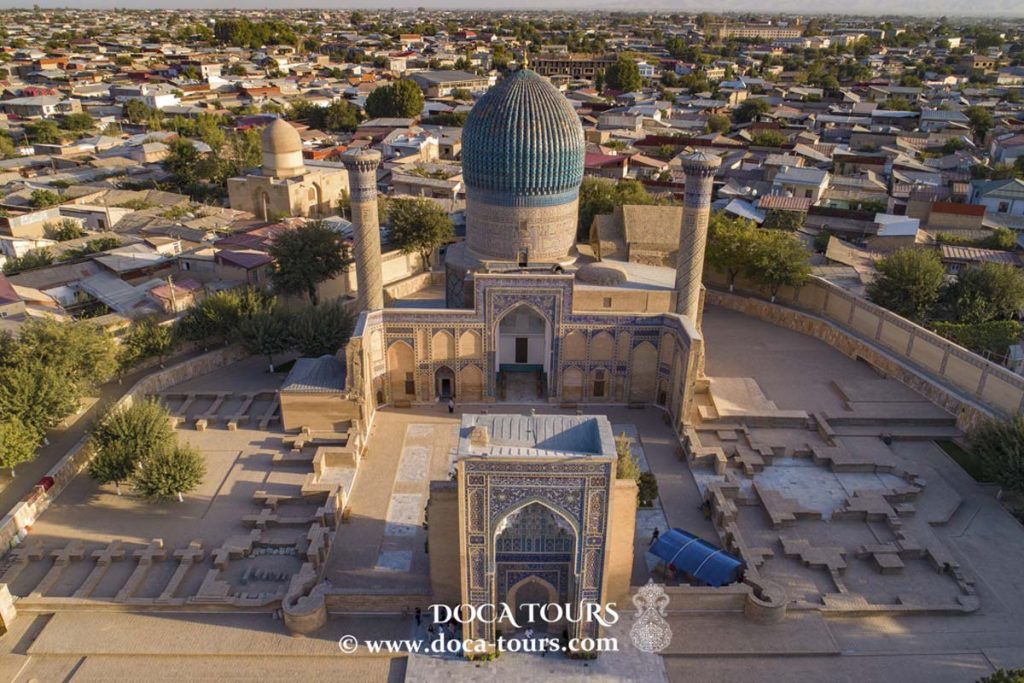
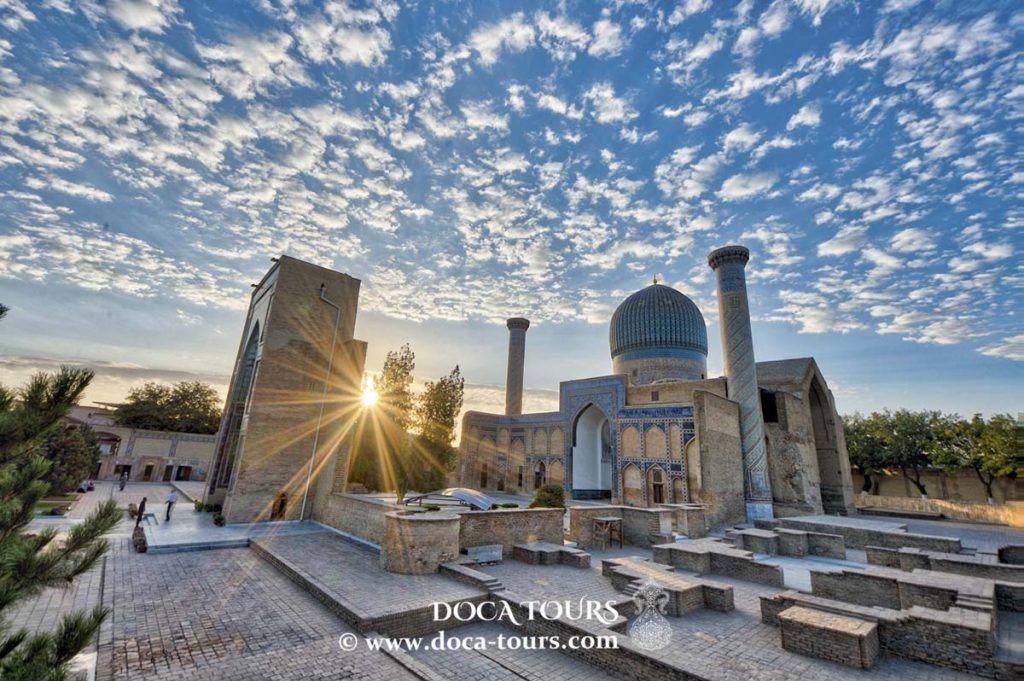
The burial site of the great commander became the madrasa built by his beloved grandson, Muhammad Sultan. However, Muhammad Sultan himself had unexpectedly passed away in the spring of 1403 at the age of 29, and by Timur’s order, he was buried in a corner chamber of this madrasa.
Thus, the madrasa, which was meant to become a center of Islamic education, became the burial site for the Timurid dynasty.
After Sahibqiran’s (Timur’s) death, his vast empire—spanning from Central Asia to the Middle East and from the Mediterranean to northern India—was governed by his sons and grandsons. Although Timur had designated his grandson Pir Muhammad Sultan as his successor before his death, not everyone recognized his authority, leading to a struggle for power.
Ulugh Beg’s Campaign and the Jade Tombstone
Decades later, the ruler of Mawarannahr, Muhammad Taraghay Ulugh Beg, launched a military campaign against rebellious beks on the borders of the Dasht-i-Kipchak and Mongolia. In 1425, he defeated the forces of Sher Muhammad Oghlan near Lake Issyk-Kul and returned home victorious with a large bounty. To commemorate this victorious campaign, Ulugh Beg ordered an inscription to be carved at the entrance to Samarkand on a rock in the “Ilon Utdi” gorge near Jizzakh.
Among the spoils, Ulugh Beg brought back two large pieces of dark green jade. Many sources indicate that these jade stones once belonged to the court of the Chinese emperor, as jade holds divine significance in Chinese culture. The stones had been taken by Mongol conquerors.
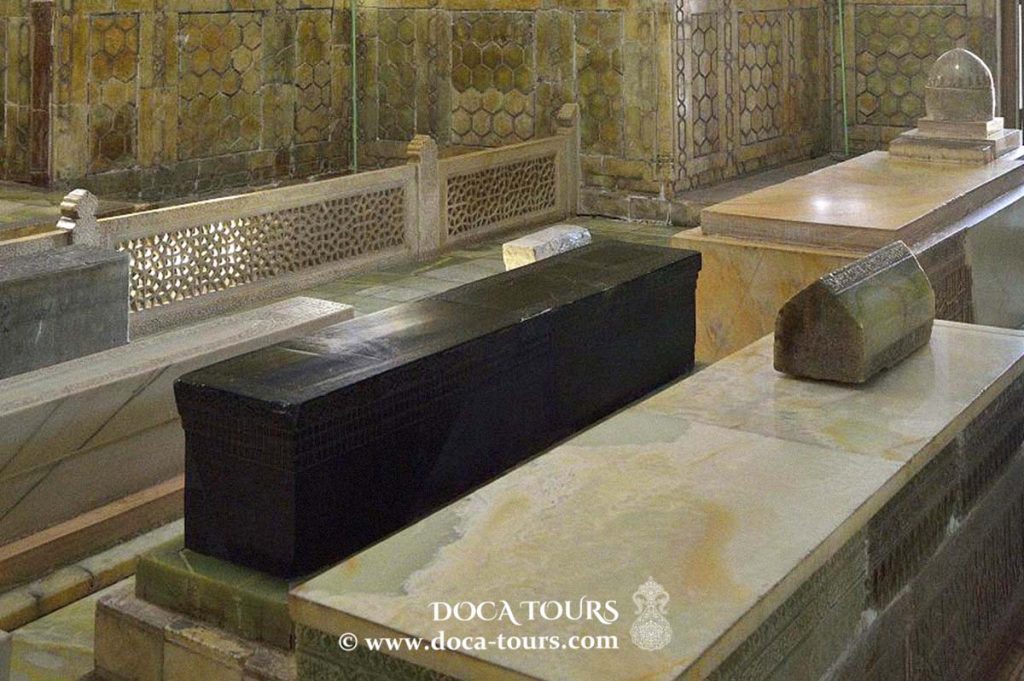
The pieces of jade were exceptionally heavy and were carefully transported to Samarkand on a specially designed cart. In Samarkand, skilled craftsmen joined the two jade pieces, polished them, engraved verses from the Quran, and placed the stone over Amir Timur’s grave as an external tombstone.
The surface of the stone bears an inscription:
“This is the tomb of the great Sultan, the merciful Khan Amir Timur Kuragan; son of Amir Taraghay…” followed by the names of Timur’s ancestors up to the ninth generation. Based on these records, information emerged suggesting that Timur’s lineage could be traced back to the ancestors of Genghis Khan.
At the bottom of the stone, another inscription reads:
“This stone was installed by Ulugh Beg Kuragan.”
It remains unclear where and how Ulugh Beg acquired the jade stones. Some sources suggest that in the second half of the 13th century, the territory of Central Asia was part of the Chagatai Ulus, and during this period, the capital of the ulus was the city of Nasaf. Between 1282 and 1307, the ulus was ruled by Kebek Khan, who crafted a throne from precious stones. One of the throne’s decorations was a jade stone that had once adorned the palace of the Chinese emperors.
In 1370, Amir Timur founded a centralized state in Mawarannahr, bringing an end to Mongol tyranny. When Sahibqiran captured Nasaf, Kebek Khan’s jade throne was no longer in the Mongol palace.
The Fate of the Jade Tombstone
Historical sources note that a month after Timur’s death, his grandson Khalil Sultan ascended the throne. Upon arriving in Samarkand, Khalil Sultan organized a grand memorial ceremony for his grandfather. The mausoleum where Timur was buried was adorned with velvet and silk carpets, walls were hung with various jeweled items, and heavy gold and silver chandeliers hung from the ceilings. Timur’s clothing was laid on the tombstone. The mausoleum remained in this state for a long time.
In 1409, power passed to Shahrukh Mirza, forcing Khalil Sultan to leave Samarkand for the city of Ray. Shahrukh Mirza ordered the removal of all non-Islamic adornments from the mausoleum, and all gold and silver items were transferred to the state treasury.
Centuries passed, and the rare jade stone remained atop Sahibqiran’s grave. Over time, Ulugh Beg and other Timurid family members were also buried alongside their great ancestor.
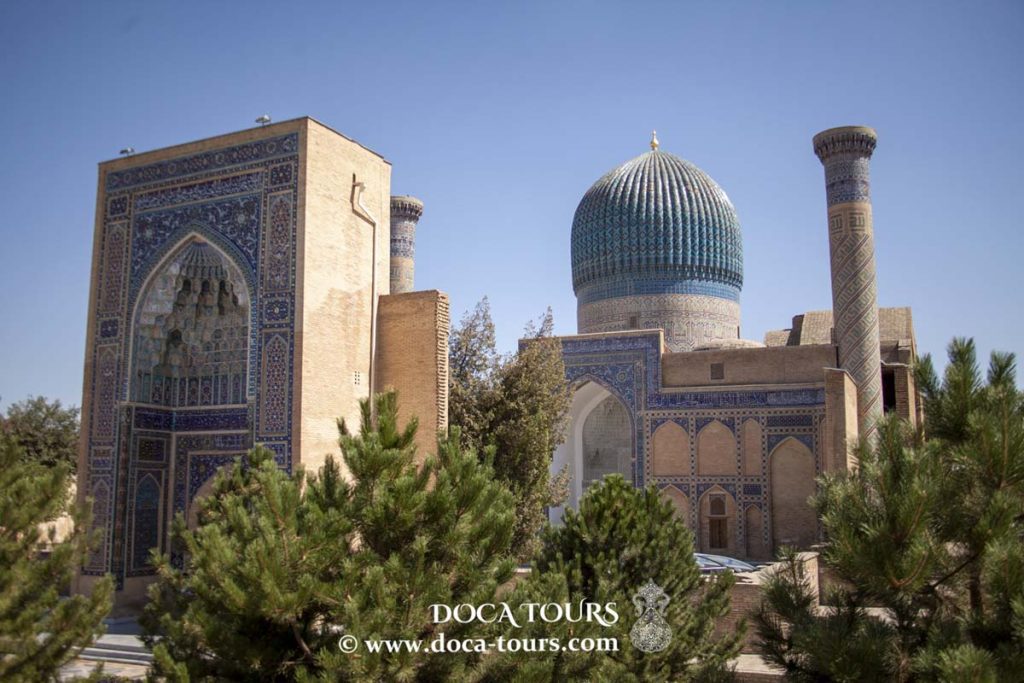
In 1740, the Persian ruler Nader Shah sent an army to the Bukhara and Khiva Khanates. A 20,000-strong force was sent to Samarkand to suppress the Uzbeks, who had mounted fierce resistance. Nader Shah had heard of the valuable jade stone in Sahibqiran’s mausoleum. He ordered his troops to remove the jade tombstone from Timur’s grave, along with the double-layered gates of the Bibi-Khanym Mosque, crafted from seven metal alloys. These treasures were transported to the city of Mashhad.
According to court historians, the jade stones were intended to adorn one of the sacred buildings in the Persian capital. Some sources suggest that Nader Shah wanted to use the stones as steps for his throne. However, after the jade was brought to Iran, Nader Shah began to feel conflicted. He understood that desecrating graves was a great sin. Soon after, Nader Shah had a dream in which Timur’s spiritual mentor, Mir Said Baraka, warned him to return the tombstone or face dire consequences. Alarmed by the warning, Nader Shah immediately ordered the jade stones to be returned to Samarkand and restored to their place.
Nonetheless, following this event, Nader Shah’s state began to decline. His previously invincible troops faced fierce resistance in Derbent and suffered heavy losses. Cities he had conquered began to fall one after another. Nader Shah was eventually assassinated by his generals in 1747.
Since then, the jade stone, known to the Chinese as the “Stone of Life,” has remained atop the grave of the great Timur.
Legacy of the Jade Tombstone
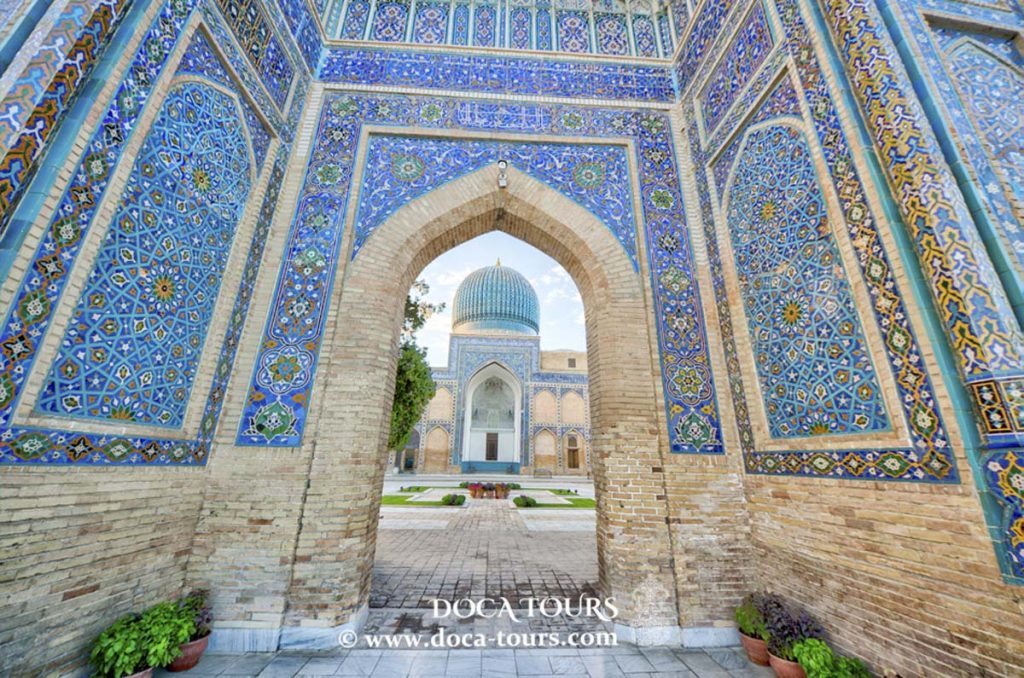
Interestingly, the mausoleum of French Emperor Napoleon Bonaparte in Paris was modeled after the Gur-e-Amir Mausoleum. The massive sarcophagus containing Napoleon’s remains is set on a green granite stone, and the dome is adorned with gold. Similarly, the sarcophagus of Tsar Alexander III in Russia is carved entirely from Siberian jade.
Chinese philosophers attributed five virtues to jade, corresponding to six human qualities: its soft luster symbolized mercy; its hardness, moderation and justice; its translucence, honesty; its purity, wisdom; and its adaptability, courage.
An ancient Chinese proverb states:
“Gold has a price; jade is priceless.”
Confucius once remarked about a good man:
“His morality is as pure as jade.”
Thank you very much for your attention.
Subscribe to the channel and don’t forget to like our videos.
#asia, #uzbekistan, #timur, #amir, #tamerlane, #architecture, #samarkand, #landmark, #travel, #art, #uzbek, #building, #ancient, #mausoleum, #history, #tourism, #central, #temur, #islamic, #historical, #mosque, #tashkent, #decoration, #city, #statue, #historic, #monument, #style, #pattern, #east, #tomb, #oriental, #heritage, #tourist, #exterior, #famous, #park, #blue, #entrance, #timurid, #square, #dome, #place, #islam, #downtown, #old, #attraction, #gate, #gur-e-amir, #arch