

























Hello friends, we welcome you to our channel. Today we want to tell you about a fantastic place called Shahi Zinda. It is one of the most famous historical places in Samarkand, Uzbekistan. If you like our content and want to support us, don’t forget to subscribe to the channel and click on the bell to get notifications about new videos. Your subscription will help us to grow and develop! Thus, we are starting.
Shahi Zinda is an amazing place where history and mysticism intertwine and the architectural masterpieces are breathtaking.
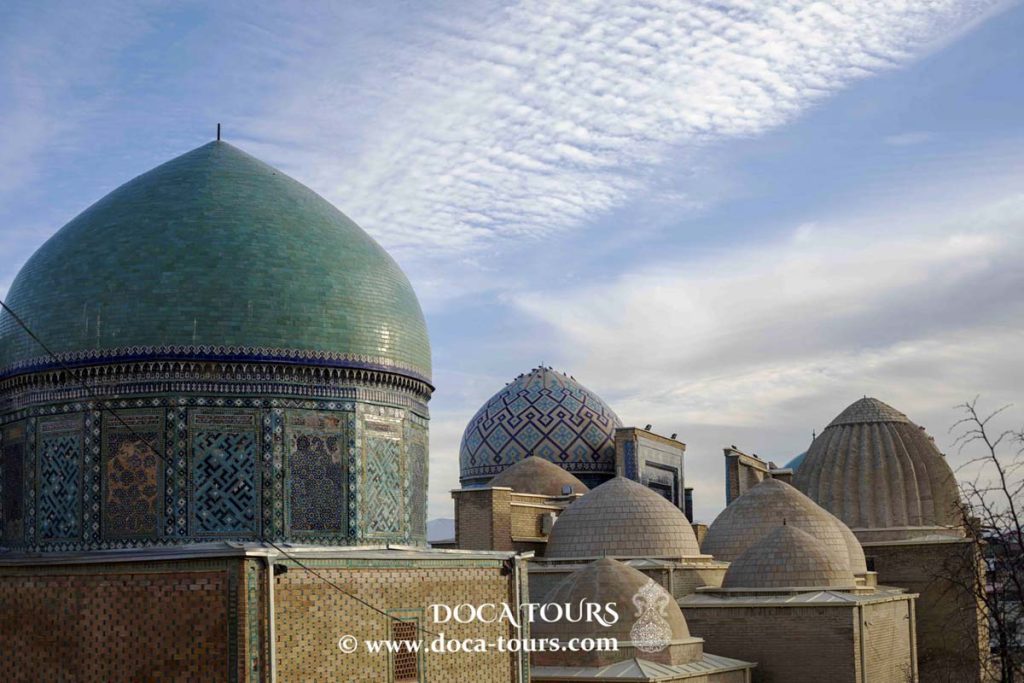
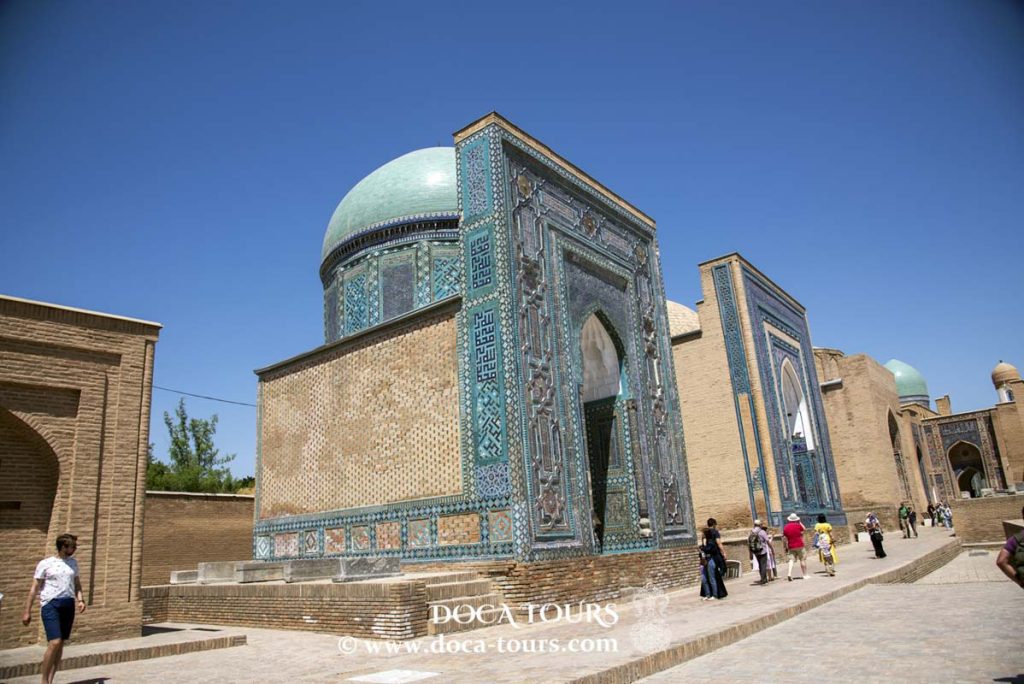
Imagine the ancient mausoleums, their domes covered with exquisite patterns that glisten under the rays of the sun. Walking along the magnificent alleys, you will plunge into the past, where every stone and every element of decoration tells its own unique story.
The Shahi Zinda complex was founded in the 11th century and it is the resting place for many members of the Timurid dynasty. It consists of numerous mausoleums and mosques, each with its own unique architecture and decorative elements.
The ensemble was formed over several centuries and has always been closely connected with the historical destiny of the city and the whole of Central Asia. This place is of great historical and cultural importance.
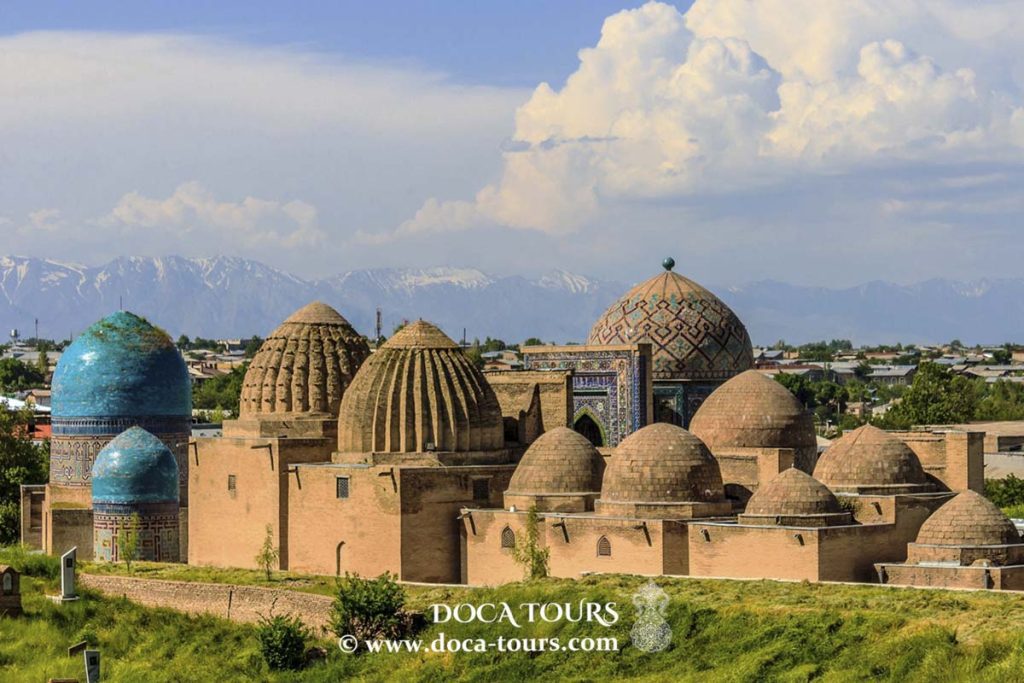
The beginning of the ensemble formation dates back to the XI century when Samarkand was one of the most important cities in the region. The city was located on the territory of the modern settlement of Afrasiab, and trade and craft life was concentrated in its suburbs, known as rabads.
The Shahi-Zinda complex got its name “The Living King” due to an interesting legend associated with the name of Kussam ibn Abbas, a cousin of the Prophet Muhammad. The governor of Mecca, Qusam, visited Samarkand in 676 on a mission to introduce Islam to the local population. While the Muslims who followed Qussam were busy performing the sacrament of namaz, the pagans from Penjikent suddenly attacked the praying people, among whom was a relative of the Prophet. At this point, the opinions of Arab historians differ: One legend says that a pagan’s arrow killed Qussam ibn Abbas; another says that he disappeared right in front of the infidels in a crack that appeared in the minbar (place of prayer) that split open under him; A third legend says that Kussam was helped to escape and reach the well of Shaaban by Saint Hyzr, in this well he hides to this day; a fourth legend says that right near the well of Shaaban Kussam’s head was cut off by a blow of a sword, but he managed to drink the “living water” from the well and received immortality. Therefore, the tombstone of the saint is adorned with the following lines: “Those who are killed in the way of Allah, do not consider them dead: no, they are alive…
The tomb of Qussam ibn Abbas is the foundation of the entire Shahi-Zinda ensemble. It was built in the XI century and was the first mausoleum in the chain of tombs of Shahi Zinda. The door leading to the tomb of Qussam ibn Abbas is one of the most attractive elements of the mazar. It was made in 1404 by a master carver of elm tree named Yusuf Shirazi. The door was originally decorated with ivory inlay, although unfortunately this decoration has not survived to this day. However, the inscription on the door, which reads: “The Prophet of the Arab, Hasham, Quraysh, Mecca and Medina, peace be upon him, said: Kussam, the son of Abbas, resembles me more than others in his appearance and character”, is still visible and gives special significance to this element of the ensemble.
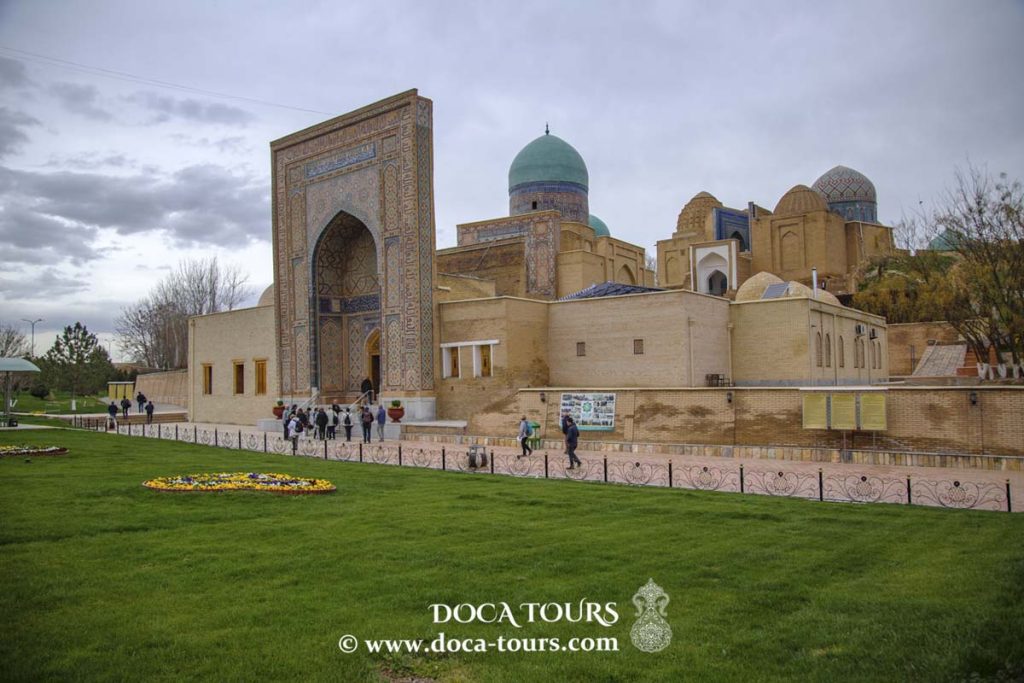
The tiers of Qussam ibn Abbas’s tombstone are inscribed with sayings from the Qur’an in gold. This gives the tombstone a special religious and artistic value and emphasizes the sacredness of the site. The Quranic sayings on the tombstone serve as a reminder of the spiritual significance and greatness of this place. At that time, it was believed that building a shrine near the tomb of a saint could help to forgive all his sins. This is one of the reasons why the mausoleums in the Shahi-Zinda complex stand so close to each other. Believers believe that proximity to a saint and his tomb can bring them spiritual purification and blessing. But especially “lucky” were those buried in the “Northern Court” Tamerlane’s wife Tuman-aka, the religious educator Khodji Akhmal and the mysterious “girl who met her death chaste” in 1360. Although much information is unknown about the last person, her presence in the complex gives it even more mystery and interest.
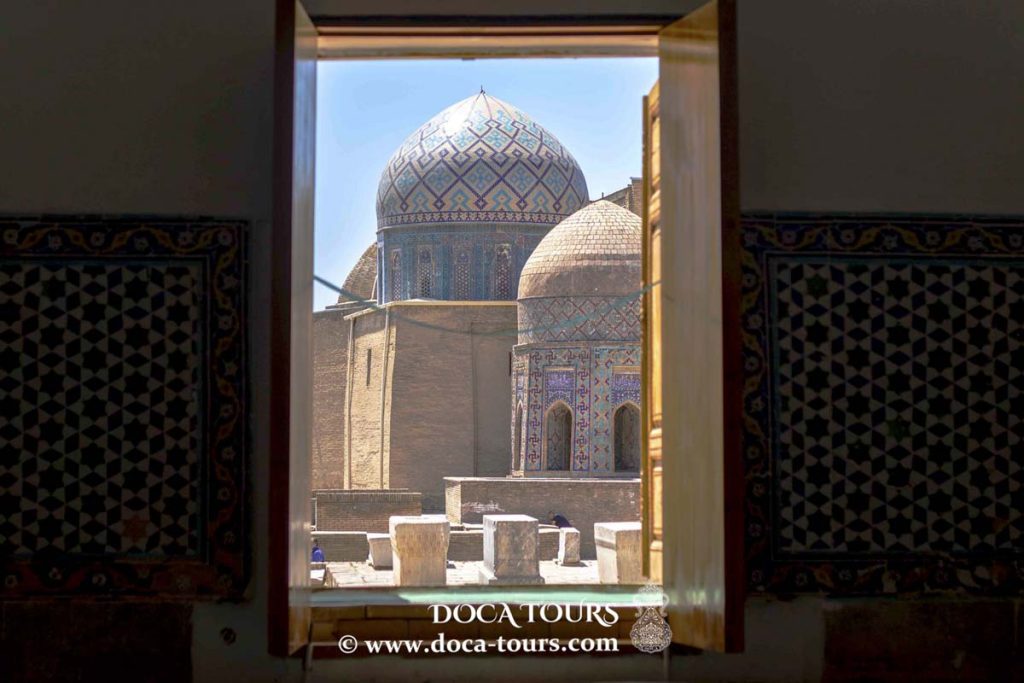
The Shahi-Zinda complex consists of several rooms, including a small mosque (ziyorathona), a gurkhona (tomb), a chillakhona (place for 40-day fasting) and a tugkhona (storage of religious equipment). Between the mosque and the tomb, there is a lattice of wood with ornate patterns. In the tomb, there is a famous tombstone made of ceramics, which is considered one of the best examples of art of that time in Central Asia.
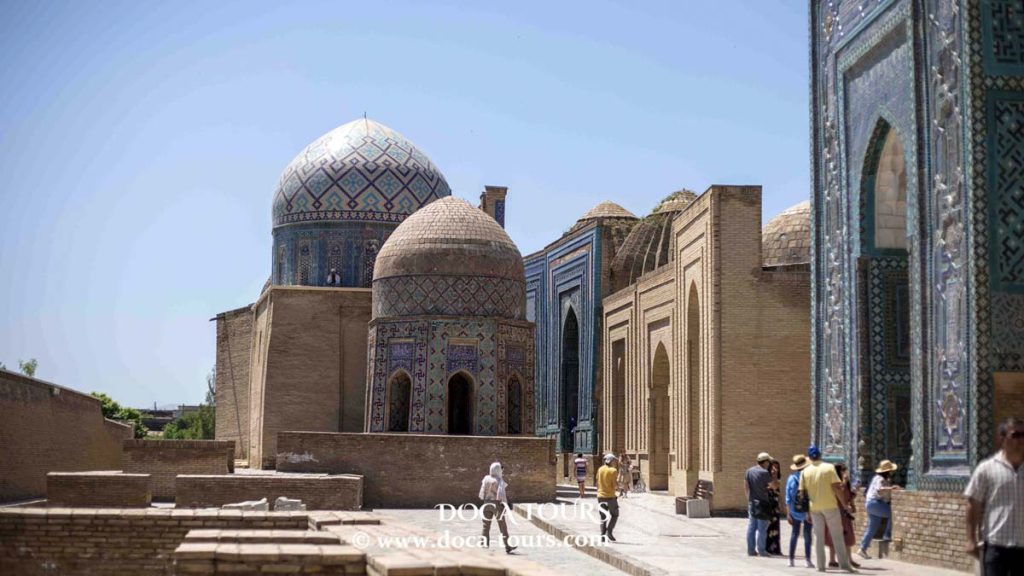
The Tuman-aka complex stands out for its diverse color scheme. It is made in purple color, which creates an impression of uniqueness and attracts the attention of visitors. The interior of the mausoleum also impresses with its muted finish and beautiful panels depicting magnificent landscapes. This adds to the atmosphere of beauty and grandeur of the place.
The complex stands out for its gracefulness and unique proportions. The interior of this mausoleum is much smaller than in other structures, yet it is one and a half times taller than the surrounding mausoleums. This gives an impression of grace and elegance to this structure.
The unfinished building, which is located in the heart of the Shahi-Zinda ensemble, is the mausoleum of Emir Burunduk, Tamerlane’s loyal military leader. This mausoleum was built using funds obtained during the military campaigns that brought Emir Burunduk fame and wealth. The interior decoration of this mausoleum is characterized by modesty: the walls are covered with white plaster and the panels are decorated with large majolica slabs. The interior decor of this mausoleum is characterized by modesty and simplicity. The walls are covered with white plaster and the panels are decorated with large majolica slabs. This creates an atmosphere of simplicity and tranquillity, reflecting the humble lifestyle and military achievements of Emir Burunduk.
Next to the mausoleum of Emir Burunduk is the tomb of the master from Nessefi, Usto Ali Nessefi. His name completes the ornamentation of the right column of the portal. This mausoleum is known as a majolica mausoleum, as it was faced with carved ornamental terracotta. This creates a unique and impressive appearance of this structure.
To the south of the tomb of Kusam ibn Abbas there is Khatun-Maliki Square, which, unfortunately, has not survived to our time. Many archaeologists believe that on this place once stood the Tamgach Bogra-Khan madrassah, built by order of the ruler of the Karakhanid dynasty – Tamgach Bogra-Khan. The madrassah served as a public-educational center and was dismantled by the 90s of the XIV century.
“The Pearl of Shahi Zinda” is considered to be the mausoleum of Shadi-Mulk-Aka. This mausoleum was built in 1327 for Timur’s niece, Shadi-Mulk-Aka. It is one of the earliest structures in Samarkand built during Timur’s time. Decorated with many ceramic slabs on the walls, this mausoleum impresses with its intricate ornamentation and the image of flowing vines on the tympanum above the arch. Its grace and beauty are truly mesmerizing.
One of the most impressive structures in artistic terms is considered to be the tomb of Shirin-Bek-Aka. Its lightness and spaciousness, as well as the use of carved set mosaics of different colors, create a magnificent effect and emphasize the beauty of the ornaments. The interior decoration of the mausoleum shines with the originality of the compositional solution, and the panels with landscapes on the walls add to its special appeal. Many archaeologists consider the tomb of Shirin-Bek-Ak to be the most perfect construction in artistic terms.
On 17 July 2004, the Government of Uzbekistan established the Public Foundation for the Restoration of the Shahi-Zinda Mausoleum Complex and the Museum of Glazed Decorations. Since that time, restoration work has begun on the architectural structures in the complex. These efforts are aimed at preserving and restoring the historical and cultural heritage of Shahi-Zinda for future generations.
The ensemble has an honoured place in the UNESCO World Heritage List. This recognition confirms its historical and cultural value, as well as its uniqueness and importance for all mankind. Shahi-Zinda is one of the most significant and visited tourist places in Uzbekistan and attracts attention with its architecture, history and spiritual atmosphere.
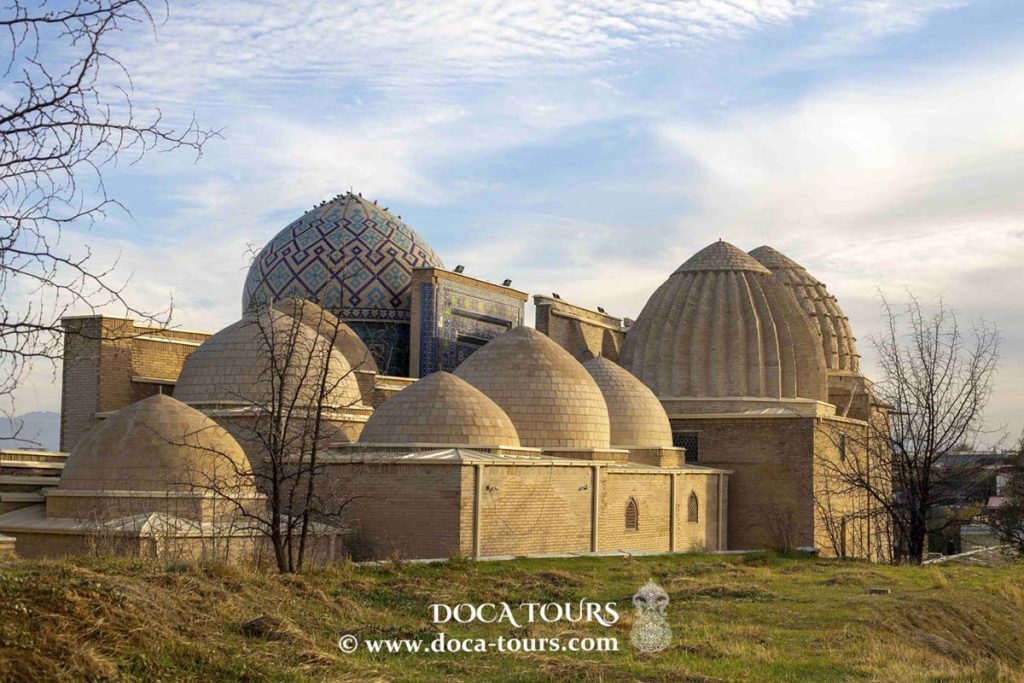
Each of the mausoleums in the Shahi Zinda ensemble is a virtuosic work of art of architecture of the XIV century. Six centuries have passed since their construction, but they still impress with their architecture, decorations and details. This testifies to the skill and talent of the architects of that time, as well as to the significance and cultural heritage of the ensemble.
A visit to Shahi Zinda is an unforgettable experience that will allow you to immerse yourself in the history and culture of this fascinating place. You can walk around its grounds, explore the mausoleums and learn about their history thanks to the information signs.
For those interested in photography, Shahi Zinda offers endless possibilities. You can capture the beauty of the architecture and create impressive photographs that will stay with you for a lifetime.
And don’t forget about the local culture and cuisine! In the vicinity of the complex, you will find numerous restaurants and cafes where you can try national Uzbek dishes. Be sure to try plov, shashlik and suzma to experience the unique flavors of this culture.
Don’t miss the opportunity to visit Shahi Zinda and discover the magic of this wonderful place with DOCA TOURS. DOCA TOURS will provide you with a professional guide, comfortable transport and quality service to make your journey unforgettable.
We are not saying goodbye to you, see you again on our channel.
Thank you very much for your attention.
Subscribe to the channel and don’t forget to like our videos.
#adult, #shakhizinda, #people, #persian, #photography, #portrait, #religion, #samarkand, #silk road, #one person, #spirituality, #tile, #tomb, #tourism, #travel, #travel destination, #uzbekistan, #pattern, #old, #ancient, #cultures, #architecture, #art, #asia, #building exterior, #cemetery, #central asia, #craft, #decoration, #mosque, #famous place, #fashion, #history, #horizontal, #islamic, #mausoleum, #memorial, #woman