























Ancient fortresses of Khorezm – Toprak kala, Ayaz kala
Video: https://www.youtube.com/watch?v=2oGTx2v6Kbk&t=33s
Within the endless sands of the Kyzyl Kum desert, the Khorezm oasis is stretched, which conceals many secrets and mysteries. Sources of the era of the Arab conquest call Khorezm – the Land of a Thousand Fortresses. Indeed, archaeologists have discovered many ancient settlements on this territory which once had been powerful fortresses and royal palaces. Thousands of fortresses spread over vast arid steppes and as gigantic statues keep the secrets of Ancient Khorezm. Even today, the grandeur and scale of the ruins amaze with their magnificence and power.
The first mentions about Khorezm (which means “Sunny Land”) are found in the Behistun inscription of Darius I. The sacred book of Zoroastrians the Avesta states that Khorezm is one of the first and best countries created by the supreme God Ahuramazda. It was exactly here that the unique culture of the Khorezmians was originated, comparable in importance to Egypt and Babylon and which had left behind an invaluable heritage.
Khorezm attracted attention and interest of numerous states of the East up to the Great Roman Empire in the West. In order to conquer this rich country praised in legends, the Achaemenid kings and Alexander the Great made their campaigns. The plundering offensives of the mighty Hephthalites, the colonization and domination of the powerful Seljukids, the victorious wars with the Karakitays in the Middle Ages testify to the enormous authority of Khorezm.
Nourishing with the mountain glaciers of the Pamir, the great Amu Darya River that time as today, carried its waters for a thousand kilometres to form a fertile oasis in the lower reaches at the outskirts of the Kyzyl Kum desert. Seasonal irrigation associated with river floods, the Aral Sea coast rich in fish and fowl and endless pastures has made this land the cradle of a unique culture that has left behind grandiose monuments – lost cities and gigantic fortresses.
Until the 30s of the XXth century, when began excavations which were carried out by the Khorezm archaeological and ethnographic expedition under the leadership of S.P. Tolstov, very little information was known about this ancient country. But the results of the excavation exceeded all the wildest expectations. Tolstov made a real scientific discovery, which is now considered one of the greatest achievements of world archeology. He discovered and studied an ancient and unique civilization completely unknown before, which is comparable only with the discovery of Troy or the Cretan civilization.
The long-term research carried out in Khorezm, as well as the study of the available written sources, showed that there are 64 archaeological monuments in this region, called cities. Historical information has been preserved about 32 of them. Archaeological studies were carried out on 20 sites, which confirmed the references in the works of medieval authors. Today the ancient cities have largely fallen into ruins, but archaeologists continue to study them. Most of the Khorezm cities were located on large caravan routes, mainly passing through Khorasan, Gorgan (a city in Iran, the administrative center of the Golestan province) and Maverannahr along the two banks of the Amu Darya to its delta. Individual cities and fortresses in most cases were located in the steppe regions of Central Asia, closer to the settlements of nomadic tribes.
In the first century BC, Central Asia became part of the Kushan Empire. During the reign of Kanishka (78–123), the Kushan empire became a powerful, strong state, acting on the world stage on an equal right with Rome, Parthia and China of that time. The remarkable architectural monuments and sculptures that appeared at this time have survived until our days. At this time, as before, irrigation systems were developed and improved, old fortresses were rebuilt, new settlements and fortresses appeared. Among the new large irrigation structures, the Kyrkkyz and Toprak kala canals can be mentioned. On the outskirts of the oasis, new fortifications characteristic of the Kushan era were erected. Among them are the Gyaurkala monument in the lower reaches of the Chermenyab and the Devkeskan-Kala fortress in the Ustyurt steppes. As a result of the development of irrigation structures, fortified cities and fortresses such as Ayazkala, Kizil-kala, Kargashin-kala, Toprak kala, Bolshaya Guldursun, and Kichik Kyrkkiz appeared. Among these monuments, Toprak kala deserves special attention.
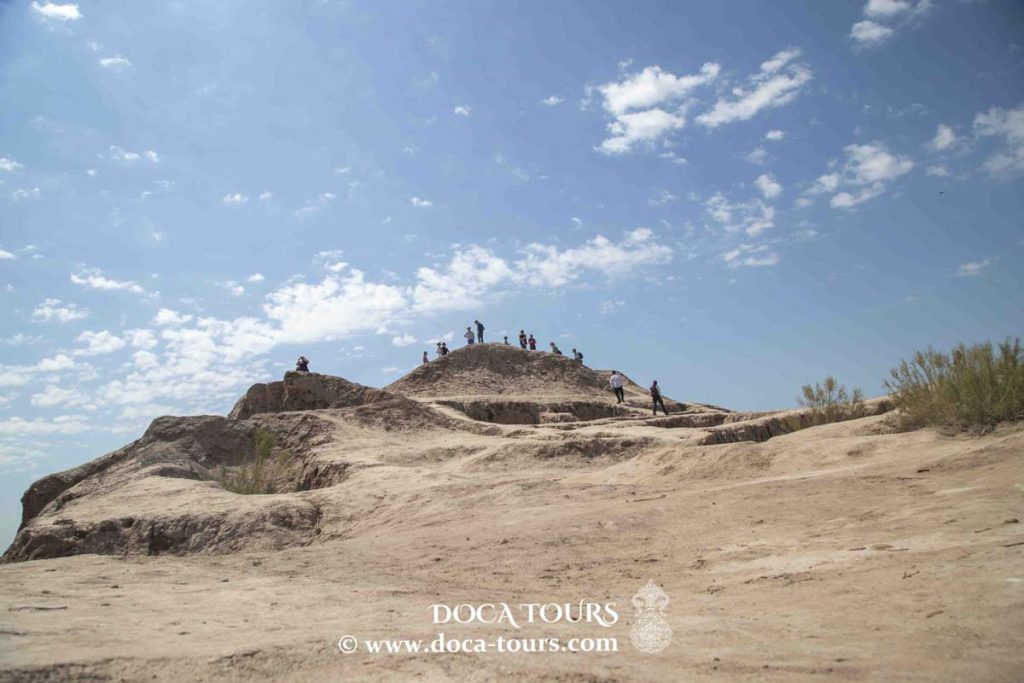
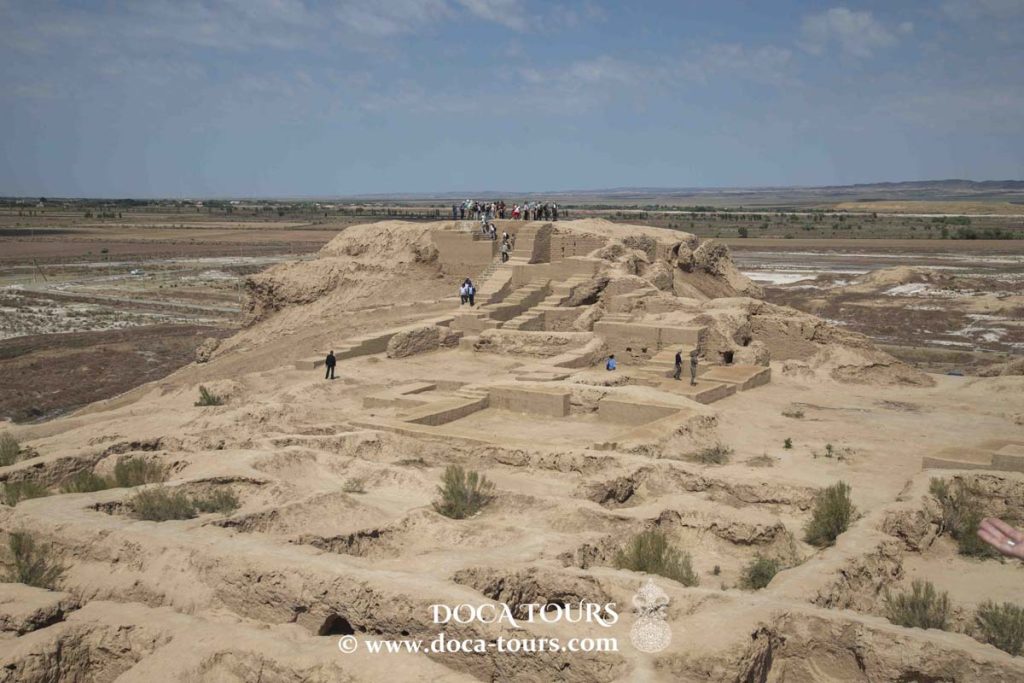
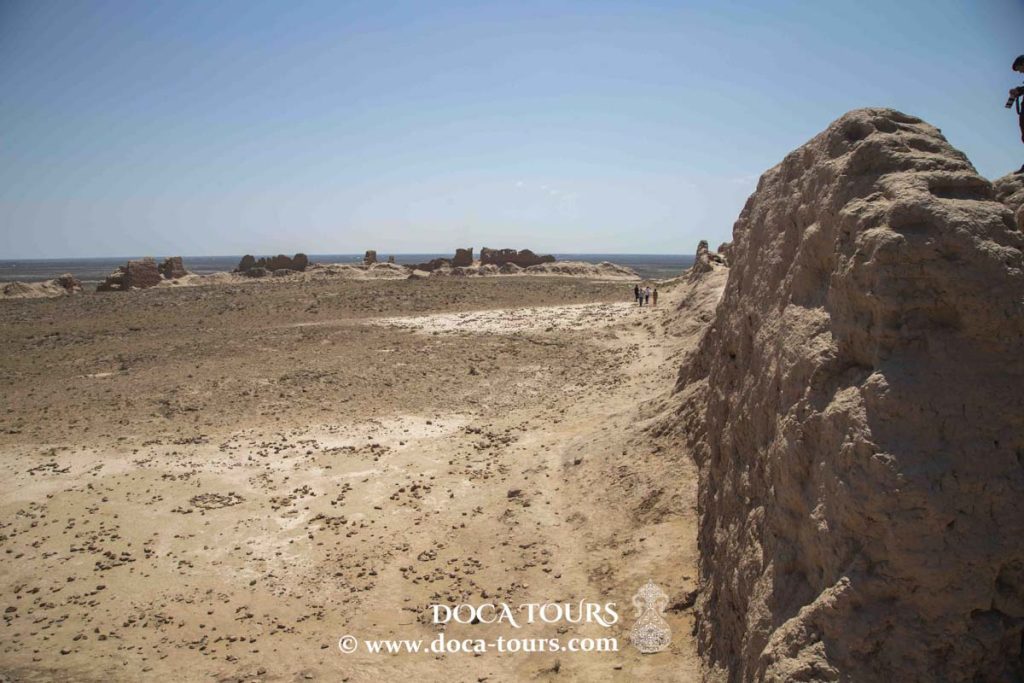
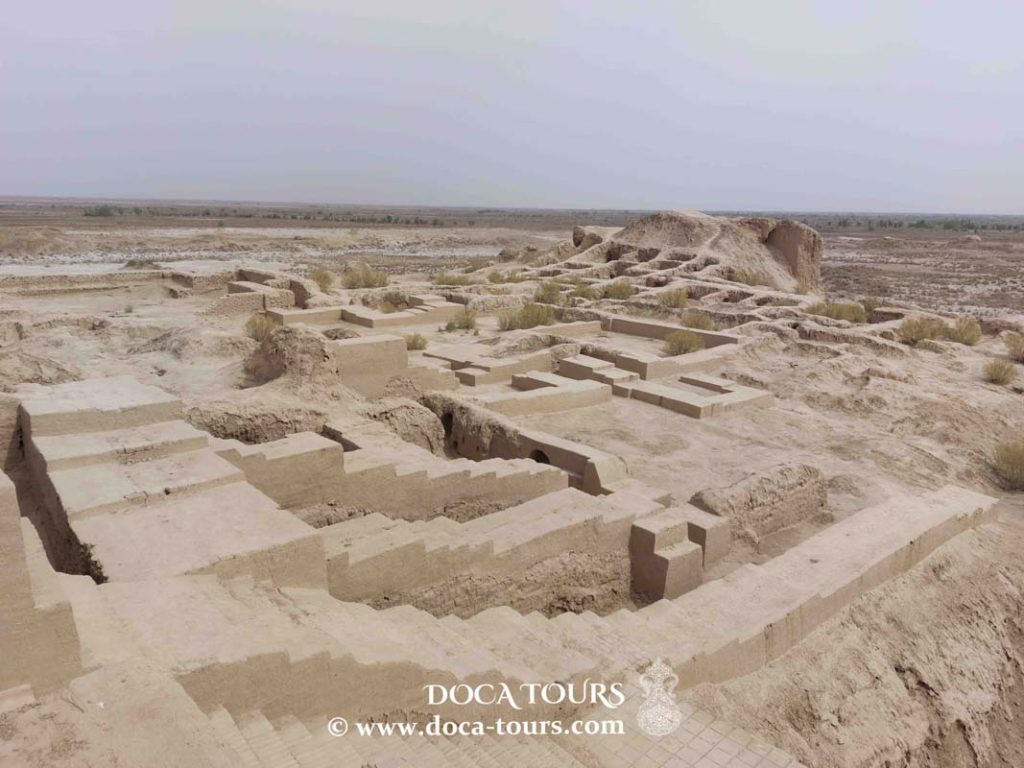
Toprak kala is located a few kilometers south of the Sultan Uvays ridge in close proximity to the Nukus-Turtkul highway. It is a vast ruin that still rises to a height of over twenty meters above the surrounding agricultural land. An ancient system of canals brought water here from the now dry branch of the Oks River.
Its name can be translated as “Earthen Fortress”. The best Khorezm architects who were famous for their high skill were engaged in the construction of this settlement. It is hard to believe, but a lot of Toprak kala structures have survived to this day, despite the low quality of building materials at that distant time. The builders used large mud bricks, clay, small stones and river sand. As a result of their work, the inhabitants of the settlement had warm and dry dwellings that could withstand all unfavorable weather conditions.
Toprak kala served as the residence of the Khorezmian kings. The fortress was built in the form of a rectangle stretched from north to south and with the dimension of 500×350 (five hundred to three hundred fifty) meters. The fortifications consisted of straight walls with archery galleries, rectangular towers spaced at equal intervals along the flanks, and a larger tower in the northeastern corner. Two-storey defensive galleries were built inside the walls. The lower gallery served for hidden movement and rest of the soldiers, and the upper one was for shooting. The city was defended through the arrow-shaped loopholes. The height of the walls reached 14 meters.
As an additional barrier, a moat was built in front of the fortress walls, which was a characteristic phenomenon of that time. The moat of Toprak kala surrounded the city walls from all sides and was arranged at a distance of 15 meters from the walls. Its width was 16 meters, and its depth reached 3 meters.
The only entrance to the fortress was built in the center of the southern wall. The city gates were considered the most vulnerable and weakest point in the defense, for this reason the builders of Toprak kala allocated an entrance to a special fortification with a passage in the form of a cranked labyrinth.
Approximately 9 meters wide Central Street passed along the entire long axis of the city, and the side streets and lanes formed residential quarters on both sides of the main street. Some of them were used as workshops and production areas. One site was set aside for a temple complex, which, judging by the amount of ash in and around the buildings was a fire temple. A large number of precious items have been found in the adjoining building, including bracelets with swirls of ram’s horns, glass jars, beads and rings. Fragments of plaster statues and pieces of gold leaf were also found. Both buildings date back to the 4th-6th centuries AD. The population of Toprak kala was about 2.5 thousand adults. Moreover, most of them were engaged in the protection and maintenance of palaces.
The most interesting buildings were located in the northern part of Toprak Kala, which occupied almost a third of the city’s territory. The northeastern corner was set aside for a bazaar or city square. The north-western corner was occupied by the citadel, which was fortified, in fact, “reserved” city with an area of 3.2 hectares. In the northwest corner, there was a huge three-tower royal palace built on a brick platform 12 meters high. It was a building that had no analogues either in Khorezm or in Central Asia. Even now, the grandiose palace towers over the territory of the city with a mighty bulk. This is fraught with many mysteries. Inside the citadel, at the foot of the platform of a high palace, archaeologists have discovered a temple of fire. In the central building of the Toprak kala palace, there were many different – residential, ceremonial, utility and utility – premises, some of which occupied two floors. All these premises were clearly divided into several independent complexes for a specific purpose, separated from each other by powerful walls.
Toprak kala is known not only for its bizarre architecture but also for the unique finds of ancient Khorezm writing. Documents written in the ancient Khorezm language were found in four rooms in the southeastern part of the palace. A total of 116 documents were found, written in black ink on wooden tablets and on leather scrolls. Eighteen documents on the tree are very well preserved. Although the documents have not yet been fully read, their character has already been determined. These are the economic documents of the palace archive.
Many rooms of the palace were decorated with wall paintings and clay sculpture, but the most beautiful was a huge central main hall (about 280 sq. meters) – “The hall of kings”, where 23 clay statues of Khorezm rulers stayed along brightly painted walls, each of statue was bigger than natural size in two times. Unfortunately, these sculptures are preserved only in fragments. Among the fragments of torsos, arms, legs, heads, there are no faces; evidently, some of the conquerors destroyed them intentionally. Facts that these statues represented the kings exactly, evidenced by the findings of two sculptures crowns, known as images on the coins. Each ruler depicted seated, was surrounded by standing figures of women – queens and princesses, men – princes, close noblemen and children. A real “portrait gallery”! However, only two badly damaged heads – woman (“wife of the king Vazamara”) and youth-prince, have survived now. Despite the damage, it is noticeable that the sculptor tried to show us the personality traits of the person.
The decoration of “The hall of dark-skinned warriors” was no less interesting and rich. This big (about 60 sq. meters) building was also decorated by a clay sculpture. However, the planning and structure of “The hall of warriors” repeated fully the planning and structure of living space for the usual Toprak kala palace. It let scientists suggest, that “The hall of warriors” was a royal bedchamber. There was a fireplace at one wall of “The hall of warriors”. There were big clay statues of rulers in niches along walls, and there were figures of warriors with the arm in hands-on special supports between statues. “The hall of dark-skinned warriors” is a particular mystery, because, according to academic M.M.Gerasimov’s reconstructions, the Khorezmians were Caucasian sort of people, they were bright-eyed blonds with the delicate cast of features, but with swarthy or bronze skin.
Another ceremonial room of the Toprak kala palace was named by archaeologists “The Hall of Dancing Masks”. The decoration of this hall was dedicated to the cult of Dionysus – the ancient Greek God of wine and fun, popular not only in the ancient world. The bas-reliefs decorating the walls of the hall depicted Bacchic dances. Perhaps the dancers were wearing Dionysian masks – during excavations, archaeologists found the head of one of the characters with a long black beard and goat ears.
The relatively small, but richly decorated “Hall of the Deer” got its name from the clay reliefs that adorned it with figures of grazing fallow deer, rendered almost in full size. Judging by the remains of the paintwork, the fallow deer were brown and the background blue. The images of fallow deer were complemented by trees entwined with vines, branches with pomegranate fruits.
Smaller rooms – probably residential – were decorated with multi-coloured wall paintings. One of these premises was named “The Harpist’s Hall” – after the image of a young woman with a harp found here. Another room (“The Hall of Heart Ladies “), which was probably part of the complex of the harem rooms, was decorated with images of women against a light background covered with red hearts.
“Near the fortress, surrounded by cultivated fields and vineyards at the time, there was a country residence and hunting park behind the square fence.
Unfortunately, most of Toprak kala ‘s material finds have not survived modern times. In the midst of S.P. Tolstov’s research, the Second World War broke out, and the expedition was curtailed, not having time to preserve all the artifacts. Many of the most valuable finds excavated – sculptures and frescoes – were badly damaged by rain and temperature changes, since most of them were made of the same material as the majestic structures themselves – from ordinary clay.
In contrast to Egyptian pyramids and palaces of Babylon, the castles of ancient Khorezm were built without stone, because there was no limestone and facet in the neighborhood, and the wood of tugai tangle did not fit for making logs and boards. But the Khorezmians, evidently, had unique building secrets, which let raise very stable buildings from mud bricks and clay. Packing, collected in the desert was strengthening streak in brickwork, and bank sand, absorbing rainwater, provided the dryness inside the building. Toprak kala was made from millions of big brick blocks, sized 40х40х12 sm. All wheels of the state were brought into making and delivery to the place of the building. Archaeologists, having studied original “trademarks” on each batch of bricks, had concluded in that time Khorezm state included no less 15 provinces with a population of about 30-50 thousand people in each.
Calculations helped to understand why the gigantic castle, which stood for almost 2000 years, was abandoned by its inhabitants just two hundred years after its construction. Initially, it was believed that the area could become depopulated due to the fact that the next turn of the Amu Darya channel left irrigation canals without water, the largest of which extended 70 kilometers from the river banks. But now scientists are inclined to believe that Toprak kala could have been abandoned for purely political reasons. In 305, the founder of the new Afrig dynasty moved his residence to Kat in the territory of the modern city of Biruni.
One and a half kilometers west of Toprak kala, there is another very interesting fortress called Kyzyl Kala. The word “kyzyl” in translation from the Turkic language means Red. This is because the fortress has a reddish tint, which is especially noticeable during sunrise and sunset. The fortress was erected as a defensive fortress, which was part of the fortification system of the ancient settlement of Toprak kala.
Until now, there are disputes about the purpose for which this fortress could be used. Moreover, some scholars suggest that it was used as a garrison barracks for troops, while other scholars believe that it is an early example of one of the many fortified mansions that were typical of Khorezm in the early medieval period.
The fortress was erected at the same time as the Toprak kala fortress, approximately in the 1st-2nd century AD. According to the legend, the fortress was connected by an underground tunnel with the Toprak kala fortress. In the event of an invasion of enemies, the rulers could leave the castle through an underground passage. However, the question of whether there is any connection with Toprak kala has not yet been investigated.
The fortress was built on a raised platform on the southern part of the Sultan Uvaisdag mountains. It has an almost square shape, with a size of 65×63 m. The height of the walls reaches 16 m, and the corners are oriented to the four cardinal directions. There are two protruding rectangular towers in the center of the northwest and southwest walls. They contained several small rooms. Inside the walls, on three sides, there was a wide two-meter corridor that served for the movement of soldiers. The entrance to the fortress was carried out from the south-eastern part of the wall through a special ramp that led to the gates of the fortress. This was the most guarded part of the fortress.
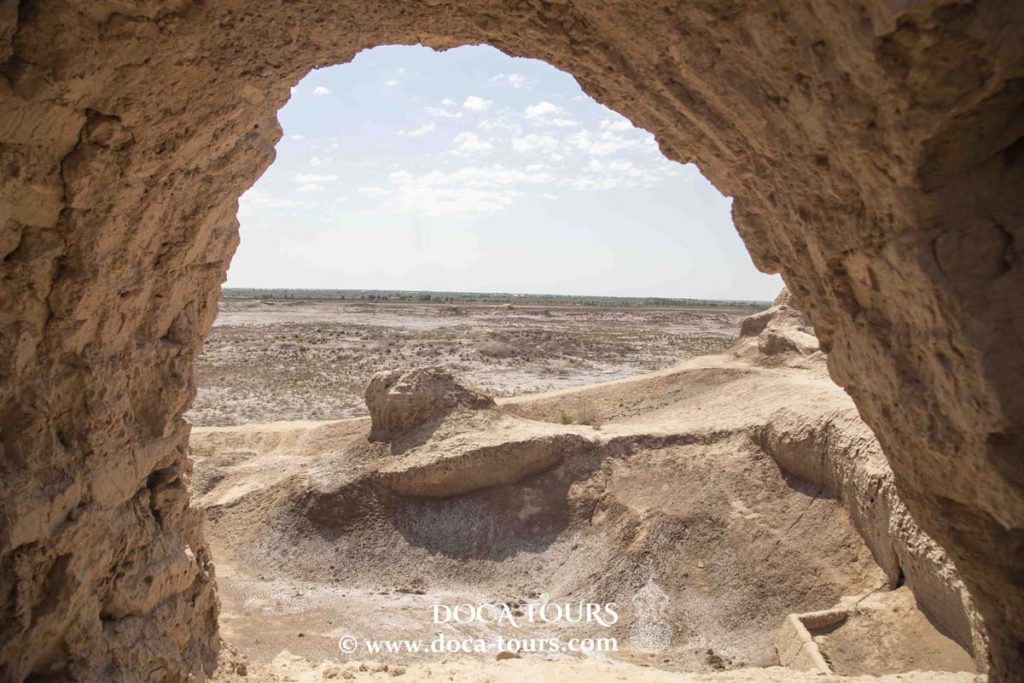
The inner part of the fortress is well preserved, and visitors entering here will find themselves on the second floor, while the lower rooms can be seen in places where the clay bricks are eroded. Inquisitive locals often crawled into these underground chambers, being confident that they could find gold, but most often they encountered snakes that like to hide from the scorching sun here. This gave rise to a legend that says that large piles of gold are hidden in these rooms, but no one can get them, because the gold is guarded by a huge snake or demon.
During excavations in different parts of the fortress, the remains of wall paintings were found in the layer of destruction. They were located at different levels and occupied different positions. Frescos that lay face down were found on the floor of the second floor.
Three fragments of frescoes were extracted from the layer. The surviving remains of the painting are represented by plant subjects. The painting was done on a thin layer of alabaster priming applied to the clay plaster. The images were outlined with a black line, executed in dark red, red-blue, yellow and black paints.
Life in the fortress ended after some kind of catastrophe associated with a big fire. It is possible that this event was associated with the Mongol conquest.
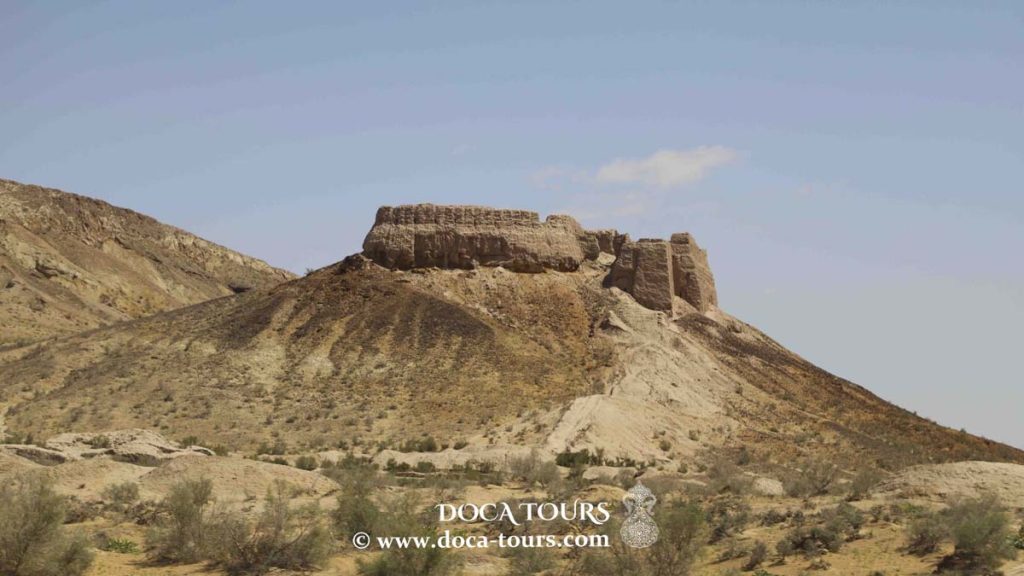
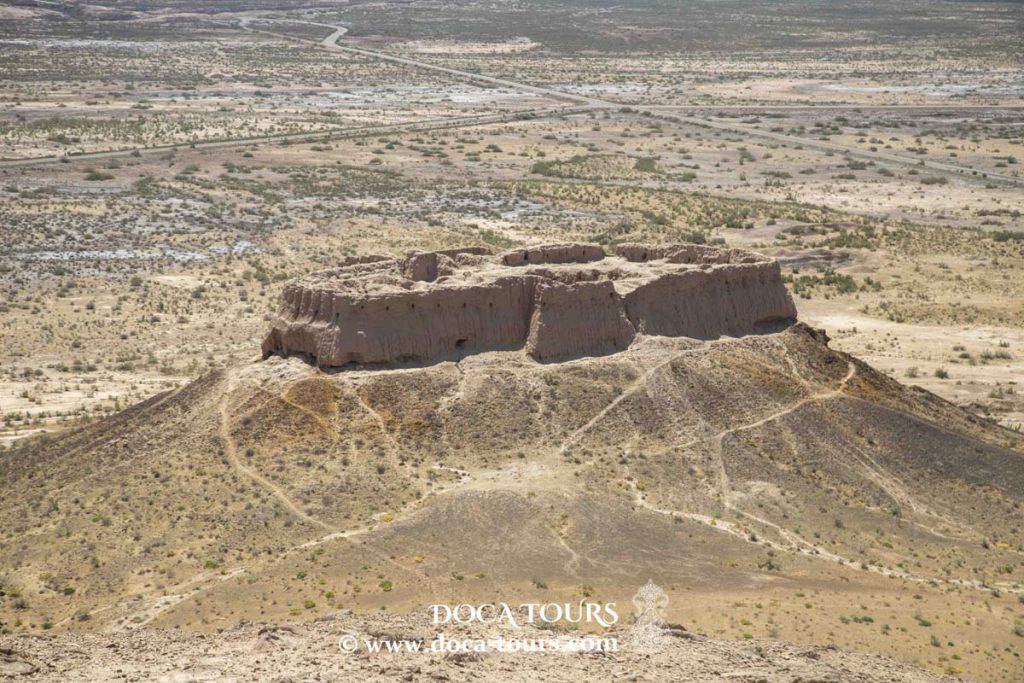
Ayaz Kala is one of the most impressive fortresses in Khorezm. There are in fact, not one but three fortresses clustered together on and around a prominent hill at the eastern end of the Sultan-uvays range. The earliest is Ayaz-kala I, located on the top of the hill, one of the forts along the edge of the K’iz-il-kum desert, providing defense against nomad raids and the Saca lands of the Syr-dar’ya delta to the north.
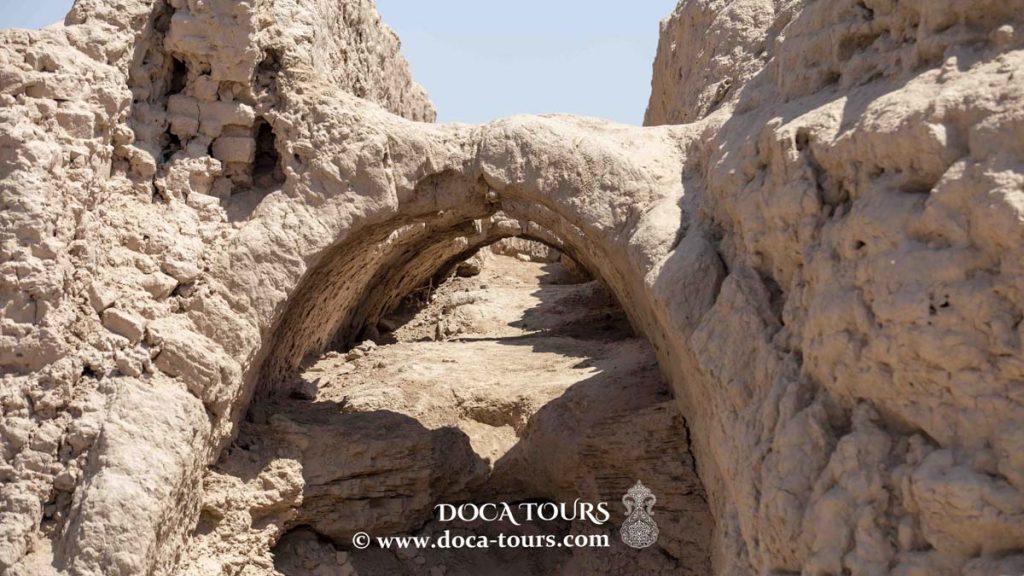
Ayaz-kala I has an area of 2.7 hectares and is rectangular in plan. The walls are well preserved up to 10 meters in height with regularly spaced towers, double storey archer’s galleries and arrow slits that can still be seen clearly. The lower gallery was entered at ground level next to the gate. The galleries would have provided cover and ease of movement for the many archers needed to defend the fort. The arched vaults of the lower galleries are still preserved in places and the visitor can walk along inside them. Construction began in the 4th century BCE when the galleried enclosure was built. Later, in the 3rd century BCE, rounded towers were added. The complex gateway is typical of Khorezmian frontier fortresses. The approach lies parallel to the south-east wall where invaders would be vulnerable to attack from above. A massive gateway defended by two rectangular towers leads into a small rectangular chamber overlooked on all sides by high walls from which bowmen could shoot at the enemy should the first gate be breached. A right-angle turn towards the second gate leading directly into the fort would break the force of a charge through the first breach. The fortress is thought to have continued in use up to around the 1st century CE, although it may have provided refuge for local inhabitants well into the early medieval period.
There is a legend associated with the fort that long ago a Khorezmian king ordered a fortress to be built to protect the northern borders of his lands from the desert nomads. He declared that the man who could build such a fortress would receive his beautiful daughter’s hand in marriage. A shepherd by the name of Ayaz living on the borders of Khorezm began to build a fortress but then learned that the king had gone back on his word and given his daughter to another man. Hearing this, he immediately stopped work on the fort and it remained unfinished. The curious thing is that archaeological research has shown that the fort is, in fact, unfinished. For the hardy visitor, a steep rocky path leads down the scree slope from the south-west corner of Ayaz-kala-I to the saddle between the hill and the smaller peak on which sits Ayaz-kala II. The less sure footed are recommended to return to the rest centre and walk down the gravel road to the bottom of the hill.

Ayaz-kala II is a small, roughly oval fortress linked by a steep ramp to an open settlement down on the plain to the west. The fort dates to medieval times. It was probably founded in the Afrighid period, some time around the late 7th to early 8th centuries CE. The walls are built of mud brick on a pakhsa socle and the tops of the walls were protected by battlements with arrowslits in the crenellations. The interior structures are well preserved and the interior surface is, in fact, the roof of the rooms. Remains of vaulted ceilings can be seen in places where some erosion has occurred. A ramp once extended down from the gateway of the fortress to the entrance of a large palatial building at the base of the hill. This palace has been described as the most beautiful early medieval building in all of Central Asia, with its large columned halls, elegant bench seating, ceremonial platform, wall murals, and fire sanctuary. Coins of the Afrighid Khorezmian kings were found here, notably those of King Bravik. This palace was built around the 4th century CE and was later destroyed by two successive fires. It was briefly reinhabited as a domestic dwelling in the 6th/7th centuries CE.
Ayaz kala III is a fortified enclosure in the shape of a parallelogram sited on the open plain below Ayaz-kala I. The enclosure has a double wall defended by rectangular towers around the whole perimeter and an elaborate gateway in the middle of the western wall. The site is about 5 hectares in area and the enclosure walls date to the 1st–2nd centuries CE, while the monumental building in the north-east corner may have an earlier foundation date around the 5th–4th centuries BCE. It is likely that Ayaz-kala III was used in Kushan times in the first centuries CE as a garrison, or possibly as a ruler’s residence and refuge for the local farming population, while a small force may still have manned the old Ayaz-kala I fortress on the hilltop simply as a lookout post. Surrounding the enclosure was found the remains of many farmsteads, with dwellings, fields, field walls and vineyards.
We know from historical monuments that the Khorezm Empire retained its greatness up to the Mongol invasion. Studying the ruins of ancient structures, we can imagine the life of cities, the rapid flourishing of crafts and trade, the noticeable development of art, a network of large irrigation structures, a system of fortresses and dozens of caravanserais. Among the numerous structures in Khorezm, only half have been explored so far. The chronicle of the dead cities of this state is replete with undeciphered pages that will surely be read sooner or later. Perhaps, the history of ancient Khorezm will eventually reveal all its secrets.
Thank you very much for your attention.
Subscribe to the channel and don’t forget to like our videos.
#karakalpakstan, #uzbekistan, #landscape, #desert, #kala, #attraction, #fortress, #history, #asia, #toprak, #nature, #historic, #picturesque, #travel, #landmark, #khorezm, #ayaz, #tourism, #xorezm, #monument, #view, #ancient, #sand, #ruins, #kyzylkum, #central asia, #day, #sunny, #historical, #fortification, #scenery, #east, #archeology, #ayaz-kala, #sky, #scenic, #kizil, #tourist, #settlement, #summer, #medieval, #kyzyl, #erosion, #hill, #uzbek, #breathtaking, #topraq, #culture, #bushes, #karakalpakistan