
























Uzbek Silk Production: A Millennia-Old Tradition Along the Silk Road
Brought to the Fergana Valley in the 4th century from the Chinese Empire by clever merchants of the ancient region
of "Dawan," it has evolved into one of the region's most important craft sectors. Today, Uzbekistan is
the world's fourth-largest silk producer (after China, India, and Japan) and exports its masterful fabrics across the entire globe.
When you travel with DOCA TOURS to the Fergana Valley, you can experience this fascinating evolution firsthand—from
the unassuming silkworm to the luminous "Abr" fabric (Ikat).
The Natural Origin: Silkworms and Mulberry Trees
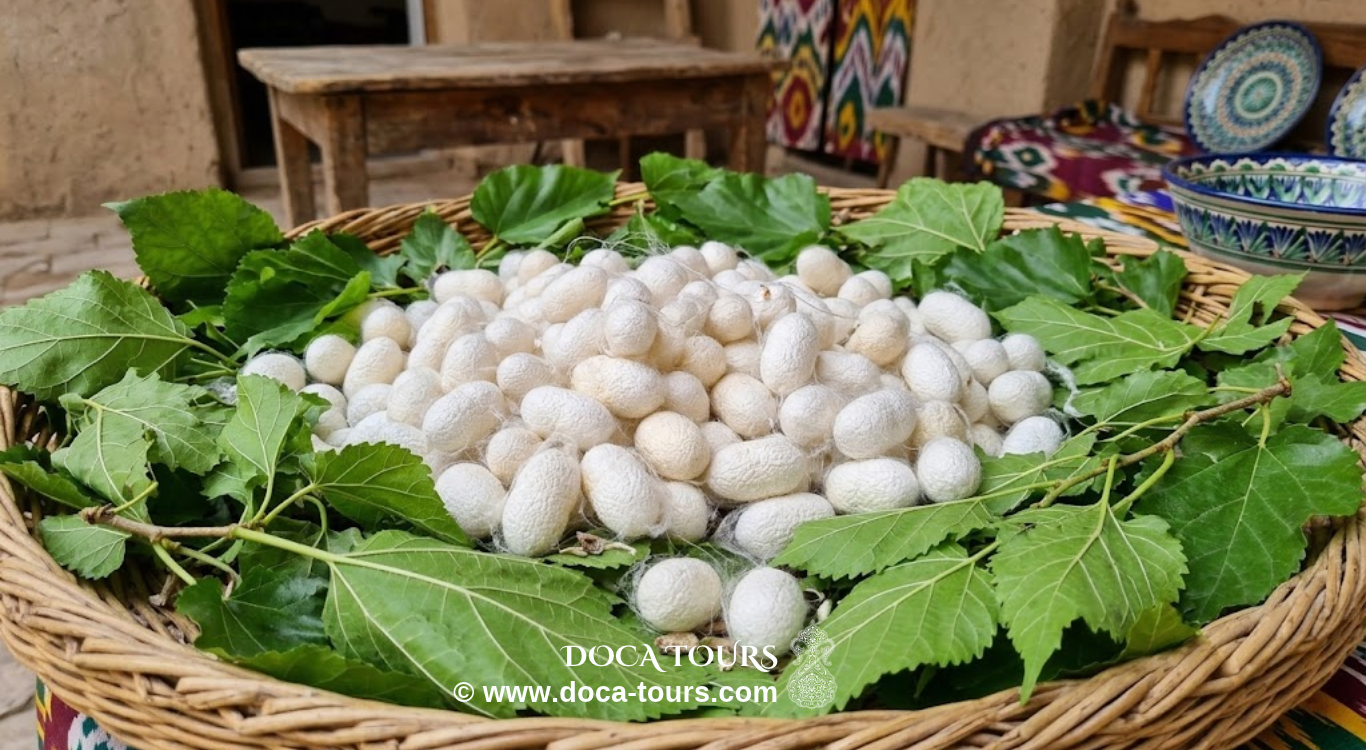
The production of this precious raw material begins with meticulous breeding. The silkworms are kept in special, well-temperature-controlled
rooms in family courtyards or modern farms. From a tiny, rice-grain-sized worm to a finished cocoon takes 28 to 29 days of
intensive care, typically from mid-April to mid-May. During this time, the silkworms feed exclusively on the fresh, tender leaves of the mulberry tree.
After the cocoons are harvested, the silk threads are unwound in a fascinating process, partly still performed on traditional wooden wheels.
The Art of Natural Dyeing and the "Abr" Pattern
Margilan, located in the heart of the Fergana Valley, is considered the undisputed center of Uzbek silk.
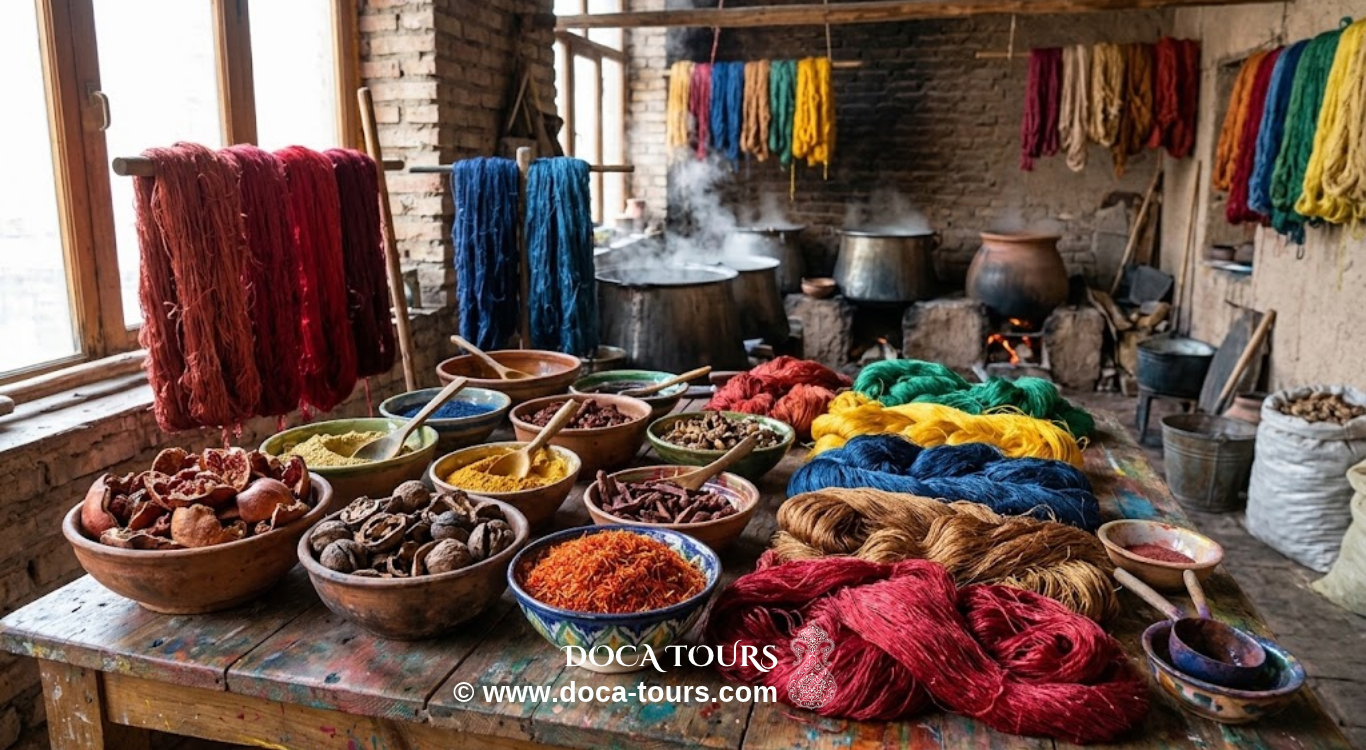
The masters of Margilan are world-famous for their silk fabrics dyed with natural plant colors.
For this purpose, pomegranate peels, walnut shells, acacias, onions, saffron, madder root (for a deep red), and even usma are used.
These natural dyes provide soft, flowing transitions that give the fabrics their rich saturation.
The Secret of Ikat (Abrband)
The pride of Uzbek textile art is the so-called "Abr" fabrics (known in the West as Ikat).
"Abr" comes from Persian and means "cloud," describing the cloudy, slightly blurred edges of the colorful patterns.
The secret to this complex craftsmanship lies in the methodology: instead of dyeing the finished fabric,
the silk threads are precisely tied off and dyed in various colors before the weaving process begins.
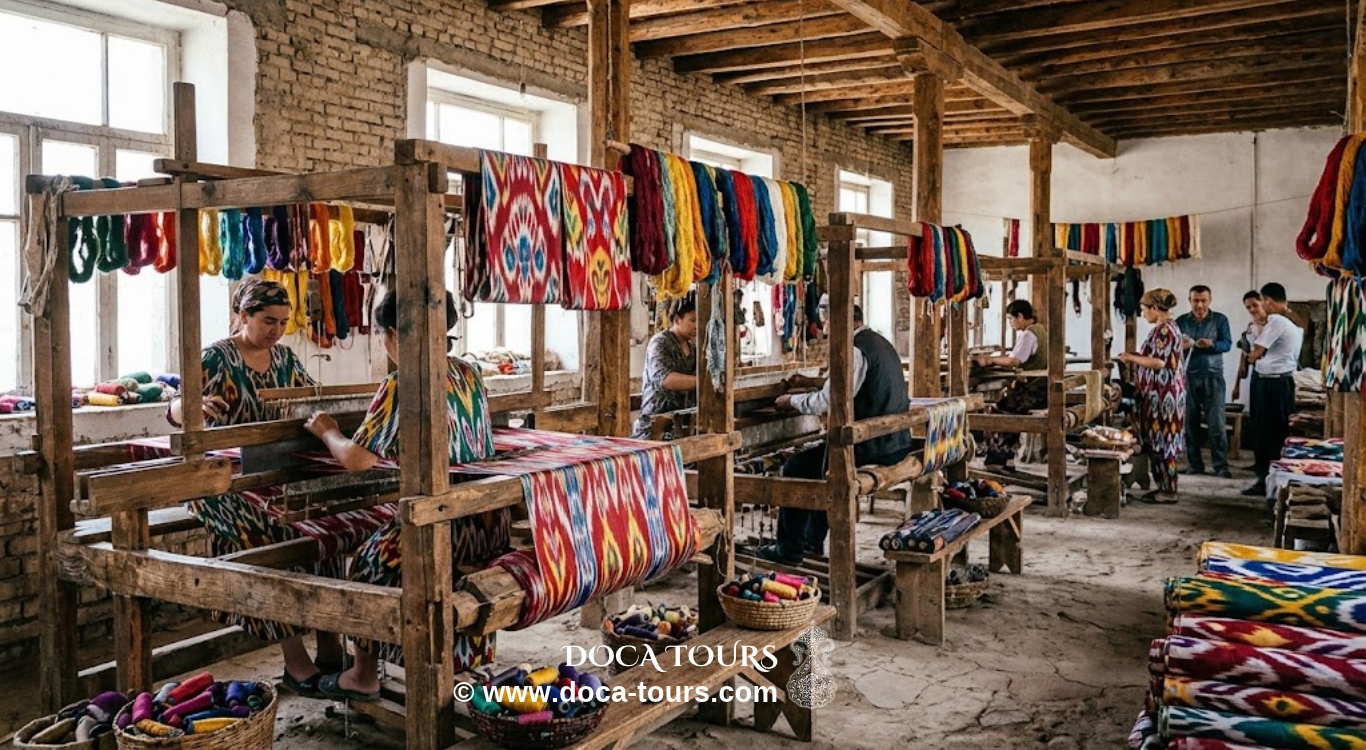
When these threads are subsequently processed on wooden pedal looms, they come together like magic to form vibrant sky
and cloud landscapes. Because the entire process—from cocoon to finished fabric—is executed by hand, this is often referred to as "wild" silk.
Modern Developments and the Uzbek Silk Cluster
Following Uzbekistan's independence in 1991, the country's silk production initially went through difficult times.
However, to save and expand this millennia-old craftsmanship, the Uzbek government comprehensively reformed the sector.
Starting in 2017, a modern "cluster system" for the silk industry was introduced.
Over 70 silk clusters were established, mulberry tree cultivation areas were drastically expanded from 40,000 to 55,000 hectares, and production was modernized.
Today, breeders in some regions can harvest cocoons up to four times a year.
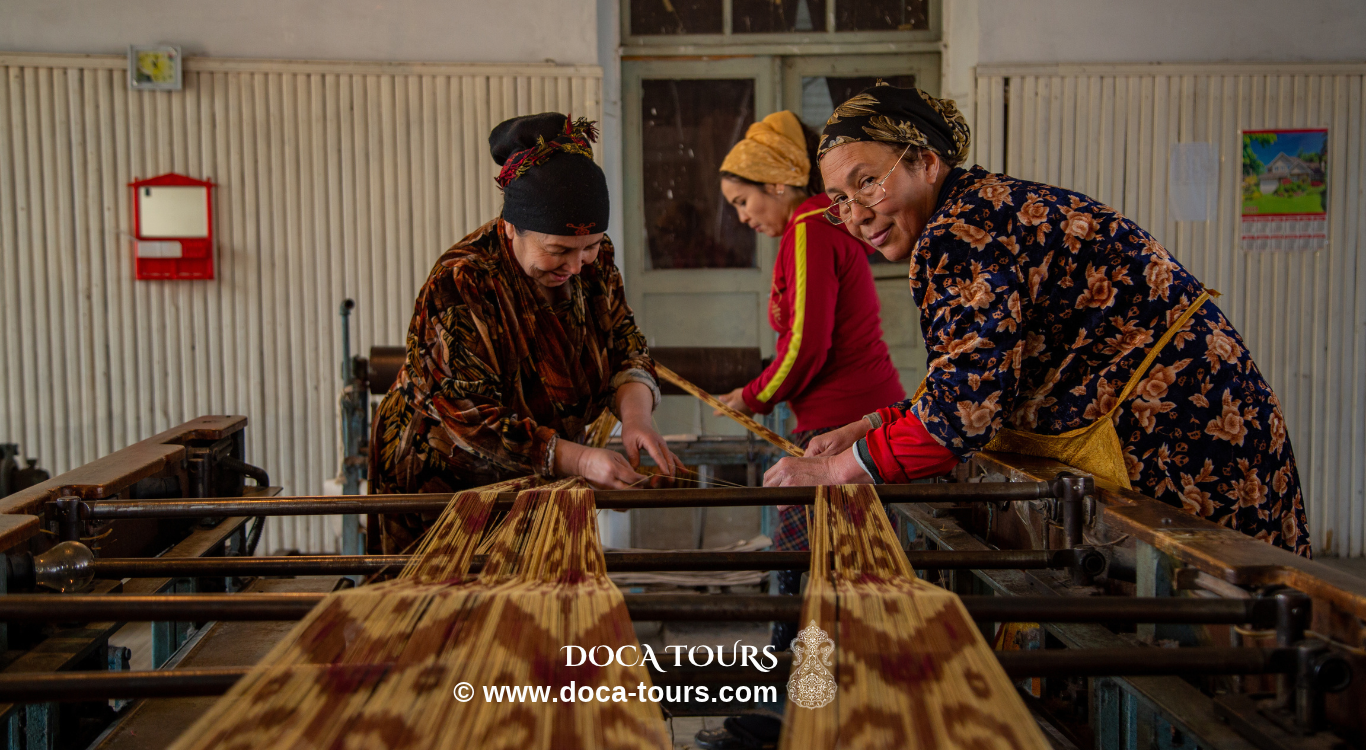
Modern enterprises like "Surxon ipagi" in Termez or the massive "Xon-atlas" factory in Margilan, which produces up to 2.5 kilometers of fabric daily,
ensure that the "Made in Uzbekistan" label stands for top-tier silk quality worldwide.
Frequently Asked Questions (FAQ) about Uzbek Silk ProductionThis is a title
What do silkworms eat? The worms feed exclusively on fresh and tender mulberry tree leaves,
for which vast plantations (55,000 hectares) have been established across Uzbekistan.
What is special about the "Abr" dyeing technique? In the Abr or Ikat technique, the silk threads are dyed section by section before weaving,
creating the characteristic slightly blurred "cloud patterns" typical of Uzbekistan.
Is Margilan the only silk center? While the Fergana Valley (especially Margilan) is the historical and traditional heart of silk production,
the modern silk industry has also expanded to other regions like Surxondaryo (Termez) through the new cluster system.
Planning your private tour? Join DOCA TOURS on a journey to Margilan! We open the doors to traditional silk manufactories where
you can watch the masters create vibrant Ikat fabrics. Contact us today for your tour along the footsteps of the Great Silk Road!