
































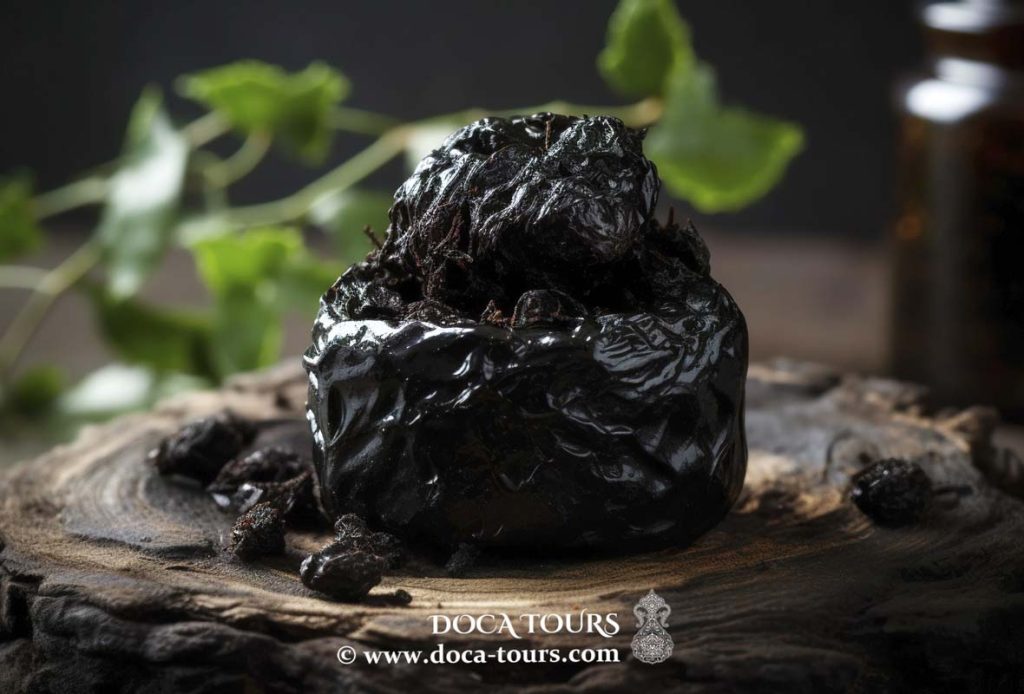
Mumiyo: What Is This Unique Medicine Found in the Mountains of Central Asia? How to Find It, and Why Is It So Expensive?
According to legend, high in the mountains, stone giants weep. Their tears, hardening over time, form a healing balm—a remedy for all ailments. Rarely does anyone discover a “giant’s tear,” but those who do are said to become the healthiest and strongest people in the world.
This legend refers to the natural curative substance known as mumiyo, which is called by various names across cultures: barag-shun, “tears of the rocks,” “mountain wax,” “stone oil,” precious mumiyo, or chao-tun (“mountain blood”).
A Medicinal Legacy Spanning Millennia
Mumiyo has been revered as a medicinal wonder for over 100,000 years. Records of its use appear in ancient manuscripts and medical treatises from Central Asia, India, Palestine, Asia Minor, and Greece. It has long been utilized in traditional medicine across regions like Central Asia, Iran, Tibet, and China.
Even Aristotle, writing in ancient times, described the healing properties of this miraculous substance. He recommended it for alleviating congenital deafness and stopping nosebleeds. Abu Bakr Rabi al-Bukhari called this miraculous balm a “perfect healing remedy,” asserting that when combined with honey, it could perform medical marvels.
The renowned physician Muhammad Zakariya al-Razi wrote that mountain resin could cure paralysis and dizziness. Abu Rayhan Biruni praised mumiyo as unparalleled in treating bone fractures. Stories about Alexander the Great being healed with “mountain tears” have been passed down through generations. In his famous work The Canon of Medicine, Avicenna (Ibn Sina) described mumiyo as an excellent remedy for strengthening the stomach and easing breathing.

Ancient Methods to Authenticate Mumiyo
During the reign of the Persian king Faridun, physicians used biological tests to verify the authenticity of mumiyo. For instance, a mixture of mumiyo and rose oil was applied to broken animal wounds; if the substance was genuine, the fractures would heal within a day. Aristotle also recommended testing mumiyo’s quality: pieces of a freshly slaughtered sheep’s liver would be coated with mumiyo, and if authentic, the liver pieces would rejoin.
The Modern Scientific Perspective
Contemporary scientists have identified that mumiyo contains over 80 essential substances, including around 30 chemical elements, amino acids, metal oxides, enzymes, hormones, and other components. Deciphering its precise chemical composition is a complex task due to its unique blend of organic and inorganic compounds. Unlike most medications that contain a few active ingredients, mumiyo includes nearly half of the periodic table of elements.
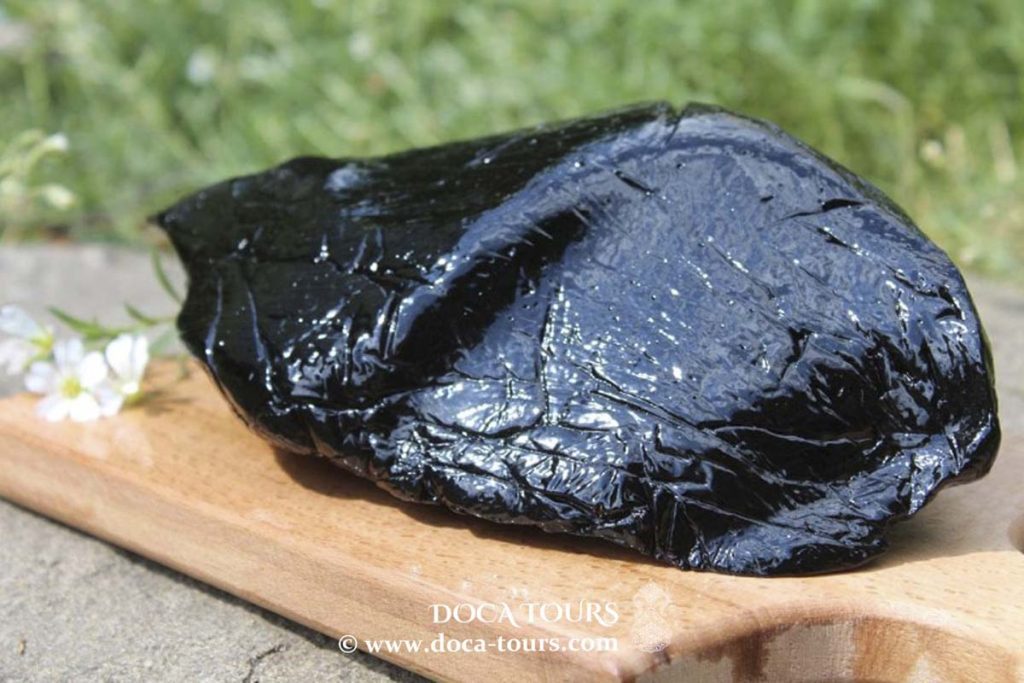
Mumiyo is a biologically active, naturally occurring product—a resin-like substance that seeps from mountain rock crevices. It is soft and dough-like, with a slightly bitter taste, sometimes reminiscent of pure dark chocolate. It comes in golden, silver, copper, and dark-brown varieties, with dark-brown being the most common in Central Asia.
The Formation and Discovery of Mumiyo
Mumiyo is found at elevations of 3,500–5,000 meters above sea level, primarily on the southern slopes of mountains. These regions require specific environmental conditions: annual precipitation of 400–600 mm, high levels of solar radiation, and significant temperature fluctuations. Mumiyo deposits are located in niches, cavities, caves, cracks, and grottoes.
Theories on Its Origins
Over the years, many theories have been proposed about how mumiyo forms. Initially, its discovery in mountains and its inorganic components led to speculation that mumiyo was akin to minerals like gold, silver, or copper. In the mid-20th century, it was hypothesized that mumiyo originated from the waste products of bats and small rodents living in caves. The rich composition of mountain mumiyo was attributed to these animals consuming medicinal herbs.
Modern theories suggest that mumiyo forms from plant matter. Residues of medicinal plants decompose over time, transforming into mumiyo under the harsh conditions of mountain climates. Most scientists now agree that mumiyo results from the natural processing of biomass, combining remnants of animal waste, plant matter, and even fragments of bee venom.
Why Is Mumiyo So Valuable?
The rarity of mumiyo, the challenging conditions required for its formation, and its extensive health benefits all contribute to its high price. Its extraction from inaccessible mountain locations adds further to its exclusivity. For centuries, mumiyo has been considered a treasure of nature, sought after for its unparalleled healing properties and enigmatic origins.
Translation to English:
After many years of research, Uzbek and Kyrgyz scientists concluded that this mountain balm is formed from the droppings of silvery dwarf field mice that inhabit high-altitude mountain ranges. These field mice feed on various mountain herbs. Their bodies do not fully digest the herbs, leaving valuable substances in their excrement, which, over time, becomes enriched with trace elements from mountain rocks under the influence of high-altitude conditions.
In the 5th-century book Judshi, it is mentioned: “In mountains rich in metals, there exists a special rock-climbing mouse that consumes these metals, and its excrement forms Barag-Shun.” Mumiyo, referred to in ancient texts as Barag-Shun, may thus contain particles of metals like gold, silver, copper, iron, or tin. For instance, mumiyo found in gold-rich areas often has a reddish-yellow color and a sweet-and-sour taste.
In 1955, the Uzbek scientist, experienced surgeon, and Doctor of Medical Sciences Odil Shakirov began studying the pharmacological properties of mumiyo based on ethnographic research and ancient medical manuscripts. In 1976, mumiyo was officially recognized as a beneficial medicinal substance for the comprehensive treatment of bone fractures. Dr. Shakirov scientifically substantiated the secrets of using mumiyo in bone healing treatments.
There are several places in the world where mumiyo is collected—it has been discovered in the mountains of the Caucasus, Central Asia, Russia, India, China, Nepal, Iran, and Burma. Today, the highest-quality mumiyo is considered to come from the Altai Mountains. Despite its wide geographical spread, finding mumiyo deposits is difficult, and its reserves are quite limited. According to reports, the Altai Mountains hold an estimated 250 tons of mumiyo.
Mumiyo contains the largest number of elements beneficial to the human body. Analysis of pieces of mumiyo found in the Altai Mountains revealed that they are 130 to 900 years old. The high price of authentic mumiyo is due to its occurrence in high, rocky mountains that are hard to access, the difficulty of collecting the raw material, and its rich content of valuable elements. Local residents who collect mumiyo themselves also use its properties to strengthen their bodies and help them adapt to harsh conditions.
The best mumiyo is considered to be black in color, shiny, and with a slight petroleum-like smell. This medicine dissolves well in water, making it suitable for consumption when dissolved in water, milk, juice, or tea, as well as for external use in the form of drops, creams, or ointments. Mumiyo also has strong biostimulatory properties. Under its influence, metabolic processes in the body are activated, red blood cell production increases, and hemoglobin levels in the blood rise.
This mountain healing substance has antimicrobial effects, enhances the body’s defenses, and is used to treat infectious diseases, colds such as tonsillitis, bone tuberculosis, fungal infections, and certain types of eczema. Experiments have shown that staphylococci die in a mumiyo solution. When taken correctly in prescribed doses, mumiyo is considered a strengthening, toning, and health-enhancing remedy that is safe for use.
Thank you very much for your attention.

Subscribe to the channel and don’t forget to like our videos.
#black, #black, #black, #black, #potion, #medicine, #medicine, #medicine, #treatment, #natural, #health, #health, #organic, #tusk, #boulder, #cradle, #stone , #swing, #swing, #crack, #support, #breed, #shake, #shake, #swing, #swing, #rock, #steer, #rock, #stupid, #rock, #foundation, #cliff, #cliff, #mountain, #appeal, #cliff, #mummy, #healthy, #mountain, #heap, #health , #Hindu, #Hindu, #Indian