































Video: https://www.youtube.com/watch?v=HHUd_HXb6dM
A wedding is one of the most important events in the life of every person. For Uzbeks, a wedding is a very important stage in life. In the process of organizing a wedding ceremony in Uzbek families, not only close relatives’ are involved, but also neighbors, friends, acquaintances, and even very distant relatives.
The Uzbeks, one might say, have been preparing for the wedding of their child since his childhood. Families have been saving up money for this event for years, preparing a dowry for the bride, building additional rooms or entire houses for the newlyweds in advance.
Mothers, usually look for a suitable couple for their sons and daughters after they reach a certain age.
Today I want to show you the wedding of my friend who lives in the village. This village is located approximately a hundred kilometers from Samarkand city.
It is impossible to tell in one release everything that happens before the wedding. For both families, preparation for a wedding sometimes lasts several months. I’d rather start my story right from the wedding day.
The wedding day for both families starts with the so-called tradition: Nahor osh. Only men are invited here, and the event takes place from early morning. The main dish of Uzbek people – pilaf is served in this event.

At this time, the newlyweds are preparing for their main celebration. Everyone is in his own house. These days the groom chooses a classic suit, and the bride, of course, a traditional white wedding dress. But these are the milestones of our time. A hundred years ago, the newlyweds looked like this:
Life in the village is simple but very authentic. It is not customary to arrange luxurious, wasteful feasts here, that`s why I decided to show you this particular wedding.
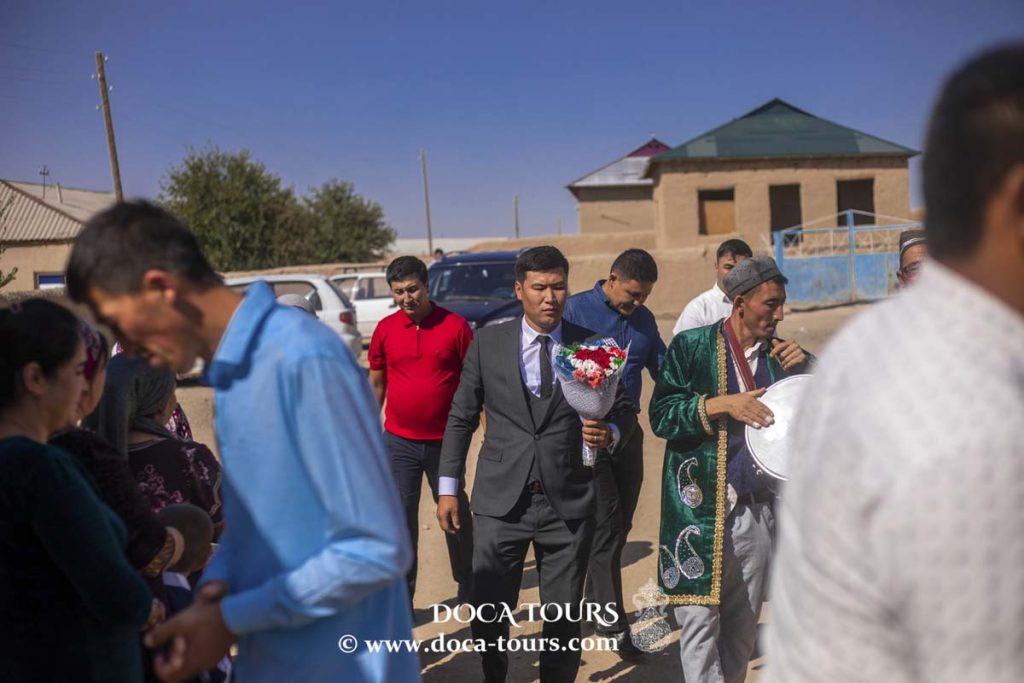
After the morning pilaf, all men gather near the groom’s house and bless the newlyweds. The Mulla reads a short prayer and after that, the groom, accompanied by his friends, goes in a cortege for the bride to her home, where, of course, they are expected.
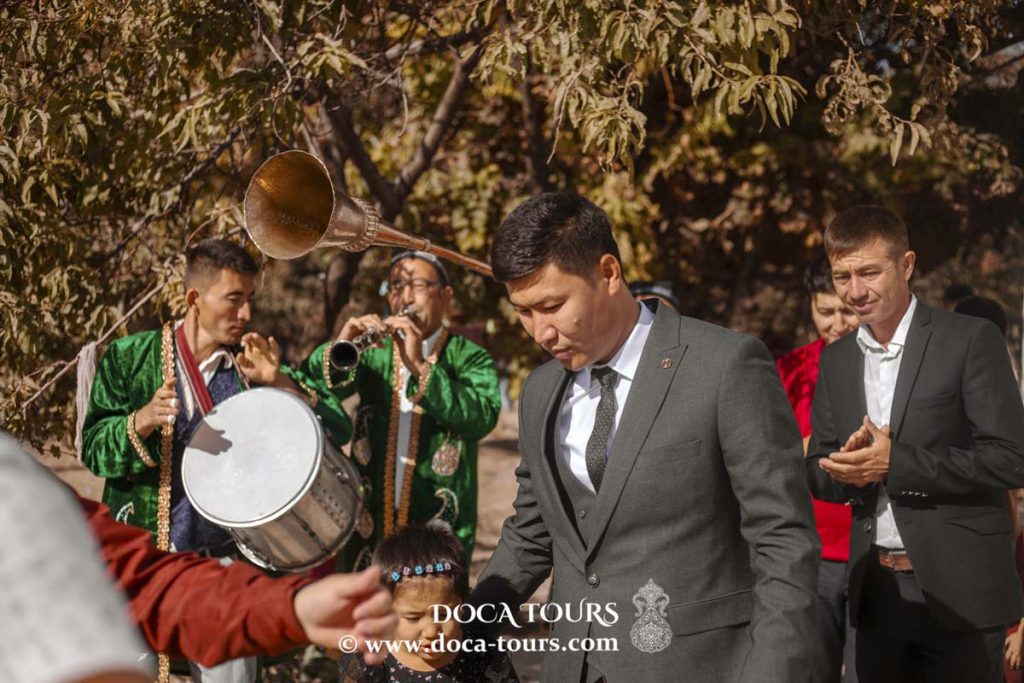
The car in which the newlyweds travel is usually rented. And those accompanying people are friends, relatives of the groom. Upon arrival at the bride’s house, the cortege usually honks to signal to show that the groom has arrived. His arrival should be festive. For this purpose, musicians are specially hired to accompany the groom to the bride’s house. At the same time, friends and relatives of the groom should accompany him with dances to music. Musicians usually use traditional musical instruments such as karnay and surnay. Karnay is a long metal wind instrument and surnay is a traditional Uzbek flute. It is believed that if you hear the sounds of Karnay and Surnay, you are automatically invited to the wedding, even if you are not familiar with the family in which the wedding is taking place. Any traveller can check this and it really works, since the Uzbeks are very hospitable and will gladly treat everyone on such a day.
It is not customary for the groom to dance on his wedding day. He must remain serious as the entire family of the bride is watching him. He should act like a real man with serious intentions.
In the house of the bride, the newlyweds expect a variety of rituals, the groom has no right to just take and pick up his bride from her house, not observing ancient traditions. First, a small meal is arranged for the groom and his friends. A short prayer is recited, and a representative of the bride’s family gives tea to the groom, as a sign that he is welcome here and that he has become related to the family of his bride.
After that the groom enters the room, where his chosen one is waiting for him, surrounded by her relatives.
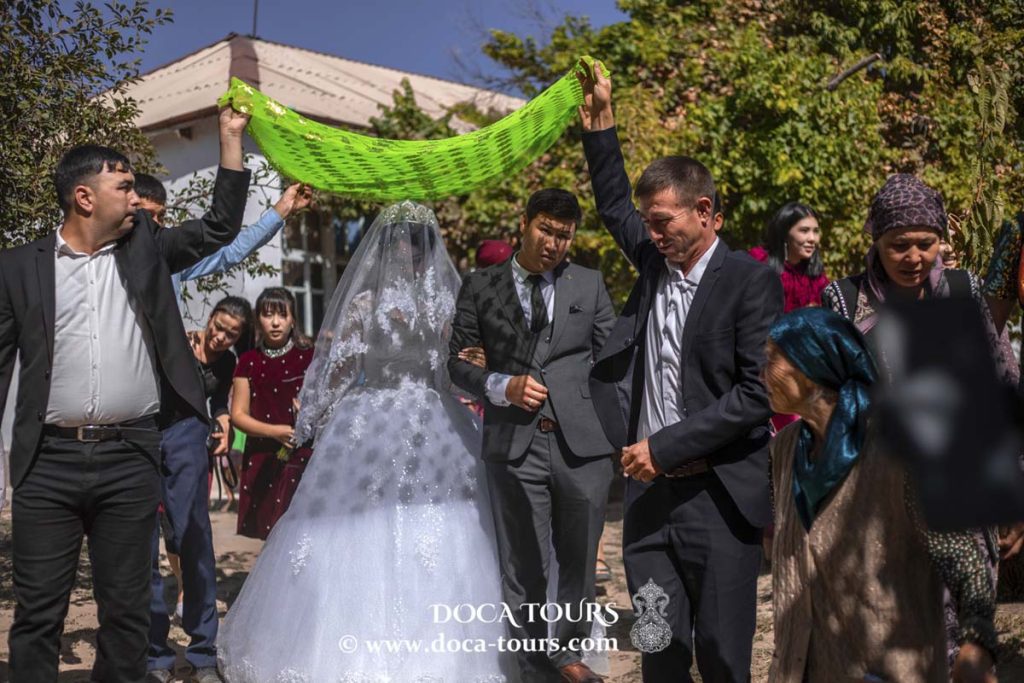
And various ceremonies and rituals begin there, which have been honored by Uzbeks for many centuries. Not all of them are associated with Islam, which is the main religion of the Uzbeks. There are also pre-Islamic traditions that are still relevant today.
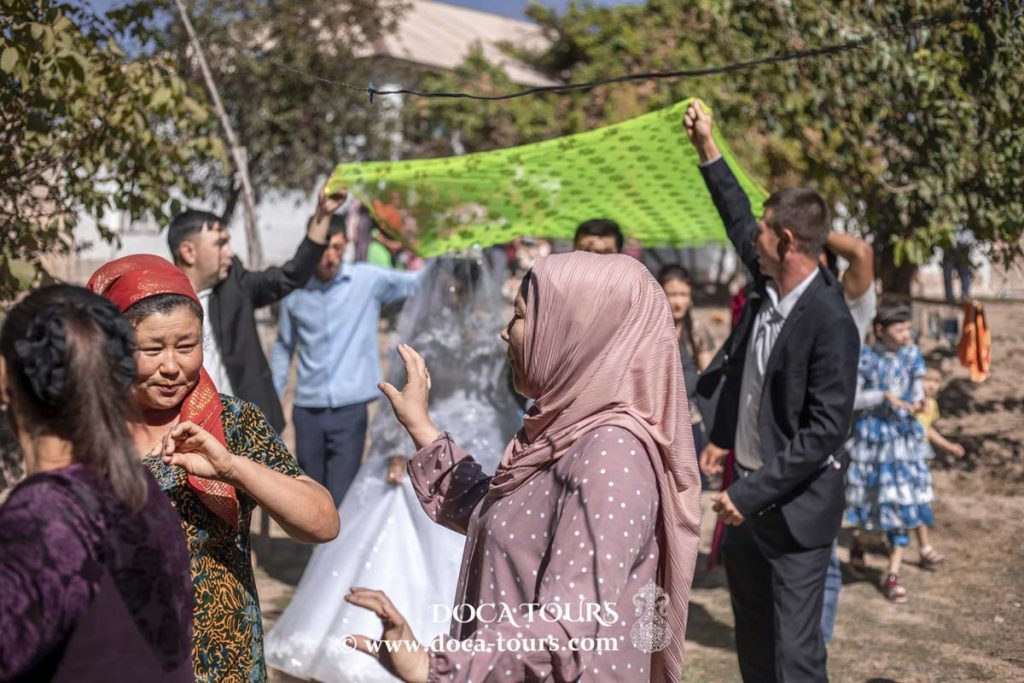
First, the bride is led to the so-called chimildik. Chimildik is a screen behind which rituals are performed. But the bride is taken to the Chimildik in a special form: she is put on a blanket, two small children, a girl and a boy, are brought to her, and, having lifted all three, they are transferred to Chimildik. Children are brought to the bride, of course, so that the bride also necessarily becomes a mother.
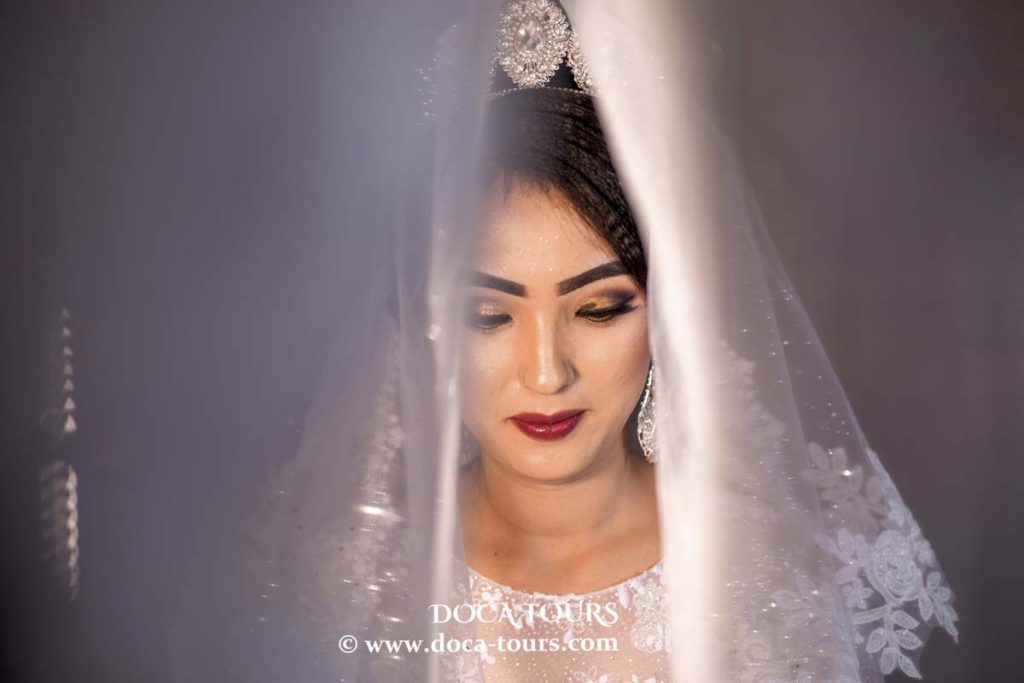
Behind the chimildik, the bride must cover her face with a veil and behave very modestly. The first ritual behind the screen is to illuminate the couple with fire or light. So that they have a bright life. In the traditional form, candles were used for this. Lighted candles used to be twisted around the Chimildik, but because of the risk of a fire – a flashlight was used here – like a beam of light.
This is followed by a ritual with a mirror. The newlyweds are asked to look in the mirror and both -groom and bride praise their candidate. In the end, everyone comes to the conclusion that they are both very pretty.
Another interesting tradition is the fictitious “sale” of the bride by her relatives. The groom must redeem her for a certain amount. Women praise their niece and the groom must give so much money that they agree to give him their niece.
Then the groom is put on a traditional robe, which is called chapan in Uzbekistan. Previously, it was an obligatory attribute of the Uzbek men’s costume, today, the only time when it must be worn is the funeral of the closest people. This also includes the traditional Uzbek black skullcap embroidered with white threads. The skullcap for Uzbeks is a symbol of ethnicity. Chapan is girded with the so-called yakkaband, which traditionally served instead of a belt.
After the traditional outerwear is worn by the groom, the bride’s relative takes a needle with a thread and passes it several times through the groom’s robe. The essence of the ritual is that the ties of the newlyweds, starting from that moment, will be forever connected. So that they live in peace and harmony and live a long, happy life.
Of course, the groom should also ever repay for this ritual.
After this, the groom’s mother-in-law and other relatives of the bride congratulate him and he is given two symbolic Uzbek bread to be a good husband, earn good money and provide for his family.
From this moment, the bride greets all those people with bows, thereby showing her respect to all relatives and friends. All relatives officially accompany the bride. Besides, bowing the bride says goodbye to her loved ones. She knows that from now on she is joining her husband’s family. In the vast majority of cases, the newlyweds after the wedding live in the groom’s house. The scenes of the bride’s farewell to her father are especially emotional. It usually cannot do without tears, and, as we can see, on both sides. After the last blessing by the elders of the clan, the newlyweds leave on a cortege. Usually, a route is made for the cortege so that young people can take a short walk to the main event, where many people are invited. The cortege goes to the registry office to officially register the marriage, visit local attractions or holy places, eat ice cream, and so on.
But things don’t always go smoothly. Sometimes local robbers block the road to the cortege. Joke. This is also an ancient tradition, where local guys also wanted to get kalym (dowry) for their neighbor and symbolically blocked the road. In this case, as we can see, the groom’s friends steer the situation. But the kalym still had to pay. Young children also get their share.
Upon arrival on the side of the groom, they must first perform another ritual associated with fire. Many argue that this has nothing to do with Islam, but with Zoroastrianism, which was the main religion of the people of Central Asia before the Arab conquest and the spread of Islam. In Zoroastrianism, fire is the main cult. Adherents of this religion are also called fire worshipers. The bride must walk three times around the fire and at the same time periodically greet the groom’s relatives with bows. Thus, the bride is cleansed with the help of fire from all negative energy.
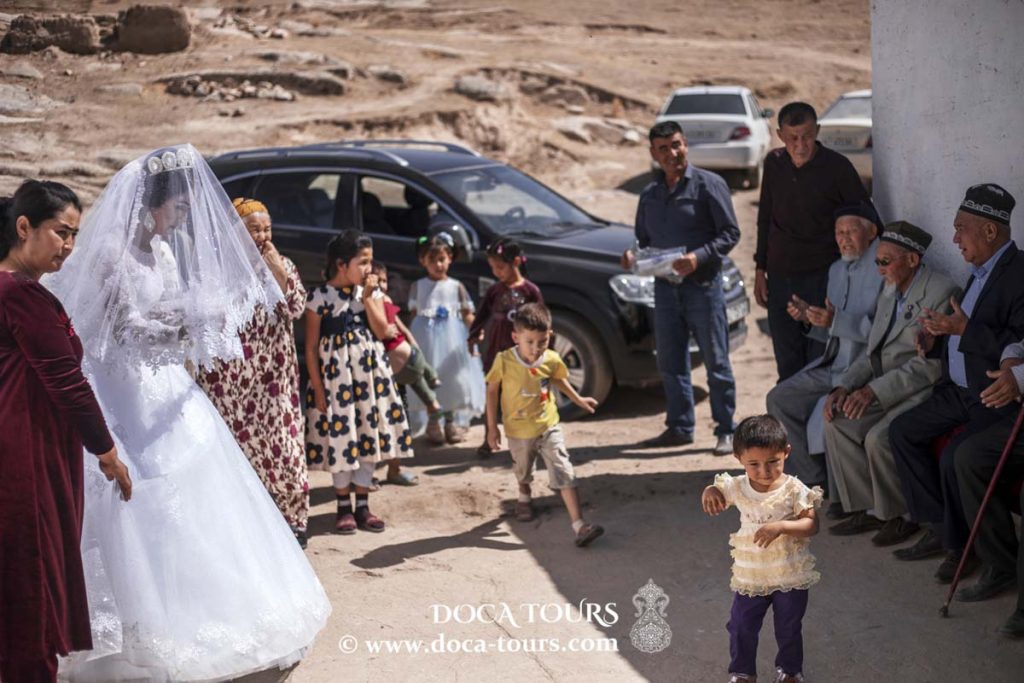
After that, the married couple accompanied by dancing, are brought to the site where the wedding will take place. In this case, it is an open space where you can seat a large number of people. But in most cases, Uzbeks rent large halls for celebrations and celebrate in them. Many of you are probably wondering: where do Uzbeks get hundreds of guests at weddings and other celebrations? The fact is that the very concept of a family is something different in comparison with European countries. If you ask an Uzbek how many people his family consists of, then he will count at least one hundred people, and these are the closest relatives. At Uzbek weddings, the bulk of the guests are the guests of the parents, not the newlyweds. It may well be that, for example, a colleague of the groom’s father or mother whom groom has never seen, but he will definitely be among the invitees, since he, in turn, always invites his colleagues to his events. Moreover, a colleague of the groom’s father can easily take his spouse or friend with him so that it is not boring. This is a small example of how many wedding guests are recruited.
As we can see, a small tribune was built for the newlyweds. And the bride again immediately greets everyone with her bows.
Traditional weddings have a strict gender seating arrangement. Men and women sit at separate tables.
Tables are set according to the financial capabilities of families. But usually, there is more than enough food, snacks and drinks. The situation with alcoholic beverages differs depending on the religiosity of the families.
All big family celebrations in Uzbekistan are accompanied by music. Usually, there is also a presenter who entertains the guests, reads poetry, and invites people to congratulate the newlyweds.
Traditionally, at the beginning of the wedding feast, music is folklore, sometimes a little sad. But as the event progresses, the rhythm becomes more and more danceable, so that the young can dance and have fun. Usually, men and women dance separately, men among men and women among women. Today, there are no specific movements that are typical of dance. Everyone moves according to their imagination. And newlyweds cannot dance at their wedding. They should sit humbly and watch the guests.
Those who are especially active in dancing are usually given money, and they put it on the table of newlyweds.
During weddings, the music is often interrupted, and the ceremony of donating robes to the elders of the clan, the teachers of the bride and groom and other respected men begin. Of course, women also give a lot of presents to each other.
After the main dish of the Uzbeks – pilaf is served. The ceremony is coming to an end. The finale of the celebration is young people cutting the cake. And according to tradition, the newlyweds treat each other with dessert, so that life together will be sweet.
After that, the bride and groom are walked from the place of celebration and the wedding ends there.
But here it was not without the pranks of the groom’s friends. They nevertheless separated him from his wife for a while, made him dance at least a little at their wedding. At the same time, many friends, taking advantage of the moment, shove money into his pocket as a gift. And in conclusion, the guest of honour was thrown as a hero! … It’s good that they didn’t drop him.
This is how an Uzbek wedding goes. I hope you enjoyed my story? See you in the next releases. Bye bye!
Thank you very much for your attention.
Subscribe to the channel and don’t forget to like our videos.
#wedding pilaf, #samsa, #tashkent pilaf, #national pilaf, #uzbek pilaf, #shashlik, #cake, #wedding, #background, #beauty, #card, #culture, #invitation, #illustration, #design, #decorative, #flower, #banner, #pattern, #ornament, #lace, #baroque, #ornate, #vintage, #symbol, #frame, #template, #element, #decoration, #concept, #ramadan, #ottoman, #royal, #luxury, #print, #kazakhstan, #vector, #abstract, #traditional, #bright, #ramazan, #backdrop, #celebrate, #persian, #art, #laser, #graphic, #style, #muslim, #arabic