























Video: https://www.youtube.com/watch?v=ki1DPev87qQ
Help Tashkent!
A brutal picket fence
the woman is dented in the wall.
Help Tashkent!
If there is forest – help
if you have bread – help,
if you have something – help,
if you have not anything, help!
Andrey Voznesensky
“From the Tashkent reportage”

Hello everybody! Today we decided to tell you about one historical and tragic event that took place in Tashkent in April 1966. Probably many of you have heard about this disaster. In this video, we will go into interesting details and facts related to these events, but first I would like to tell you in detail about the phenomenon of the earthquake itself so that you can evaluate and compare the Tashkent earthquake.
So let’s start in order. What is an earthquake? Why is it happening? And how is it characterized?
An earthquake is a tremors and vibrations of the earth’s surface. According to science, earthquakes are signs of the process of geological transformation of the planet. It was believed that the main cause of earthquakes is extensive geological and tectonic movements, but modern research shows that their nature is not fully understood. The manifestation of these forces is associated with temperature drops in the bowels of the Earth. Most often, earthquakes occur on the outskirts of tectonic plates. Over the past two centuries, strong earthquakes have resulted from the ripping open of large faults that come to the surface.
Unfortunately, Central Asia is a very active seismic zone. One of the catastrophic earthquakes is the Ashgabat earthquake that occurred on the night of October 5th to 6th, 1948 in the area of the capital of the Turkmen SSR – Ashgabat. It began at 2:17 pm local time with a magnitude of 7.3 on the Richter scale. The outbreak was located at a depth of 18 km and almost directly under the city. In addition to Ashgabat, many settlements were affected in the surrounding regions of the country and neighboring Iran.

Almost 9000 people were evacuated to other cities in the USSR. The evacuation was attended by 120 aircraft and many ambulance trains and equipment.
It is considered one of the most destructive earthquakes in human history. The intensity of shaking at the epicenter reached 9-10 points.
Now let’s talk about our main topic:
The Tashkent earthquake occurred on 26 the April, 1966, at 05:23 a.m. The epicenter was located practically in the center of Tashkent – in the so-called Kashgarki region. A relatively small magnitude (5.2 on the Richter scale) was observed, but due to the shallow depth of the focus – from eight to three km, it caused 8-9-point shaking of the earth’s surface and serious damage to buildings in the city center. Scientists believe that right under the city, at a depth of 6 km, there is a fracture of two crystalline plates and seismic shocks occur during their movement.
By the way, the tremors were more than seven hundred. The force of the first shock was approximately 8.5 on the Richter scale.
The radius of maximum damage was about ten square kilometers. On the outskirts of Tashkent, the seismic effect reached only six points. Strong vibrations of the soil occurred with a frequency of 2-3 Hertz, every 10-12 seconds.
The relatively small number of victims (only 8 dead and several hundred injured) in a city with a population of one million people was due to the predominance of vertical rather than horizontal seismic vibrations, which prevented a complete collapse of even fragile adobe houses.
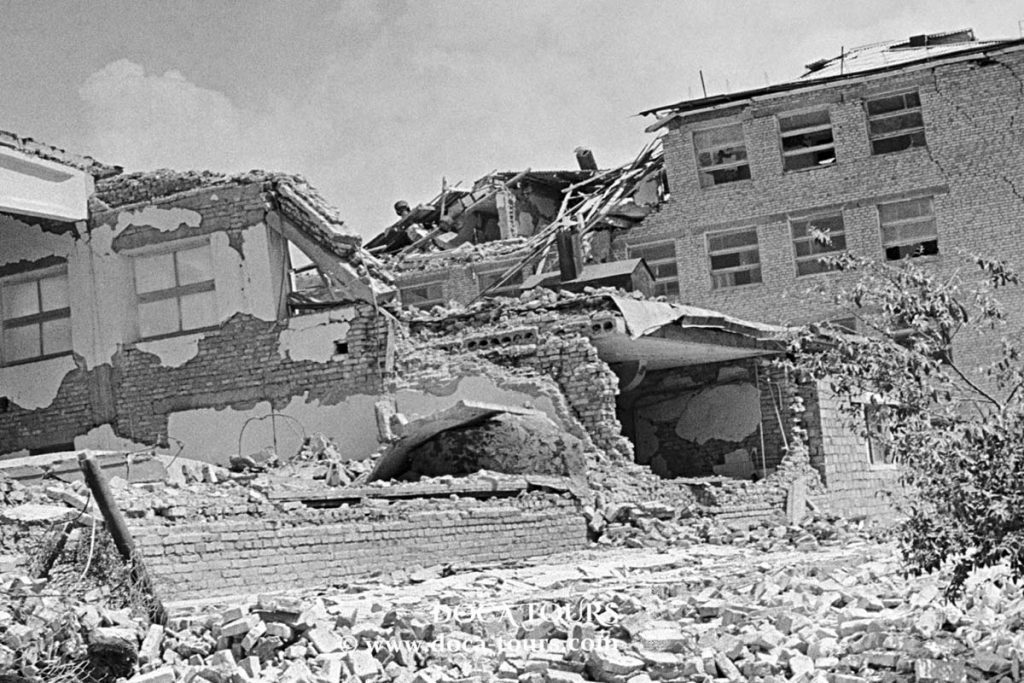
As a result of the earthquake, almost the entire central part of Tashkent was completely destroyed. Raw brick, which was the main building material before the earthquake, could not withstand such shaking.
More than 2 million square meters of residential space, 236 office buildings, about 700 trade and catering facilities, 26 utilities, 207 educational institutions, 36 cultural institutions, 185 medical and 245 industrial buildings were damaged or completely destroyed.
78,000 families were left without a roof over their heads – this is more than 300,000 people out of more than one million people living in Tashkent at that time. 125,000 children were taken to the countryside and other union republics. They were placed in pioneer camps, sanatoriums and other institutions.
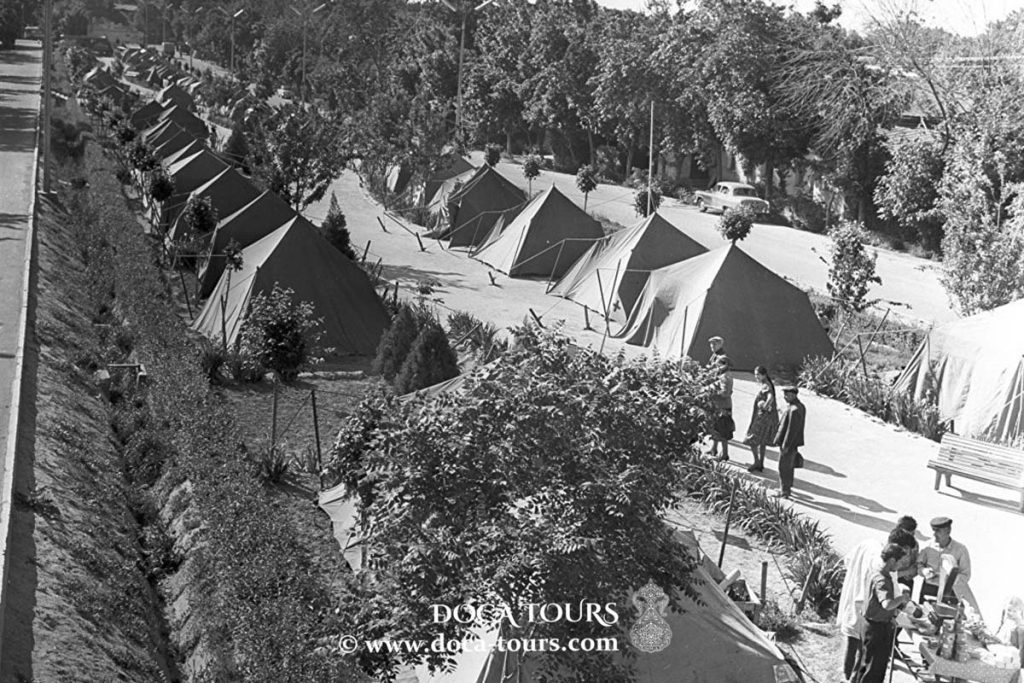
Thus, a few days after the earthquake, all of Tashkent population moved to the street. For this, the government issued 16,000 army tents. They not only lived in tents but also worked. The tents were used as pharmacies, dispensaries, post offices, canteens, etc.
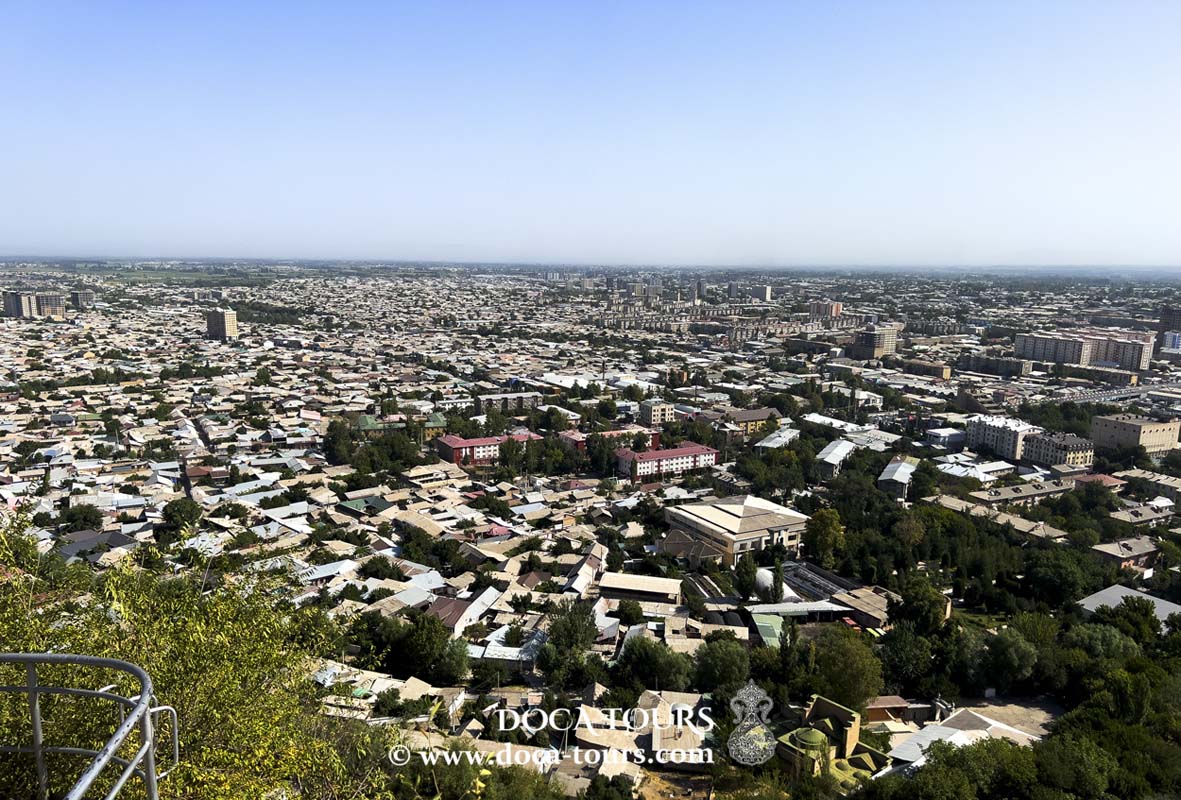
Looking at today’s Tashkent, it is very difficult to imagine that the whole city was pitched with tents. They stood everywhere and even on Broadway. The big plus was that the weather was already warm in the spring.
Interestingly, despite the fact that the whole city lived on the street, crime decreased rapidly at this time. The people rallied, although at night everyone was constantly guarded by a patrol.
One of the problems was also the dust that was constantly rising. In this regard, the movement of cars in the evenings and at night was prohibited.
The tremors continued for several weeks after April 26th. The entire officials of the USSR, headed by Brezhnev arrived in Tashkent. When Brezhnev was making a speech, a rumble was heard from the Pakhtakor Stadium, apparently, at that moment they scored a goal to the opponent’s goalpost. And then Brezhnev said: I can`t feel that you have such big trouble here. The people are having fun! And exactly after his words, another strong shock took place. Then Brezhnev said: Apparently I will also have to spend the night in a tent this night!
Another interesting fact tells us that a few days after the earthquake, a concert was held at the Opera and Ballet Theater. During the concert, there was also a 7-point shock. Because of fear, people wanted to leave the theatre, but a certain representatives of the government stood up and said: This building was built by the architect Shchusev forever! And everyone stayed on to watch the concert.
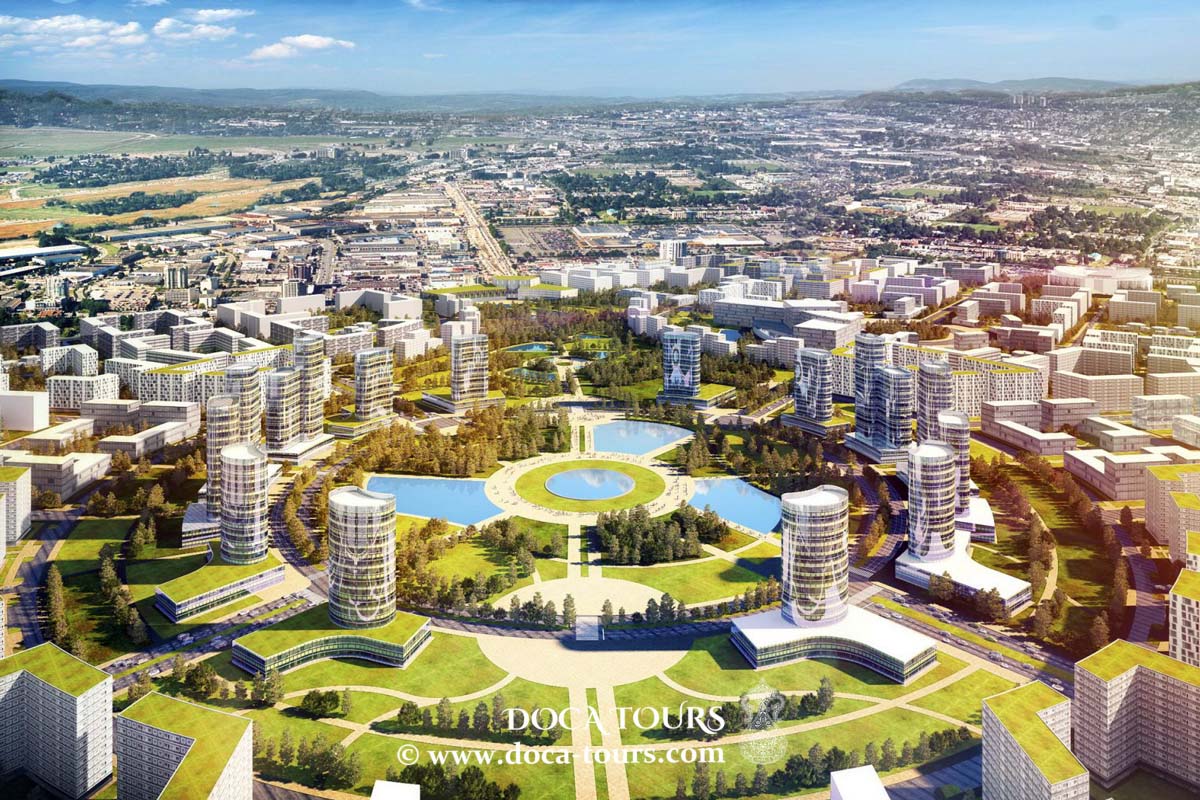
This large-scale reconstruction of the center of a large city was successful due to the fact that the entire USSR participated in the restoration of Tashkent which was the fourth largest city in the Union after Moscow, Leningrad and Kiev. With the help of the union republics, reconstruction was carried out and new micro districts were built in the center of the city and on free lands around the city. In the course of these works, for example, Chilanzar and other residential areas appeared. Many of these houses, neighborhoods and streets have long bore the names of the cities that helped Tashkent in those difficult days.
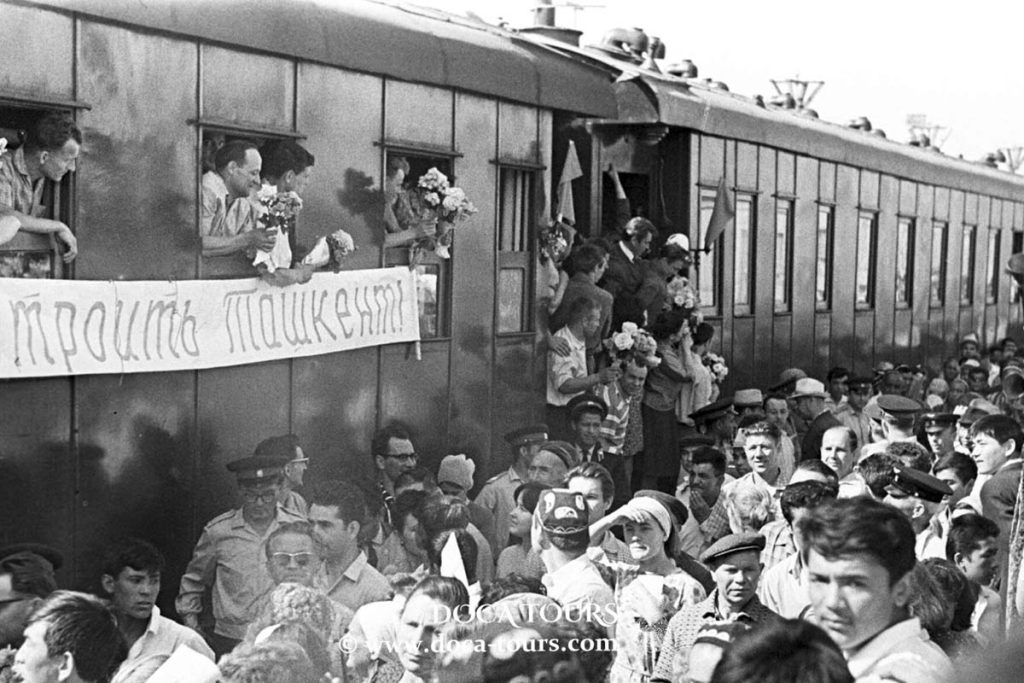
Literally from the next day after the disaster, builder brigades, volunteers and many other specialists came to Tashkent and restored it.
The railway workers calculated that if all the wagons with help from fraternal countries were connected then the train would be the length from Tashkent to Moscow. Among those people who were rebuilding Tashkent, there were 10,000 students from all over the USSR.
9 house-building factories were created. And by the end of the summer of 1966, all Tashkent residents were moved into new apartments. And it’s amazing how the USSR managed to build everything in time.
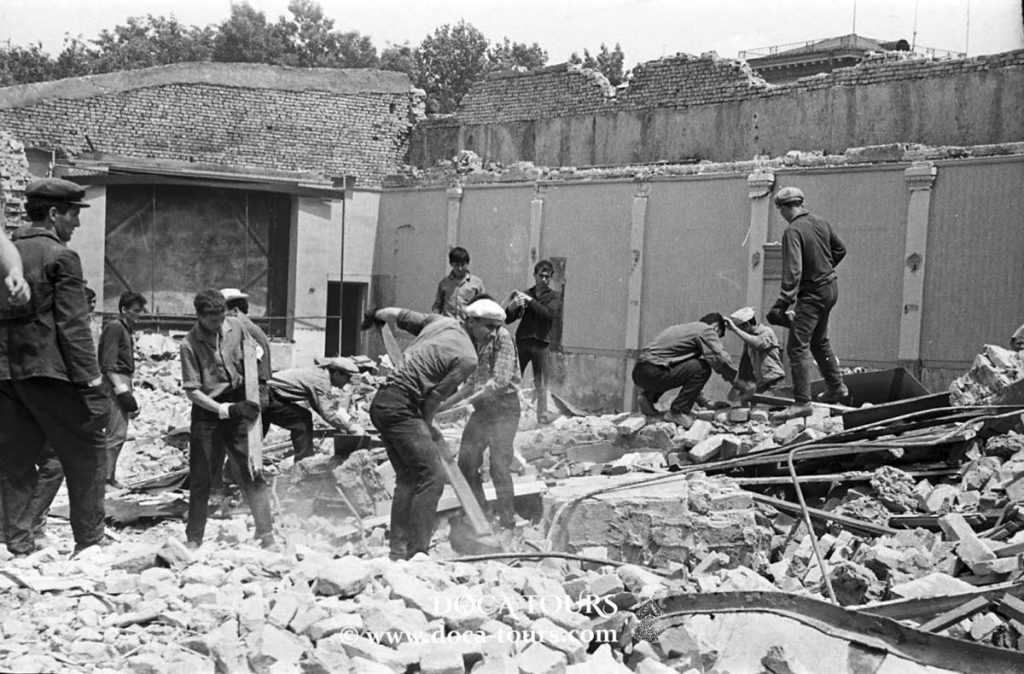
The main task was: not only to restore the city but also to build its buildings strong and earthquake resistant.
The multi-storey and large-panel houses were built but they did not forget the national Uzbek style, which can still be seen in Tashkent today. In addition, each of the fraternal republics has left its own flavor on its buildings. This turned Tashkent into a unique museum of Soviet architecture, which has no analogues in the whole world.
It is noteworthy that until 1966 Tashkent was almost completely one-story. At the time of the earthquake, there were only two nine-story residential buildings in the entire city.
Of course, after the resettlement of Tashkent residents from cozy one-story houses with a courtyard to multi-storey buildings, the way of life of people began to change. The earthquake also contributed to multinational weddings as the people became one.
The people of Tashkent were supported not only financially, but also morally. In those days, many famous artists came from all over the world and gave concerts and performances. A good example is the visit of the famous French mime Marcel Marceau, who donated all of his concert incomes to the city’s restoration fund. In the same way, ordinary people donated their savings to this fund.
Statistics show that after the earthquake, there were much more people who moved to this city than those who left it.
This disaster gave rise to many slogans. The most famous were two of them.
1. We are shaking but not giving up!
2. Tashkent will soon be the best city in the country!

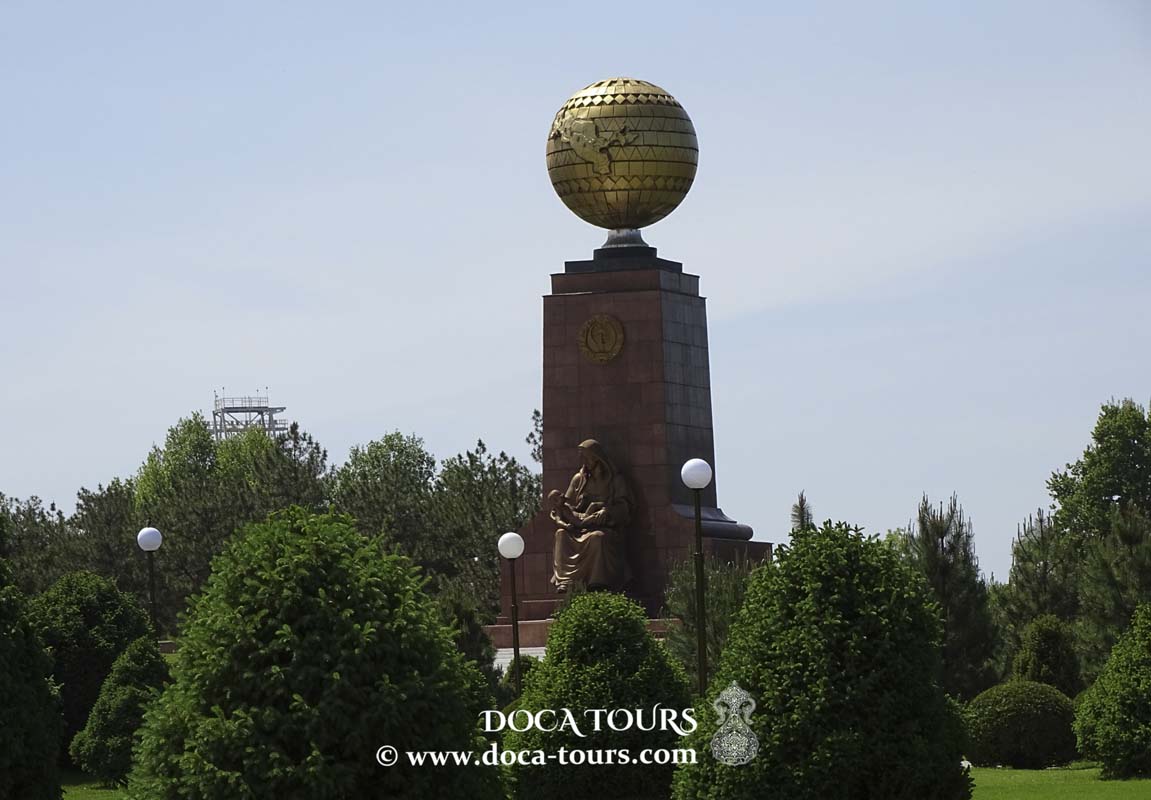
In honor of that event, a memorial complex “Courage” was erected. The author of the monument was the Moscow sculptor Ryabichev. Here you can see that this family withstands the earthquake.
The city was completely rebuilt in about 10 years. It was the hardest challenge for the people of Tashkent. But it is known that crises bring people together. Tashkent was restored and is still one of the most beautiful cities in the world!
Thank you very much for your attention.
Subscribe to the channel and don’t forget to like our videos.
#uzbekistan, #earthquake, #uzbek, #tashkent, #old, #architecture, #city, #asia, #central, #asian, #uzbekistani, #iwan, #medieval, #caravanserai, #picturesque, #stone, #attraction, #ornament, #islam, #blue, #culture, #gate, #capital, #madrasah, #madrasa, #bow, #frontal, #shaybanid, #landmark, #kukeldash, #chorsu, #islamic, #main, #arched, #view, #dynasty, #sight, #entrance, #tiles, #sightseeing, #viewpoint, #town, #toshkent, #ivan, #bazaar, #breathtaking, #inner, #garden, #yard, #courtyard